
 View Charts



Why Do Gold Bars Have Serial Numbers?
A Small Number With an Important Job
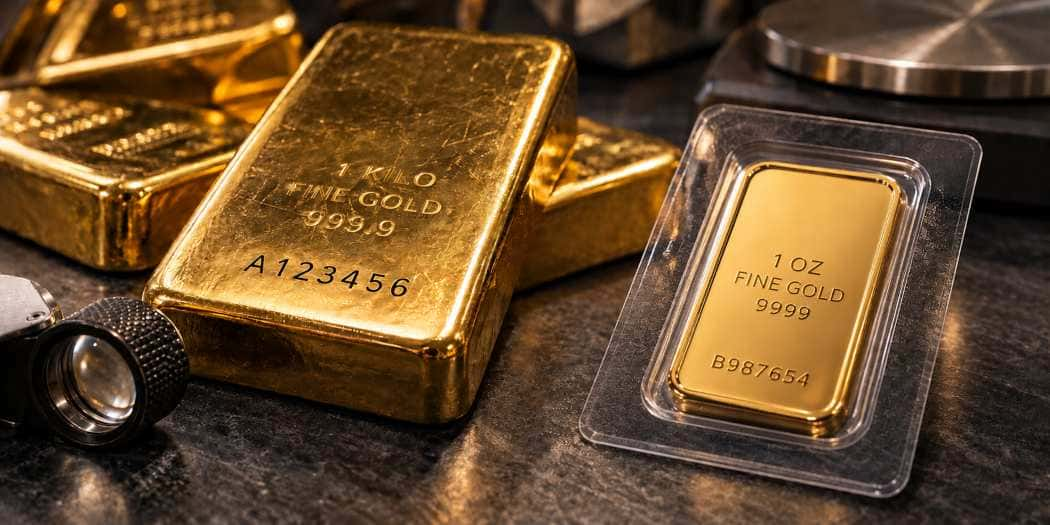
Look closely at many investment-grade gold bars and you may find more than a refinery logo, weight, and fineness. There may also be a string of letters or numbers unique to that particular bar. The marking can look insignificant, but it gives an otherwise standardized piece of gold an individual identity.
Serial numbers can help refiners, vaults, dealers, and owners distinguish one bar from another and connect it with production, assay, inventory, or custody records. For certain retail products, the number on the gold also corresponds with information on an accompanying assay card. At the institutional level, serialization is an established part of bullion-market recordkeeping.
A serial number, however, should not be confused with proof that a gold bar is genuine. Understanding what the number does—and what it cannot do—is useful whether you are buying your first gold bar or examining bullion you already own.
Why Refiners Put Serial Numbers on Gold Bars
Gold bars are intentionally standardized. Two one-ounce bars from the same refinery may have the same dimensions, design, weight, and fineness, making them difficult to distinguish without an individual identifier. A serial number solves that problem by giving a particular bar an identity that can be associated with manufacturing, inventory, assay, or custody records.
The concept becomes especially clear in the institutional bullion market. The LBMA Good Delivery standards require gold bars used for settlement in the London market to carry markings that include a serial number, refiner's assay stamp, fineness, and production date. The LBMA-SGE specification for 1-kilogram .9999 fine gold bars goes further by requiring unique, non-reusable serial numbers referenced against inventory lists to provide traceability.
Retail manufacturers may use different systems, but the underlying principle is similar. Serialization makes it possible to identify an individual bar instead of treating it merely as another piece of gold of the same weight and purity.
How Serial Numbers Work With Assay Cards and TEP
Serial numbers are particularly noticeable on retail bars sold in assay packaging. An assay card commonly identifies the manufacturer, stated weight, and fineness, while some products pair a number printed on the card with the serial number appearing on the bar. PAMP Suisse, for example, states that its 1 oz PAMP Suisse minted gold bar carries an individual serial number on its CertiPAMP assay-card packaging that is also stamped on the bar itself.
This is also where buyers may encounter TEP, or Tamper-Evident Packaging. TEP is protective packaging designed to show visible evidence if it has been opened or altered. Depending on the manufacturer and product, an assay card may incorporate tamper-evident features so the bar, certification details, and identifying information remain together in a sealed presentation.
The terms are related but not interchangeable. An assay concerns verification or certification of characteristics such as weight and purity, while TEP describes the tamper-evident nature of the packaging. Some bullion products combine both functions, but the exact packaging and security system varies by manufacturer.
Does a Serial Number Prove a Gold Bar Is Real?
No. A serial number is an identification feature, not standalone proof that a gold bar is authentic. Numbers, markings, and even packaging can potentially be copied, which is why authentication should never depend on seeing a plausible serial number alone.
Evaluation may consider several characteristics together, including weight, dimensions, fineness markings, manufacturer details, surface characteristics, packaging, and appropriate gold testing methods. For professional bullion, the LBMA also publishes non-destructive testing and weighing guidelines for the physical market, illustrating why determining what a bar actually contains involves much more than checking its visible markings.
Packaging deserves the same caution. A sealed assay or TEP can preserve the original presentation and make interference easier to detect, but intact packaging does not independently establish authenticity. A serial-number mismatch, inconsistent printing, or questionable seal can instead be a reason to examine a bar more closely.
Do All Gold Bars Have Serial Numbers?
Not every gold bar is individually serialized. Whether a number appears can depend on the refiner, bar size, manufacturing method, product line, and standards under which the bar was produced. Buyers should therefore not assume that an unnumbered bar is counterfeit simply because another gold product they own carries a serial number.
The distinction between institutional and retail bullion is important here. London Good Delivery bars must satisfy specific requirements for characteristics such as weight, fineness, dimensions, and markings, including serialization. Those standards do not automatically apply to every smaller retail product manufactured by a refinery that also appears on the Good Delivery List.
Retail products consequently vary. Some bars have a unique number applied directly to the gold and repeated on the assay card, while others use different identification or security arrangements. The specifications for the exact product are therefore more useful than applying one manufacturer's serialization practices to every gold bar.
Can You Trace a Gold Bar by Its Serial Number?
There is no universal public database where an investor can enter the serial number from any gold bar and automatically retrieve its complete production and ownership history. That is an important limitation because the presence of a number can make a bar seem more universally traceable than it really is.
What can be verified depends on the producer and the system surrounding the bar. At the wholesale level, serial numbers can appear in refinery, inventory, shipment, vault, and chain-of-custody records. The LBMA's Gold Bar Integrity initiative, for example, uses standard bar information including a unique refiner-generated serial number, assay, brand, and production date as part of its database framework.
Retail verification is more product-specific. Certain manufacturers offer proprietary verification systems, while others rely on physical markings, assay information, packaging, and established distribution channels. A serial number is therefore best understood as one component of an identification system rather than a universal tracking code.
What If a Gold Bar Is Removed From Its Assay?
Removing a bar from assay packaging does not change how much gold it contains. If the serial number is physically applied to the bar, opening the package does not erase that identifier. What changes is the connection between the bar and its original sealed presentation.
Keeping an assay intact can make it easier to preserve certification information, serial details, and manufacturer packaging together, potentially simplifying future inspection or resale. Professional buyers may still independently authenticate the gold regardless of packaging, however, so an opened assay does not make genuine bullion worthless and an intact assay does not guarantee authenticity.
For ordinary investment bullion, the serial number itself also usually does not make one otherwise identical bar more valuable than another. Value primarily reflects gold content, the prevailing gold price, manufacturer recognition, condition, liquidity, and the premium or discount in the physical market. Special collectible or limited-edition products can be different when buyers place additional value on a particular numbered issue.
What a Gold Bar's Serial Number Really Tells You
A serial number does not add gold to a bar, guarantee authenticity, or create a universal ownership record. Its primary purpose is simpler: it gives an individual bar an identity that can be connected with other information, whether that means a retail assay card or the more extensive records surrounding institutional bullion.
For buyers, the number is best viewed as one part of a larger verification picture. Refinery markings, weight, fineness, dimensions, assay information, TEP, manufacturer security features, seller reputation, and professional testing can all contribute useful information. A gold bar's serial number may be small, but understanding its purpose—and its limitations—can make it much easier to evaluate physical bullion correctly.
FAQs
Why do gold bars have serial numbers?
Gold bars can have serial numbers to distinguish individual bars and connect them with manufacturing, assay, inventory, or custody records. Serialization is particularly important in professional bullion markets where bars may move among refiners, vaults, financial institutions, and other market participants. Retail bars may also use serial numbers alongside assay cards and other security features, although serialization practices vary considerably between manufacturers and products.
Does every gold bar have a serial number?
No. Not every gold bar is required to carry an individual serial number. Requirements and practices vary according to the manufacturer, product type, bar size, manufacturing process, and applicable market standards. Large London Good Delivery gold bars are subject to LBMA serialization requirements, while smaller retail bullion products can use different identification systems. A missing serial number therefore does not automatically indicate that a gold bar is counterfeit.
Does a serial number prove that a gold bar is genuine?
No. A serial number alone cannot prove that a gold bar is genuine because numbers and other visible markings can potentially be copied. Authentication should consider the entire product, including its weight, dimensions, fineness, manufacturer markings, surface characteristics, packaging, and applicable security features. When authenticity is uncertain, professional testing is more reliable than assuming a plausible-looking serial number confirms that the underlying metal is genuine gold.
What does TEP mean on a gold bar?
TEP stands for Tamper-Evident Packaging. It refers to protective packaging designed to show visible evidence if it has been opened or altered. Certain gold bars are sold in assay cards that also incorporate tamper-evident features, allowing the manufacturer to keep identifying information, certification details, and the physical bar together. TEP can add useful security, but intact packaging should not be treated as independent proof of authenticity.
Should the serial number on an assay card match the gold bar?
For products designed with matching bar and assay serial numbers, the numbers should correspond. A mismatch can indicate that the bar and its original packaging have been separated or that the product deserves further examination. Not every manufacturer uses identical serialization systems, however, so buyers should verify the specifications of the particular product rather than applying one manufacturer's packaging conventions to every gold bar on the market.
Can I trace a gold bar using its serial number?
Sometimes, but there is no universal public serial-number database covering every gold bar. Refiners, vaults, and institutional market participants may maintain records associated with serialized bars, while certain manufacturers offer proprietary authentication or verification systems. The information available to an individual retail owner depends on the manufacturer and product. A serial number should therefore not be interpreted as a universal tracking code that automatically reveals a bar's complete history.
Is a gold bar worth less if the assay packaging is opened?
Opening assay packaging does not change the quantity of gold contained in a genuine bar, but it can affect presentation and separate the product from its original sealed certification. Keeping original packaging intact when practical can make future identification and evaluation easier. Professional bullion buyers may still authenticate an opened bar independently, so an opened assay does not mean that the bar has lost its underlying precious-metal value.
Do serial numbers make gold bars more valuable?
Usually not for standard investment bullion. Two otherwise equivalent bars generally derive their value primarily from gold content, the market price of gold, manufacturer recognition, liquidity, condition, and prevailing premiums. Serialization can support identification and confidence in the product, but the number itself normally does not add significant bullion value. Limited-edition or collectible products can be different if buyers specifically value a numbered issue or particular serial number.
Related reading you may find interesting:
Why Do Gold Coins Contain Different Amounts of Pure Gold?