
 View Charts


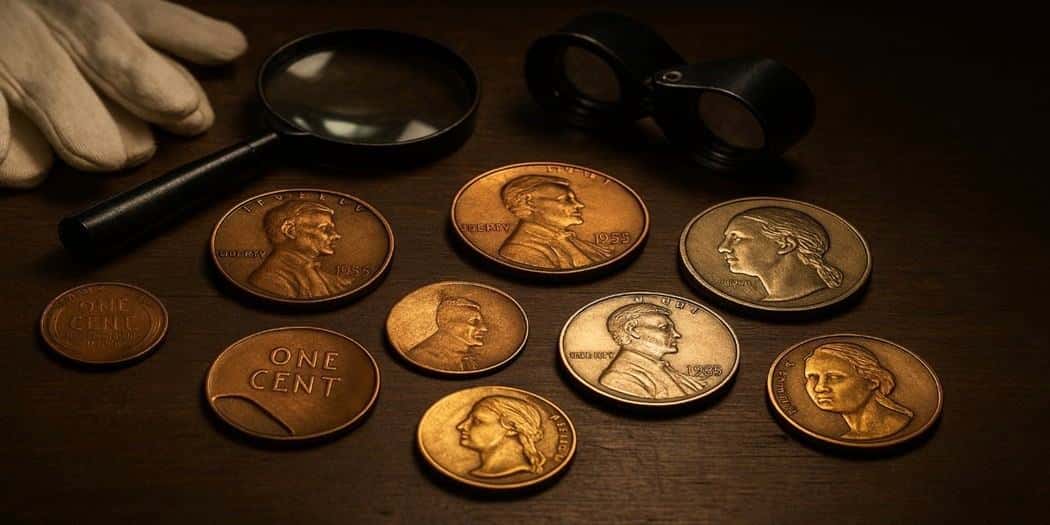
Why Coin Errors Fascinate Collectors
Error coins have a special place in numismatics. Unlike standard issues struck to perfection, these pieces reveal the quirks and accidents of the minting process — from misaligned dies to mismatched planchets. Because errors are unintentional and usually scarce, they create excitement among collectors who prize uniqueness, rarity, and the story each coin tells. Historical circumstances such as wartime material shortages and mint transition years often contributed to some of the most famous errors, giving them added context and value. Some error coins, like the famous 1955 doubled die cent, have sold for tens of thousands of dollars, proving that mistakes can become masterpieces.
Major Types of Mint Errors
1. Doubled Die Coins
A doubled die occurs during the hubbing process when the die itself receives a doubled impression. Coins struck from that die show dramatic doubling, often most visible on dates, mottos, and lettering.
Historical Context: In the 1950s, manual hubbing was more prone to misalignments, resulting in dramatic varieties like the 1955 doubled die cent.
Example: The 1955 Lincoln Cent Doubled Die Obverse (DDO) remains one of the most famous U.S. errors, with auction prices exceeding $40,000 for high-grade examples.
2. Off-Center Strikes
If a coin blank (planchet) is not properly seated in the striking chamber, part of the design will be missing. The degree of misalignment affects value: the more dramatic the off-center, the higher the premium.
Example: Lincoln cents struck 50% off-center with clear dates can bring hundreds of dollars at auction.
3. Broadstrikes
When a coin is struck without the retaining collar, the metal flows outward freely. The result is a flattened, wider coin that still shows a complete design, but without a defined rim.
Example: Broadstruck Jefferson nickels are collectible curiosities, often fetching multiples of face value.
4. Clipped Planchets
During blanking, if a coin blank is cut overlapping the edge of the sheet or a previous cut, it produces a clipped planchet. Collectors value cleanly curved clips with full details.
Example: A 1960s Washington quarter with a large curved clip recently sold for over $100.
5. Wrong Planchet Errors
A coin struck on a blank intended for another denomination or metal type. These “wrong metal” errors are among the most dramatic and sought-after.
Historical Context: In 1943, the U.S. Mint switched from bronze to zinc-coated steel for cents to conserve copper for WWII. A few leftover bronze planchets were mistakenly used.
Example: The 1943 bronze Lincoln cent sold for over $1.7 million in 2010.
6. Double-Struck Coins
When a coin is struck twice, either aligned or misaligned, the result is overlapping design details. Misaligned double strikes are especially dramatic.
Example: Double-struck state quarters, showing rotated or off-center secondary strikes, are collector favorites.
7. Mule Errors
A mule is a coin struck with mismatched dies — for instance, an obverse from one denomination paired with a reverse from another.
Example: The 2000 Sacagawea dollar / Washington quarter mule error, discovered in vending machine circulation, has sold for over $100,000.
8. Die Cap Errors
If a coin sticks to a die, it can continue striking subsequent blanks, creating a “cap” that deforms the design. These are rare and visually striking.
Example: Lincoln cents with die cap errors are instantly recognizable, sometimes bringing thousands at auction.
9. Cud Errors
When a piece of the die breaks away, part of the coin design is replaced by a raised blank blob of metal. Collectors enjoy cud errors because they visually demonstrate die failure.
Example: Cud Lincoln cents are popular entry-level errors, often selling for $25–$100 depending on size and clarity.
10. Missing Edge Lettering
Modern coins like Presidential Dollars feature edge inscriptions. A missing or incomplete edge legend creates a collectible variety.
Example: 2007 Washington dollars missing “In God We Trust” on the edge caused a frenzy when first discovered, with values over $1,000 before stabilizing.
11. Transitional Errors
When a coin is struck with a metal composition from a different year, it is called a transitional error.
Historical Context: In 1944, the Mint returned to bronze cents, but leftover steel planchets from WWII created the famous 1944 steel cent.
Example: These transitional steel cents are valued at over $100,000 in high grades.
12. Strike-Through Errors
Occurs when foreign material like wire, grease, or even a nail comes between the die and the blank, leaving an unusual imprint.
Example: Roosevelt dimes struck through cloth or wire create dramatic textures that collectors eagerly pursue.
13. Rotated Die Errors
One die is misaligned relative to the other, so when you flip the coin, the reverse is not properly oriented.
Example: A Morgan dollar with a 180-degree rotated die alignment can command strong premiums.
14. Lamination Errors
Caused by impurities or flaws in the metal strip used to make blanks. This results in peeling or flaking of the coin’s surface.
Example: Lincoln cents with visible lamination “peels” are affordable starter errors, usually under $50.
15. Multiple Strikes and Flip-Over Strikes
When coins are struck more than once in different orientations, sometimes flipped between strikes, the designs overlap or invert.
Example: Kennedy halves with flip-over double strikes are prized rarities, often selling for thousands.
16. Overdate & Repunched Mint Mark Varieties (RPMs)
These varieties occur when dies are altered or reused, leaving traces of previous digits or mintmarks. Overdates feature an earlier date faintly visible beneath a newer one (such as the famous 1942/1 Mercury dime), while RPMs show a mintmark punched more than once, often at a slightly different angle or location.
Historical Context: Before the 1990s, mintmarks were punched into dies by hand, creating opportunities for visible overlaps.
Example: The 1942/1 dime and 1918/7-D Buffalo nickel are legendary overdates, both commanding five-figure prices in high grades. RPMs like the 1955-D/D Lincoln cent are more affordable, offering beginners an entry point into variety collecting.
Error Coins vs. Post-Mint Damage
New collectors often confuse true errors with damage. A mint error occurs during the striking process (e.g., wrong planchet, off-center strike). Post-mint damage happens afterward — like scratches, bends, or drilling — and does not add collectible value. Certified grading services like PCGS and NGC can authenticate true mint errors and prevent costly mistakes. One of the biggest pitfalls for beginners is mistaking environmental damage, such as corrosion or chemical toning, for a rare mint error. Careful study of error types and comparison with verified examples can help sharpen an eye for authenticity. Collectors who invest in reference guides and submit coins for certification build confidence while protecting themselves from overpaying for damaged pieces.
Collector Demand Trends
Error coin collecting has surged in the last decade. Social media platforms and online auction houses have made discoveries more visible and exciting, turning coins like the 1955 doubled die cent and the 2007 missing edge lettering dollar into household names. Demand for dramatic errors has grown sharply, with prices in major auctions reaching record highs. YouTube channels, TikTok, and Instagram reels showcasing error coin “finds” in pocket change have fueled a new wave of grassroots enthusiasm among younger collectors. Meanwhile, established numismatists are competing for registry set dominance, pushing premiums higher for certified examples. With error coins blending historical intrigue, visual appeal, and scarcity, market experts predict this demand trend will remain strong for years to come.
Collecting Strategies for Error Coins
-
Start Small: Begin with affordable types such as clipped planchets, lamination errors, or modest off-centers.
-
Move Up: Expand into dramatic doubled dies, transitional errors, or even mules as your knowledge and budget grow.
-
Buy Certified: PCGS and NGC provide third-party authentication and protect against counterfeits.
-
Diversify: Build a set across error types rather than focusing on just one, adding educational depth to your collection.
-
Stay Informed: Follow auction houses and forums to spot new discoveries early.
The Enduring Appeal of Error Coins
Error coins blend bullion value, rarity, and historical intrigue. From doubled dies to wrong planchet rarities, each tells the story of the imperfect process of minting coinage. Collectors can enjoy both affordable curiosities and six-figure rarities, while preserving wealth in tangible form. By learning error types, recognizing market demand, and developing a collection strategy, enthusiasts can protect — and grow — their investments while exploring one of the most fascinating corners of numismatics.