View Charts
Top 12 U.S. Mint Error Coins Worth Collecting
 9
9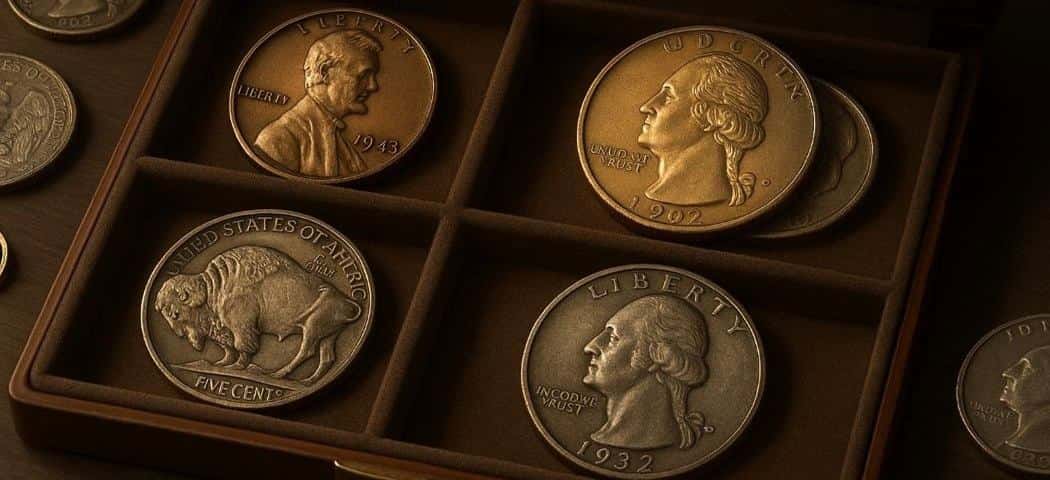
Why Mint Error Coins Capture Attention
Error coins are accidents of history — mistakes at the U.S. Mint that slipped into circulation, creating some of the rarest and most valuable collectibles in American numismatics. From doubled dies to wrong planchets, these coins highlight the fascinating intersection of human error and minting technology. Many have become legends, selling for six or seven figures at auction. Below, we highlight 12 of the most famous U.S. Mint error coins, their stories, and what collectors should know.
Top 12 U.S. Mint Error Coins
1. 1943 Bronze Lincoln Cent
During World War II, pennies were struck in zinc-coated steel to conserve copper. A few 1943 bronze planchets were mistakenly used, producing one of the most coveted error cents.
-
Why it matters: Rarity and historical significance.
-
Auction record: One example sold for $1.7 million in 2010, with recent sales still topping six figures.
2. 1955 Doubled Die Obverse Penny
Perhaps the most iconic doubled-die in U.S. history, dramatic doubling appears on “LIBERTY” and “IN GOD WE TRUST.” Even beginners recognize this variety.
-
Why it matters: Striking visual error and widespread fame.
-
Auction record: A MS65 Red specimen realized $124,875 in 2020 at GreatCollections.
3. 1922 “Plain” Lincoln Cent (No D Mintmark)
In 1922, only Denver struck cents — but some were minted without the “D” mintmark. These “plain” cents are highly collectible.
-
Why it matters: Unique anomaly in the Lincoln Wheat Penny series.
-
Auction record: A high-grade MS64 BN sold for $82,250 at Heritage Auctions.
4. 1937-D “Three-Legged” Buffalo Nickel
A polishing error on the reverse die erased one of the buffalo’s legs, leaving the famous “three-legged” nickel.
-
Why it matters: Visual novelty and recognition.
-
Auction record: An MS66 specimen sold for $97,750 in 2021.
5. 1944 Steel Lincoln Cent
After bronze returned to production in 1944, leftover steel planchets were accidentally used, resulting in ultra-rare 1944 steel cents.
-
Why it matters: Fewer than 50 are believed to exist.
-
Auction record: One sold for $408,000 in 2021.
6. 1975 “No S” Proof Roosevelt Dime
In 1975, two proof dimes struck in San Francisco lacked the “S” mintmark. Only a couple are confirmed.
-
Why it matters: Proof coinage error, virtually unique.
-
Auction record: Sold for $516,000 in 2024.
7. 2000 Sacagawea / Washington Quarter Mule
This “mule” combines a Sacagawea reverse with a Washington quarter obverse. Only a small number are known.
-
Why it matters: Rare design mismatch.
-
Auction record: One example brought $192,000 at auction.
8. Roosevelt Dime Struck on a Nail
This dramatic error occurred when a dime planchet was replaced by a foreign object — in this case, a nail — inside the press. The coin’s design was partially imprinted onto the metal surface of the nail, creating one of the most visually unusual mint errors ever recorded.
-
Why it matters: Its dramatic appearance and extreme rarity make it one of the most collectible U.S. Mint mechanical mishaps.
-
Auction record: One such piece sold for $42,300 in recent sales.
9. 1964 SMS Kennedy Half Dollar
A small number of “Special Mint Set” halves were struck with prooflike finishes. These carry an aura of mystery, as no official SMS was issued in 1964.
-
Why it matters: Numismatic mystery and rarity.
-
Auction record: One sold for $108,000 at Heritage Auctions in 2019.
10. 1804 Silver Dollar
Often called the “King of American Coins,” the 1804 dollar was struck decades later as diplomatic presentation pieces. With only 15 known, they command enormous sums.
-
Why it matters: Legendary rarity, though not a traditional mint “error.”
-
Auction record: One specimen sold for $7.68 million in 2021.
11. 2000-P Sacagawea Dollar / Quarter Mule with Feeder Finger
A bizarre mishap combined a Sacagawea design with a quarter press feeder finger imprint, producing an extraordinary mule error.
-
Why it matters: Combines multiple error elements.
-
Auction record: Private sales suggest values into the six figures.
12. 1932 Washington Quarter “Missing Edge Reed” Varieties
Washington Quarters normally feature sharp reeding (grooved edges) to discourage clipping and counterfeiting. In 1932, the inaugural year of the series, some coins were struck without full or consistent reeding on the edge, creating collectible varieties.
-
Why it matters: These errors highlight early minting challenges in the Washington Quarter series and are sought after by specialists.
-
Auction record: Examples have sold for $5,000–$10,000 depending on grade.
Key Error Types to Watch For
While these 12 coins are iconic, collectors should also recognize broader error categories:
-
Off-Metal / Wrong Planchet – e.g., 1943 bronze cent, 1944 steel cent.
-
Doubled Dies – dramatic hubbing errors, like the 1955 cent.
-
Off-Center Strikes – coins not fully seated in presses.
-
Clipped Planchets – blanks cut incorrectly.
-
Die Breaks & Cuds – cracks or missing chunks of the die.
-
Mule Coins – mismatched obverse and reverse dies.
-
Struck-Thru Errors – foreign objects interfere during striking.
Collector Tips: How to Spot, Verify, and Value Error Coins
-
Use reference guides and die attribution catalogs (e.g. “special mint error” books, Cherrypicker’s).
-
Always verify with reputable grading services (PCGS, NGC, ANACS) — they handle authentication and grading.
-
Magnification is essential — many errors are subtle and invisible to the naked eye.
-
Check for counterfeits — especially for high-value errors like 1943 bronze. Magnet tests, weight checks, and spectral analysis help.
-
Follow auction history — track realized prices in major auction houses to understand market demand.
-
Don’t ignore lesser-known errors — sometimes smaller-value errors (clips, die breaks) are undervalued gems.
-
Condition matters — a rare error in poor condition often sells less than a common coin in top grade.
-
Document provenance — a well-documented chain of ownership helps buyers trust authenticity.
Enhancing Your Portfolio with Rare Errors
Mint error coins blend history, artistry, and accident. From the 1943 bronze cent to the 2000 mule, these pieces tell unique stories of the Mint’s past while commanding huge premiums at auction. By studying error types and learning from famous examples, collectors can build portfolios that stand out not just for bullion value, but for historical intrigue. In a market where rarity and story drive demand, mint errors remain some of the most fascinating treasures in U.S. coinage.
9 Comments