
 View Charts


The Mysterious 1804 Draped Bust Silver Dollar: The King of American Coins
The 1804 Draped Bust Silver Dollar, often acclaimed as "The King of American Coins," is one of the most illustrious and highly coveted items in numismatic history. Although it bears the date 1804, the coin was actually minted in the mid-1830s, 50s and 60s by the U.S. Mint. This silver coin’s rich history, extreme rarity, and high value make it a true numismatic treasure. In this article, we delve into the intriguing story of the 1804 Draped Bust Silver Dollar, its design varieties, and scarcity.
Historical Background
The 1804 Draped Bust Silver Dollar was born out of a series of events and decisions that make it one of the most storied coins in U.S. history. Initially intended to be struck in 1804, no silver dollars were actually minted that year. The U.S. Mint had ceased production of silver dollars after 1803 due to the rising value of silver bullion, which made it impractical to continue minting these coins. It wasn't until the 1830s that the U.S. Mint finally began to produce the 1804 Draped Bust Silver Dollars. These coins were minted as part of diplomatic gift sets for presentation to foreign dignitaries and to satisfy the growing interest of collectors.
The production of the 1804 Draped Bust Silver Dollar in the 1830s was prompted by the administration of President Andrew Jackson. The U.S. government sought to strengthen diplomatic ties and demonstrate the nation's prosperity and advanced minting capabilities. The coins were included in special presentation sets along with other U.S. coins of the time. These sets were given to notable figures, including the Sultan of Muscat and the King of Siam, enhancing the historical and diplomatic significance of the 1804 Draped Bust Silver Dollar.
Class I, II, and III Coins
The 1804 Draped Bust Silver Dollar exists in three distinct classes, each with its unique history:
Class I
These coins were struck in 1834 as part of diplomatic gift sets given to foreign dignitaries. Eight Class I coins are known to exist.
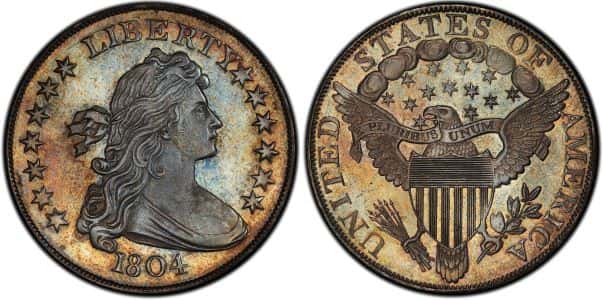
Image source: https://www.pcgs.com/coinfacts
Class II
These were unauthorized restrikes created in the mid-1850s. Only one Class II coin is known, and it lacks a "collar" or edge device.
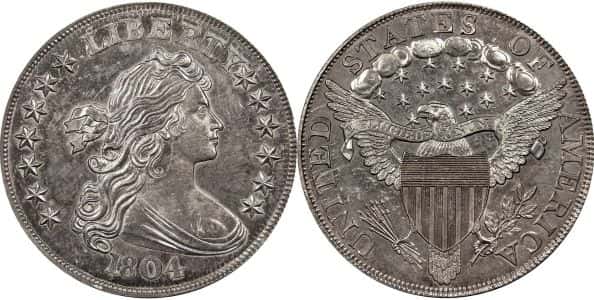
Image source: https://www.pcgs.com/coinfacts
Class III
These coins were struck in the late 1850s and early 1860s, with six examples known. They were intended to satisfy the growing demand from collectors.
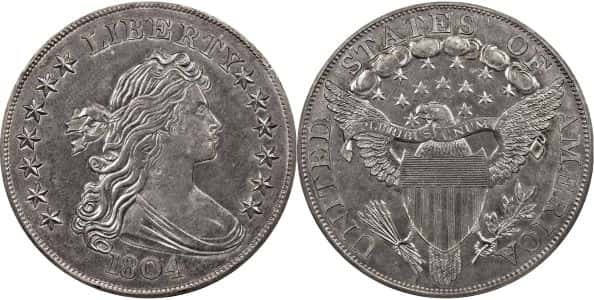
Image source: https://www.pcgs.com/coinfacts
Design and Specifications
The 1804 Draped Bust Silver Dollar features the iconic design created by Robert Scot, the first Chief Engraver of the U.S. Mint.
- Obverse: The obverse showcases a right-facing portrait of Lady Liberty with flowing hair and a draped bust, surrounded by 13 stars representing the original colonies. The “1804” date is positioned below Liberty.
- Reverse: The reverse features a heraldic eagle with a shield on its chest, clutching an olive branch and arrows, symbolizing peace and military readiness. Above the eagle's head, a ribbon inscribed with "E PLURIBUS UNUM" flutters between a cluster of stars and clouds.
- Specifications: Composition: 89.24% silver, 10.76% copper; Diameter: 39-40 mm; Weight: 26.96 grams
Rarity and Market Value
The extreme rarity of the 1804 Draped Bust Silver Dollar significantly contributes to its allure and market value. With only 15 known specimens across all classes, each coin is a prized possession in any collection.
Market Values
The value of the 1804 Draped Bust Silver Dollar varies based on its class and condition. Here are some recent auction prices:
- Class I: In August 2021, a Class I specimen (PCGS PF68) sold for $7.68 million at a Stack’s Bowers auction.
- Class II: The only known Class II coin is held in the Smithsonian Institution and is considered priceless.
- Class III: In April 2009, a Class III example (PCGS PF58) sold for $2.3 million at a Heritage Auctions event.
The King of American Coins
The 1804 Draped Bust Silver Dollar is a numismatic masterpiece, deeply cherished for its profound historical significance, exceptional rarity, and exquisite design. This coin, often regarded as the "King of American Coins," encapsulates the rich and complex history of early American coinage. Its origins are steeped in intrigue and prestige, having been struck not in its dated year of 1804, but in the 1830s for inclusion in diplomatic gift sets. This delayed production adds an element of mystery and allure, enhancing its status among collectors. With only 15 known specimens in existence across three distinct classes, the 1804 Draped Bust Silver Dollar is an extraordinarily rare treasure. Its stunning design, featuring Lady Liberty with flowing hair on the obverse and a heraldic eagle on the reverse, showcases the artistic excellence of early U.S. Mint engravers. The survival of these few coins, given their storied past and the high silver content, stands as a testament to the enduring legacy and craftsmanship of American coinage. At Bullion Exchanges, we appreciate that this coin not only represents a pinnacle of numismatic art but also serves as a tangible link to the early diplomatic and economic history of the United States.