
 View Charts


A Numismatic Rarity with Unmatched Value
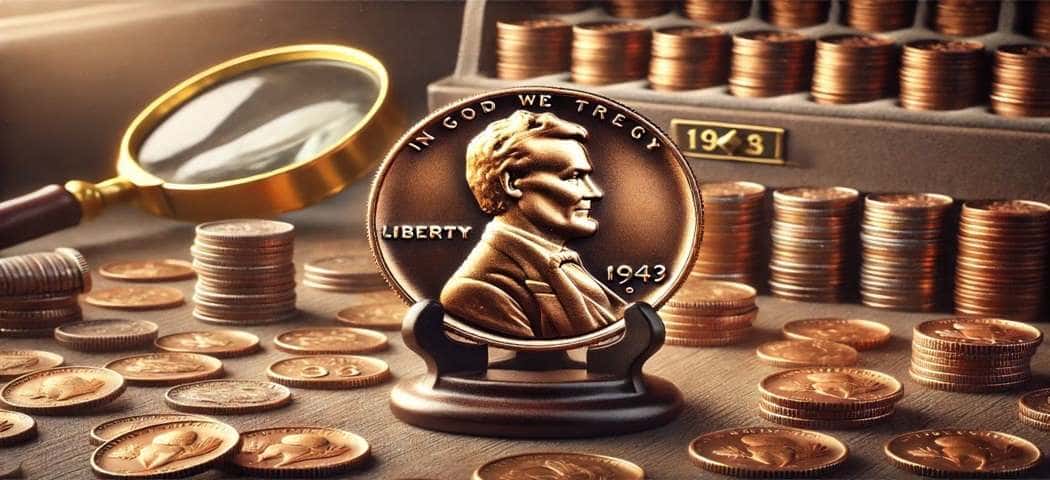
Among all Lincoln Wheat Cents, the 1943 Copper (Bronze) Penny remains one of the rarest and most sought-after error coins in U.S. history. This accidental minting mistake has fascinated collectors, investors, and historians alike. With only a few confirmed specimens, this penny has set record-breaking prices at auctions, making it a prized piece in numismatics.
This guide explores why the 1943 Copper Penny is so rare, how it was mistakenly produced, its auction history, and how to determine if you own one.
The Lincoln Wheat Cent: A Historic Tribute to an American Icon
The Lincoln Wheat Cent, first introduced in 1909, was a groundbreaking coin in U.S. numismatic history. It was the first American coin to feature a real historical figure, honoring President Abraham Lincoln on the centennial of his birth. Prior to this, U.S. coinage primarily depicted allegorical representations of Liberty rather than actual people.
Designed by Victor David Brenner, a renowned sculptor, the Lincoln Cent’s obverse features a detailed portrait of Lincoln, inspired by a 1864 photograph taken by Mathew Brady. The reverse showcases two wheat stalks encircling “ONE CENT” and “UNITED STATES OF AMERICA”, symbolizing prosperity and national strength.
The Lincoln Wheat Cent remained in production until 1958, when it was replaced by the Lincoln Memorial reverse. However, it remains one of the most collected and historically significant coins in U.S. history, with key dates—like the 1943 Copper Penny—becoming some of the rarest and most valuable coins ever minted.
The 1943 Copper Penny: A Wartime Error
Why Was the 1943 Penny Supposed to Be Made of Steel?
During World War II, the U.S. government prioritized copper for military production, particularly for ammunition and communications equipment. To conserve resources, the U.S. Mint switched from traditional copper pennies to a new steel composition coated in zinc.
However, due to a minting error, a small number of 1943 pennies were struck on leftover copper planchets from 1942 instead of the intended steel blanks. This mistake created one of the most famous and valuable minting errors in U.S. history.
How Many 1943 Copper Pennies Exist?
Experts estimate that only 10 to 15 genuine examples of the 1943 Bronze Penny have been discovered. Since all three U.S. Mints (Philadelphia, Denver, and San Francisco) were striking steel cents that year, the copper error could have originated at any of them.
Here’s how many authentic 1943 Copper Pennies have been confirmed so far:
-
Philadelphia Mint: ~10 known examples
-
Denver Mint: 1 confirmed specimen
-
San Francisco Mint: Fewer than 5 known examples
Because of their extreme rarity, collectors and investors are always on the lookout for undiscovered pieces that may still be in circulation or private collections.
How Much Is a 1943 Copper Penny Worth?
Due to its scarcity and historical importance, the 1943 Copper Penny consistently fetches six-figure prices at auctions.
Record-Breaking Auction Sales
-
$840,000 – A MS64BN 1943-D (Denver Mint) Copper Penny sold for $840,000 in a 2021 auction, making it one of the highest-priced specimens of its kind.
-
$504,000 – In 2020, a MS63BN 1943-S (San Francisco Mint) Copper Penny was purchased for $504,000, reinforcing its desirability among collectors.
-
$372,000 – A MS62BN 1943 (Philadelphia Mint) Copper Penny was auctioned for $372,000 in 2021, highlighting the continued demand for these elusive coins.
Even lower-grade authentic 1943 Copper Pennies sell for hundreds of thousands of dollars, making them one of the most valuable U.S. coins ever struck.
How to Tell If You Have a Genuine 1943 Copper Penny
Because of its high value, the 1943 Bronze Penny has been widely counterfeited. Some fake versions are copper-plated 1943 steel cents, while others are altered 1948 pennies with modified dates.
Ways to Identify a Genuine 1943 Copper Penny:
Magnet Test
-
Real 1943 Copper Pennies are NOT magnetic because they contain no steel.
-
Fake versions made from steel will stick to a magnet due to their iron content.
Weight Test
-
Authentic 1943 Copper Pennies weigh approximately 3.11 grams.
-
Steel cents weigh only 2.7 grams.
-
If your 1943 penny is lighter than 3.11 grams, it is likely a common steel cent.
Check the Mint Mark
-
Philadelphia Mint – No mint mark.
-
Denver Mint – A small “D” mintmark under the date.
-
San Francisco Mint – An “S” mintmark under the date.
Professional Authentication
-
Submit your coin to PCGS (Professional Coin Grading Service) or NGC (Numismatic Guaranty Company) for official authentication and certification.
Having a third-party grading service confirm authenticity is essential, as a genuine 1943 Copper Penny can sell for hundreds of thousands of dollars or more.
Other Extremely Rare Lincoln Wheat Cents
Although the 1943 Copper Penny is the rarest, several other high-value Lincoln Wheat Cents command significant auction prices:
1944 Steel Penny – $300,000+
-
Similar to the 1943 Copper Penny, this error occurred when a few steel planchets were accidentally used in 1944 instead of copper.
1909-S VDB Lincoln Cent – $168,000
-
The first-year Lincoln Cent featured designer Victor David Brenner’s initials (VDB) and had a low mintage of just 484,000, making it a key date for collectors.
1922 No D Lincoln Cent – $90,000+
-
An error from the Denver Mint, where the “D” mintmark was accidentally omitted, creating one of the most famous key dates in the Lincoln Cent series.
The Enduring Legacy of the 1943 Copper Penny
The 1943 Copper Lincoln Cent remains one of the rarest, most valuable, and most famous U.S. coins. With only a few genuine pieces in existence, collectors continue to dream of finding one hidden in pocket change or an old collection.
If you believe you own a 1943 Copper Penny, be sure to test its authenticity and have it professionally graded. As history has proven, even a single penny can be worth a fortune—and the 1943 Bronze Penny is the perfect example of that.
Another article that may interest you:
Lincoln Wheat Pennies Explained: History, Rarity, and Collector Value