
 View Charts


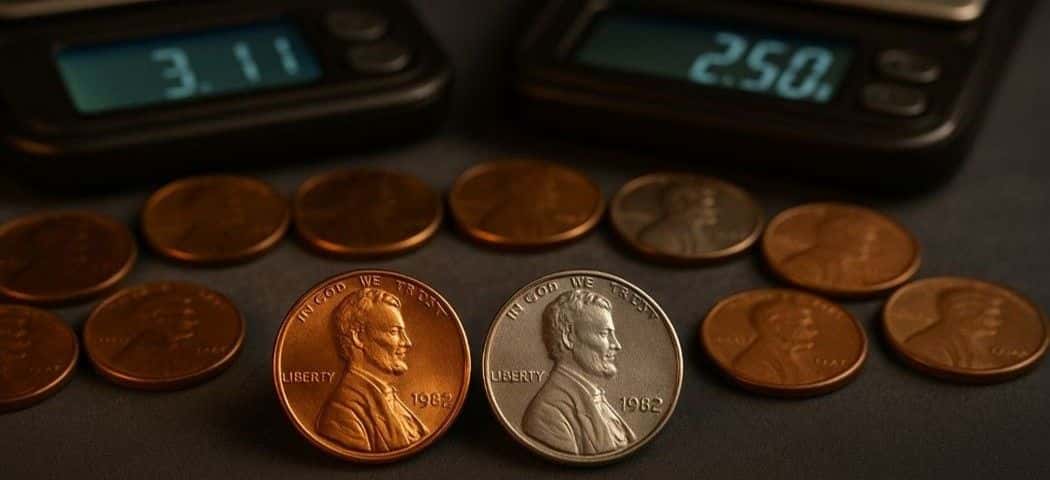
A Transitional Year That Transformed the Lincoln Cent
Few coins capture the attention of collectors quite like the 1982 Lincoln Cent — a seemingly ordinary penny that represents one of the most pivotal transitions in modern U.S. coinage. While billions were produced, this was the year that ended the era of copper coinage and introduced the zinc-based cent still in circulation today.
At first glance, 1982 pennies look identical. However, subtle differences in weight, metal composition, and date style have made this issue a cornerstone for both new and advanced numismatists. Adding to the intrigue, a rare transitional error — the 1982-D Small Date Copper penny — has become one of the most valuable modern coin discoveries in American history.
This article explores the origins of the change, how to identify the different 1982 varieties, and what makes certain examples worth thousands of dollars to collectors and investors alike.
Historical Background: From Inflation to Innovation
In the early 1980s, the U.S. Mint faced a serious economic dilemma. Rising inflation and a surge in global copper prices meant that the metal inside each penny was worth more than its face value. By 1981, the cost to produce a one-cent coin had exceeded one cent — an unsustainable situation that threatened to pull copper coins out of circulation as Americans began hoarding them for metal content.
To resolve the crisis, Congress approved the Mint’s proposal to switch the cent’s composition from nearly pure copper (95%) to a copper-plated zinc alloy. This new planchet consisted of a 99.2% zinc core with a thin 0.8% copper coating, dramatically reducing production costs and ensuring the penny’s survival as a circulating coin.
However, because the conversion occurred midway through 1982, both copper and zinc cents were struck that year — a rare overlap that produced one of the most complex sets of U.S. coin varieties ever released. The decision not to distinguish the two compositions with separate markings has since fueled decades of collector interest and speculation.
Design and Symbolism: A Familiar Face Through Change
Despite the dramatic composition change, the design of the 1982 penny remained unchanged. Sculptor Victor David Brenner’s classic portrait of President Abraham Lincoln, introduced in 1909 for Lincoln’s 100th birthday, continued to grace the obverse. It remains one of the longest-running designs in U.S. Mint history.
-
Obverse:
Features a right-facing bust of Abraham Lincoln, with the inscriptions LIBERTY, IN GOD WE TRUST, and the date 1982. The mintmark (D for Denver, none for Philadelphia) appears below the date. -
Reverse:
Designed by Frank Gasparro, it depicts the Lincoln Memorial in Washington, D.C., symbolizing unity and national strength. The inscriptions UNITED STATES OF AMERICA, E PLURIBUS UNUM, and ONE CENT surround the image. -
Edge: Plain, as is standard for U.S. cents.
This continuity of design reflected the Mint’s goal: to make the transition invisible to the public while ensuring long-term financial sustainability. To this day, the 1982 penny stands as a visual bridge between the copper era and the modern zinc age.
Specifications and Varieties: The Year of Eight Pennies
The U.S. Mint’s midyear changeover led to an unprecedented scenario — eight distinct varieties of 1982 Lincoln Cents. The variations come from three key factors: metal composition (copper or zinc), mintmark (Philadelphia or Denver), and date style (Large or Small Date).
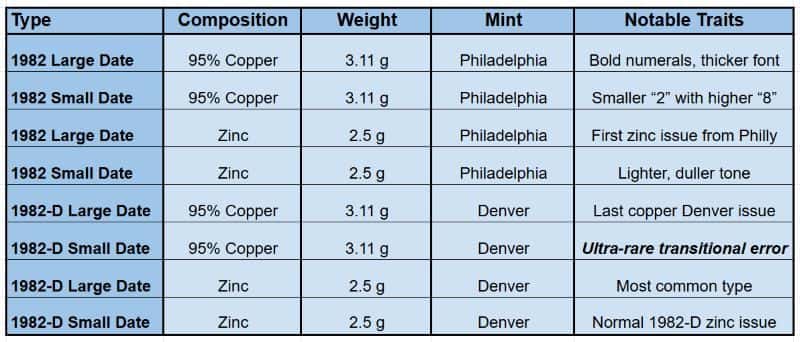
How to tell Large vs. Small Date:
On the Small Date, the “2” has a delicate curve and the top of the “8” aligns with the “9.” The Large Date has thicker numerals and the “8” sits slightly lower. Under magnification, these differences are clear and easy to learn with practice.
The Legendary 1982-D Small Date Copper Penny
This is the crown jewel of all modern Lincoln Cent varieties — the 1982-D Small Date Copper transitional error. During the switch to zinc planchets, a few leftover copper blanks were accidentally fed into Denver Mint presses equipped with Small Date dies. These coins weigh 3.11 grams instead of 2.5 and are genuine transitional off-metal strikes.
Only a handful are known to exist, verified by PCGS and NGC, making them among the rarest Lincoln cents in existence.
-
In 2017, one graded MS63BN sold for $18,800 at Heritage Auctions.
-
In 2021, another example brought over $24,000.
Experts believe that fewer than 10 confirmed specimens exist, though undiscovered examples may still be hidden in old coin jars or rolls.
Collectors can test potential finds by weighing each 1982-D penny — if it reads 3.11 grams, it could be a life-changing discovery.
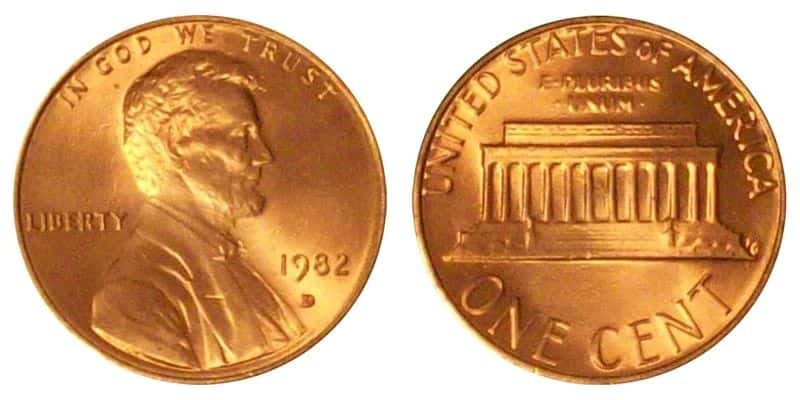
1982-D Small Date Copper Penny
Collector and Investor Appeal
The 1982 penny series appeals to a broad range of collectors for several reasons:
-
Historical Transition: It represents the end of the copper era and the start of modern minting economics.
-
Affordability: Most varieties remain easily collectible and can be found in circulation or bulk rolls.
-
Variety Hunting: With eight recognized types, collectors can build an engaging and educational mini-set.
-
High-End Investment Potential: Rare transitional errors like the 1982-D Small Date Copper are valued in the tens of thousands.
-
Cross-Market Interest: Copper’s intrinsic value links the coin to the broader precious and industrial metals market, adding depth for investors who also follow the spot price of gold and silver price trends.
The combination of accessibility and potential for high-value discovery makes this year one of the most exciting for roll hunters and serious numismatists alike.
Modern Relevance and Collecting Tips
The 1982 Lincoln Cent continues to fascinate collectors more than 40 years later. Here’s how to build and protect your set:
-
Weigh every coin: Copper = 3.11 g, Zinc = 2.5 g.
-
Inspect the edge: Copper coins have a consistent red tone; zinc coins often show a dull or spotted edge.
-
Check for die cracks or doubling: Minor minting errors can increase value slightly.
-
Never clean your coins: Cleaning damages the surface and can reduce grade and value.
-
Use professional holders: Airtight flips or slabs prevent oxidation and protect from handling damage.
-
Consider certification: Third-party grading by PCGS or NGC adds authenticity and enhances resale value.
Even for seasoned collectors, few coins offer as much educational insight or collecting variety as the 1982 penny.
A Small Coin with a Big Story
The 1982 Lincoln Cent is far more than a one-cent piece — it’s a time capsule of America’s economic and industrial evolution. Its midyear composition change marked the end of over 150 years of copper coinage and the beginning of modern U.S. minting.
For casual collectors, it’s an accessible entry point into numismatics. For specialists, it’s a treasure trove of varieties and transitional errors that reward patience, knowledge, and curiosity.
Whether you collect for fun, for history, or for value, the 1982 penny stands as a reminder that even the smallest coins can tell the biggest stories.
FAQ: 1982 Lincoln Memorial Penny
Why is the 1982 penny so significant?
It marks the U.S. Mint’s historic switch from copper to zinc cents, creating multiple varieties and a famous rare transitional error.
How many 1982 penny varieties exist?
There are eight distinct types, including both copper and zinc versions from Philadelphia and Denver Mints with Small and Large Date designs.
How can I tell if my 1982 penny is copper or zinc?
Use a digital scale — copper pennies weigh 3.11 grams, zinc pennies weigh 2.5 grams.
What makes the 1982-D Small Date Copper penny valuable?
It’s a transitional mint error — struck on leftover copper planchets when the Mint had already switched to zinc.
What is the value of a 1982-D Small Date Copper penny?
Depending on grade, examples have sold for $10,000 to $25,000+ at major auctions.
Are all 1982 pennies worth keeping?
Yes — they’re inexpensive to collect, educational, and could hide a rare transitional error.
Were proof pennies struck in 1982?
No official proofs were made that year, though some early dies produced semi-prooflike surfaces.
Why did the U.S. stop making copper pennies?
Rising copper prices made it more expensive to mint the coin than its face value.
Can 1982 pennies still be found in circulation?
Absolutely — billions were made, and many still circulate or appear in mixed bank rolls.
Should I get my 1982 pennies graded?
Yes, especially if you suspect a rare error. Professional certification confirms authenticity and ensures maximum resale value.
Related reading you may find interesting:
What Makes a Penny Valuable? Rare Dates, Errors & Value
Images sourced from: USA Coin Book