View Charts
The 2026 July 4 Quarter Could Spark America's Biggest Coin Hunt
 26
26
A New Kind of Semiquincentennial Collectible Is About to Enter Circulation
Most U.S. Mint anniversary coins follow a familiar path. Collectors place orders, products sell out or remain available, and the coins eventually find their place in albums, vaults, and collections across the country. The Mint's latest Semiquincentennial announcement breaks that pattern entirely.
In a surprise move tied to America's 250th anniversary, the United States Mint announced plans to produce 250,000 special 2026 Declaration of Independence Quarters featuring a unique 'July 4' privy mark. Rather than offering them through traditional Mint channels, these coins will be released directly into circulation and mixed randomly with ordinary 2026 quarters. There will be no dedicated product launch, no special packaging, and no guaranteed way to obtain one.
That decision transforms the coin from a collectible product into something much more unusual: a modern treasure hunt.
At a time when many Americans rarely handle cash and collectors can purchase almost any modern issue with a few clicks online, the Mint is effectively recreating the excitement that once drove generations of coin hunters to examine every coin that passed through their hands. The result could become one of the most talked-about numismatic events of the Semiquincentennial celebration.
A Semiquincentennial Quarter Most Collectors Cannot Simply Buy
Scarcity in modern numismatics often revolves around limited mintages or strong demand. What makes the July 4 quarter different is that availability itself becomes part of the story.
Collectors accustomed to ordering products directly from the Mint may find themselves facing an unfamiliar challenge. The Mint has indicated that the special quarters will be distributed through banks and financial institutions nationwide alongside standard 2026 Declaration of Independence Quarters. Because the coins will enter circulation randomly, there is no direct purchase option and no guaranteed method of acquisition.
That approach immediately changes collector behavior. Instead of monitoring release dates and online order windows, enthusiasts may find themselves visiting local banks, requesting quarter rolls, and examining circulation finds in search of the distinctive privy mark. The experience resembles the hobby's earlier decades, when discovering a scarce coin often depended on patience, persistence, and a bit of luck.
The psychology of the hunt has always been one of the most powerful forces in numismatics. Collectors enjoy ownership, but many enjoy discovery even more. By making the quarter available only through circulation channels, the Mint has shifted attention away from purchasing and toward finding, creating a collecting experience that feels increasingly rare in the modern marketplace.
Why 250,000 Quarters Is Smaller Than It Sounds
At first glance, 250,000 coins may appear to be a substantial number. In most collectible categories, a quarter-million examples would hardly qualify as scarce. Context, however, matters.
The United States routinely produces hundreds of millions of quarters for circulation each year, with total annual output often exceeding one billion coins across both the Philadelphia and Denver Mints. Even individual commemorative circulating designs frequently reach mintages in the hundreds of millions, dwarfing the figures announced for the July 4 privy mark issue. Against that backdrop, 250,000 pieces represents an exceptionally small subset of the broader quarter supply expected to enter circulation during the Semiquincentennial year.
The challenge becomes even more apparent when viewed on a national scale. Those quarters are not being released into a single city, region, or collector event. They are expected to enter circulation through financial institutions across the country. As a result, the number of coins available within any particular local market may be surprisingly small.
For many Americans, finding one may depend as much on timing as geography. A collector who happens to obtain newly distributed rolls shortly after release could have a dramatically different experience than someone searching months later after many examples have already been removed from circulation by collectors and casual savers.
This dynamic is likely to create a perception of scarcity that extends beyond the official mintage itself. Once collectors begin setting examples aside, the number actively circulating could decline quickly, making future discoveries increasingly difficult.
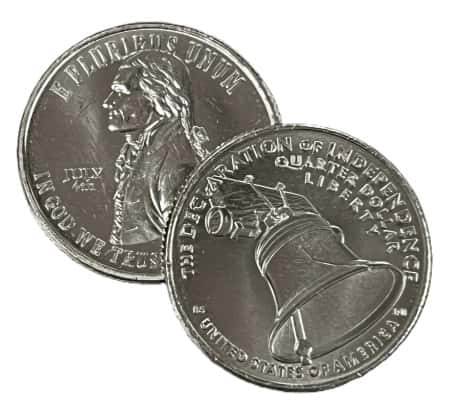
2026 Declaration of Independence Quarter with a 'July 4' privy mark
The July 4 Privy Mark Changes the Collecting Equation
The decision to add a special privy mark may prove just as important as the coin's limited production. Privy marks have become increasingly popular in modern numismatics because they allow mints to create distinctive varieties without fundamentally changing a coin's primary design. Collectors often view them as a bridge between standard circulating issues and special commemorative releases.
The quarter’s design reinforces its connection to the nation’s founding. The obverse features Thomas Jefferson, primary author of the Declaration of Independence and the third U.S. president, alongside the inscriptions ‘E PLURIBUS UNUM,’ ‘IN GOD WE TRUST,’ and ‘1776 ~ 2026.’ The reverse shows the Liberty Bell in motion, its familiar crack emphasizing both the promise and fragility of the young republic, surrounded by inscriptions honoring the Declaration of Independence, liberty, and the United States.
For the Declaration of Independence Quarter, the 'July 4' privy mark does more than identify a special edition. It directly ties the coin to the day most closely associated with the nation's founding. While every Semiquincentennial coin honors America's 250th anniversary, only this circulation issue carries a visual marker that explicitly references Independence Day itself.
The practical impact is equally important. Because the special quarters carry no mint mark and will circulate alongside ordinary 2026 Declaration of Independence Quarters, the privy mark becomes the defining characteristic collectors must locate. Finding one will require attention, patience, and a willingness to inspect coins that many people might otherwise overlook. In that sense, the Mint has transformed a small design element into the centerpiece of an entirely new collecting experience.
Coin Roll Hunting Could Return to the Spotlight
For decades, searching circulation rolls represented one of the most accessible entry points into coin collecting. Many hobbyists remember examining rolls of cents, nickels, and quarters in hopes of finding older dates, silver issues, mint errors, or low-mintage releases. The rise of online marketplaces gradually changed that dynamic, making it easier to purchase desired coins rather than search for them.
The July 4 quarter has the potential to reverse that trend, at least temporarily. Because collectors cannot simply order the coin from the Mint, many will likely return to methods that have become less common in recent years. Banks may see increased requests for quarter rolls, while collectors organize local searches, online reporting groups, and social media discussions dedicated to tracking discoveries.
What makes the situation especially interesting is that the hunt extends beyond dedicated numismatists. Unlike many modern Mint products that remain largely within collecting circles, these quarters will pass through grocery stores, restaurants, gas stations, and countless everyday transactions. That broad exposure could introduce new participants to the hobby, particularly younger collectors encountering the excitement of a circulation find for the first time.
The Semiquincentennial program already carries unusual visibility because of America's 250th anniversary. Adding a nationwide search element may expand that visibility even further.
Modern Circulation Rarities Have Created Excitement Before
The concept is not entirely unprecedented. Several modern U.S. coin releases have generated intense interest because they could be discovered in circulation rather than purchased directly.
The 2019 and 2020 West Point quarters provide perhaps the closest recent comparison. Those coins were distributed through circulation channels rather than sold in traditional Mint products, leading collectors to search quarter rolls in hopes of finding the elusive 'W' mint mark. The program generated widespread enthusiasm and introduced many casual collectors to coin hunting.
Earlier examples include the Wisconsin State Quarter varieties, the Delaware 'Spitting Horse' quarter, and the Cheerios Sacagawea dollar. While each emerged under different circumstances, all demonstrate the same principle: when collectors believe a coin can be found rather than purchased, participation often increases dramatically.
The July 4 quarter adds another dimension because it combines circulation-only availability with a major national anniversary. The historical significance of the Semiquincentennial gives the coin a broader audience than many previous circulation finds, potentially amplifying demand well beyond traditional hobby circles.
Most Americans May Never Notice One
Ironically, one of the factors that could make the July 4 quarter more desirable is the likelihood that many examples will circulate unnoticed.
Most people do not examine their change closely. A quarter received during a routine transaction is typically spent again without much attention, especially in an era when cash transactions continue to decline. Even among those aware of the Semiquincentennial program, not everyone will know to look for the privy mark.
This creates an unusual dynamic. The Mint is producing 250,000 special quarters, yet many may pass through numerous hands before being recognized. Some will likely disappear into collections almost immediately. Others may circulate for years before being identified. A few could remain hidden in jars, drawers, cash registers, and coin accumulations long after the initial release excitement fades.
That uncertainty is part of what makes circulation finds so compelling. Unlike a coin purchased directly from a Mint catalog, each discovery carries a story. The collector is not merely acquiring an object; they are uncovering something that could easily have gone unnoticed.
How Difficult Will the Search Really Be?
The answer depends largely on distribution patterns and collector participation. On paper, 250,000 coins sounds like a significant number. In practice, those pieces will be scattered across a nation of more than 340 million people and mixed among vast quantities of ordinary quarters.
Some collectors may locate examples quickly, particularly if they obtain fresh bank rolls shortly after release. Others could search thousands of quarters without success. Geography, timing, and luck will all play meaningful roles in determining individual outcomes.
What seems more certain is that availability will become more challenging over time. Each quarter removed from circulation by a collector reduces the number remaining in active commerce. Unlike standard circulating issues that continue to appear in large quantities, the July 4 privy mark quarter has a fixed production figure. Once distributed, no additional examples will be produced.
That reality may encourage early searching as collectors attempt to secure examples before the pool of available coins gradually shrinks.
A Different Kind of Legacy for the Semiquincentennial Program
Most Semiquincentennial coins will be remembered for their designs, historical themes, and connection to America's founding story. The July 4 quarter may ultimately be remembered for something else entirely: the experience it created.
By introducing a limited-edition circulation rarity tied directly to Independence Day, the U.S. Mint has transformed an anniversary coin into a national search. The excitement surrounding the release is likely to stem as much from the possibility of discovery as from the coin itself.
Whether collectors find one in a bank roll, receive one in change, or hear about a discovery from a friend, the quarter has the potential to reconnect Americans with a tradition that once defined coin collecting. In a year dedicated to celebrating the nation's history, that may prove to be one of the most memorable achievements of the entire Semiquincentennial program.
Image source: U.S. Mint
Related reading you may find interesting:
US Mint Strikes 250 Silver July 4 Declaration Quarters
2026 U.S. Constitution Quarter: Honoring 'We the People'
26 Comments