View Charts
2026 U.S. Constitution Quarter: Honoring 'We the People'
 0
0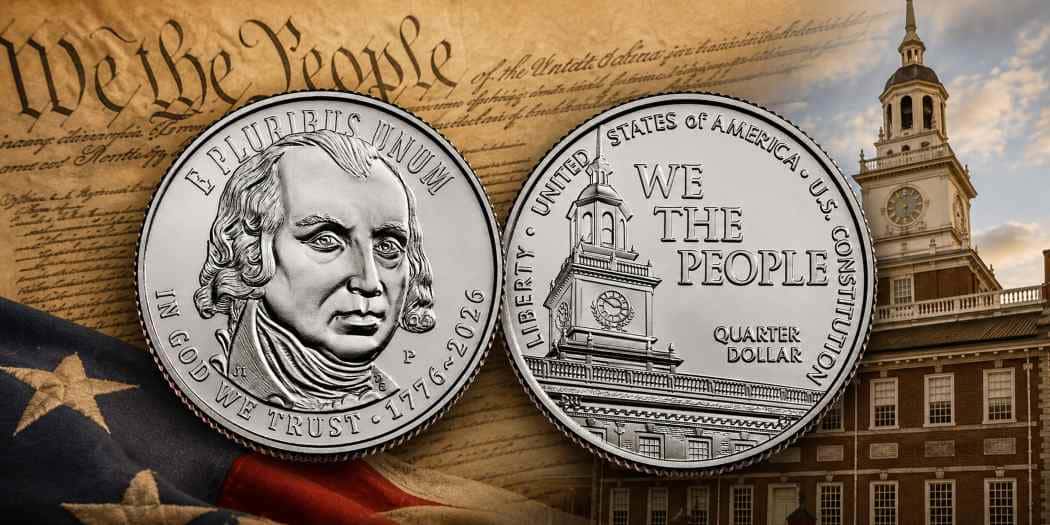
The Semiquincentennial Quarter Series Reaches the Constitution
The United States Mint's 2026 Semiquincentennial quarter program traces pivotal moments in American self-government. After the Mayflower Compact, Revolutionary War, and Declaration of Independence, the fourth design turns to the document that established the framework for the federal government: the U.S. Constitution Quarter.
The progression is fitting. Independence did not resolve how the new country would govern itself. The Constitution addressed that challenge by creating a federal system based on representative government, divided powers, and checks and balances. The quarter brings that history together through James Madison on the obverse and Independence Hall with the words 'WE THE PEOPLE' on the reverse.
From Independence to a New System of Government
Following the American Revolution, the Articles of Confederation left the national government with limited authority and exposed disagreements over taxation, commerce, representation, and the balance of power among the states.
Delegates gathered in Philadelphia in 1787 to address those weaknesses, ultimately producing an entirely new framework of government. The Constitution divided federal authority among legislative, executive, and judicial branches while establishing safeguards against unchecked power. Its opening words, 'We the People,' captured another fundamental principle: political authority would derive from the people. That concept provides the central theme of the 2026 U.S. Constitution Quarter.
James Madison Represents the Constitutional Convention
The obverse places James Madison, the nation's fourth president, at the center of the design, reflecting his important role in shaping and defending the Constitution.
Madison arrived at the Constitutional Convention with extensive preparation and a vision for a stronger national government. His ideas influenced the debates, while his notes became an invaluable historical record of the proceedings. He later joined Alexander Hamilton and John Jay in writing the Federalist Papers, advocating for ratification of the Constitution. These contributions earned Madison his familiar association as the 'Father of the Constitution.'
The obverse also carries 'E PLURIBUS UNUM,' 'IN GOD WE TRUST,' and the dual date '1776 ~ 2026,' connecting Madison's constitutional legacy to America's 250th anniversary.
Independence Hall Connects Two Founding Documents
The reverse centers on Independence Hall in Philadelphia, creating a strong connection between consecutive Semiquincentennial quarters. The preceding Declaration of Independence Quarter depicts the Liberty Bell; the Constitution Quarter expands the setting to the building associated with both founding documents.
Across the design appears 'WE THE PEOPLE,' emphasizing the principle that government derives its authority from the governed. Additional inscriptions include 'UNITED STATES OF AMERICA,' 'LIBERTY,' 'U.S. CONSTITUTION,' and 'QUARTER DOLLAR.'
Together, the Liberty Bell and Independence Hall connect two stages of America's founding story: declaring an independent nation and establishing the governmental structure under which it would operate.
A Five-Coin Story of American Self-Government
The five 2026 quarter designs commemorate the Mayflower Compact, Revolutionary War, Declaration of Independence, U.S. Constitution, and Gettysburg Address, creating a progression through the development and preservation of American representative government.
The Constitution Quarter occupies a pivotal place in that sequence. The earlier designs move from the idea of government by agreement through the struggle and declaration of independence. The Constitution then addresses what followed: how the new nation would govern itself. The final Gettysburg Address Quarter carries the narrative into the Civil War and the struggle to preserve those founding principles.
This interconnected approach gives collectors a reason to view the five quarters as chapters in a single historical narrative rather than unrelated anniversary designs.
Philadelphia and Denver Add to the Collecting Appeal
Circulating-quality U.S. Constitution quarters are produced at Philadelphia and Denver, with corresponding P and D mint marks. The standard quarter has a copper-nickel composition, weighs 5.670 grams, measures 24.26 millimeters in diameter, and features a reeded edge.
The two mint marks create additional possibilities for collectors. Some may seek one example of every design, while others will pursue complete Philadelphia and Denver sets or search rolls and bags for especially attractive examples and potential varieties.
Unlike a precious-metal commemorative whose intrinsic value responds directly to the silver price, these circulating quarters are primarily numismatic collectibles. Their appeal rests on design, condition, mint origin, historical significance, and their place within a distinctive one-year anniversary program.
Why the Constitution Quarter Stands Apart
The Constitution is an especially appropriate subject for America's 250th anniversary because its importance extends beyond a single historical event. It remains the foundation of the federal system, creating a direct connection between the founding era and American government today.
The design also benefits from visual continuity with the Declaration of Independence Quarter. Placed together, the Liberty Bell and Independence Hall reinforce the relationship between two documents that established an independent nation and then defined its governmental structure. James Madison and the 1776 ~ 2026 dual date add further historical context.
Those elements could broaden the coin's appeal beyond collectors pursuing the complete series, particularly among those interested in American history, presidential coinage, and the Constitution itself.
Anniversary Quarters and Modern U.S. Numismatics
Circulating coinage has marked major American anniversaries before. The 1976 Bicentennial Quarter, with its colonial drummer and 1776–1976 dual date, remains recognizable decades after the celebration.
The 2026 program expands that concept by using five quarters to tell a broader historical story. Anniversary status alone does not guarantee future numismatic value; condition, varieties, surviving populations, collector participation, and long-term demand all matter. The Constitution Quarter nevertheless begins with a clearly defined historical identity that separates it from ordinary circulating coinage.
'We the People' at 250 Years
The 2026 U.S. Constitution Quarter marks a crucial transition in the Semiquincentennial story. Independence had been declared and won, but the Constitution transformed it into a lasting framework for government. By pairing James Madison with Independence Hall and 'WE THE PEOPLE,' the design focuses not simply on a historic document but on the principle underlying it: government deriving its authority from its citizens.
For collectors pursuing the five-quarter program, the Constitution issue connects the nation's founding with the final Gettysburg Address design. For others, Madison, Independence Hall, the anniversary dual date, and one of America's most recognizable civic phrases give the coin enough historical significance to stand on its own.