View Charts

2026 Gettysburg Address Quarter: Design, History and Collecting
 0
Lincoln's Gettysburg Address Returns to American Coinage
The final quarter in America's 2026 Semiquincentennial series reaches beyond the nation's founding to examine whether its original ideals could survive a civil war. Featuring Abraham Lincoln and imagery inspired by his Gettysburg Address, the coin commemorates a moment when preserving the United States became inseparable from reconsidering the meaning of American freedom.
That choice gives the 2026 Gettysburg Address Quarter an unusual place in the anniversary program. The preceding designs commemorate the Mayflower Compact, Revolutionary War, Declaration of Independence, and U.S. Constitution. Gettysburg shifts the narrative to 1863, when the nation was fighting over the future of the Union and the institution of slavery.
The coin also offers a striking contrast with the earlier 2026 U.S. Constitution Quarter. Where that design emphasizes the creation of a national government, the Gettysburg issue examines the struggle to preserve it and fulfill the principles upon which it was founded.
Abraham Lincoln's Portrait Captures a Nation at War
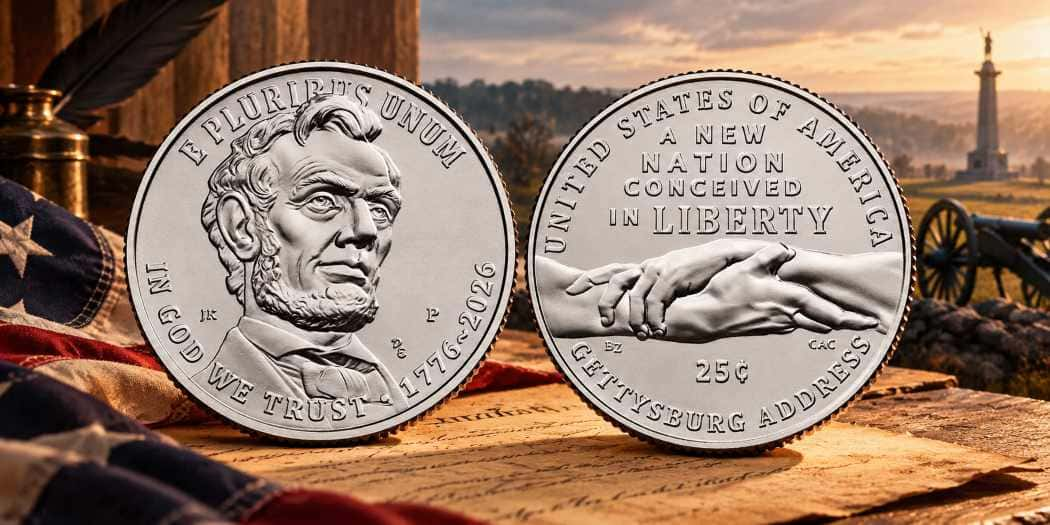
The obverse replaces the familiar George Washington portrait with Abraham Lincoln, the nation's 16th president. His expression is deliberately somber, reflecting the immense responsibility he carried during the Civil War. Rather than presenting a ceremonial likeness, the design emphasizes the physical and emotional burden of leadership during one of the country's most destructive conflicts.
Lincoln's face is rendered with pronounced lines and a steady gaze. The portrait suggests determination without disguising the toll of war, an approach that distinguishes it from more idealized presidential imagery. The design was created by Justin Kunz and sculpted by Don Everhart, according to the U.S. Mint's official Semiquincentennial design documentation.
The obverse inscriptions include E PLURIBUS UNUM, IN GOD WE TRUST, and the dual date 1776 ~ 2026. That date is particularly significant because Lincoln's speech took place decades after independence. Its presence connects the Civil War to the founding principles that Lincoln invoked when addressing the nation at Gettysburg.
The portrait also establishes a visual distinction within the five-quarter program. Each issue features imagery associated with its historical subject, giving collectors a series of changing obverses and reverses instead of the usual combination of a fixed presidential portrait and rotating commemorative designs.
Two Clasped Hands Carry the Reverse Design's Message
The reverse depicts two hands firmly clasped together, a symbolic representation of national unity. Above them appears the inscription A NEW NATION CONCEIVED IN LIBERTY, drawn from the opening of Lincoln's Gettysburg Address. Additional inscriptions identify the United States, the Gettysburg Address, and the coin's denomination of 25 cents.
Beth Zaiken designed the reverse, which was sculpted by Craig Campbell. Their composition relies on a simple human gesture rather than a battlefield monument, military figure, or architectural landmark. That decision directs attention toward the speech's larger message: the nation's survival depended on the principles for which its soldiers had fought.
The clasped hands can be understood as an appeal to reconciliation, although the historical circumstances were considerably more complicated. Lincoln delivered his address while the Civil War continued, and the country remained deeply divided over slavery and the future of the Union. The design's symbolism therefore represents an aspiration rather than an accomplished peace.
Its restraint is also notable. Instead of attempting to illustrate an entire historical event, the reverse uses a recognizable gesture and a carefully selected phrase to invite reflection. The words and imagery work together, making the quarter distinctive even among commemorative coins devoted to major episodes in American history.
Why the Gettysburg Address Became a Defining American Speech
The Battle of Gettysburg took place July 1–3, 1863, when Union forces defeated Confederate General Robert E. Lee's Army of Northern Virginia in Pennsylvania. The fighting resulted in approximately 51,000 casualties and marked a major turning point in the war. Months later, the battlefield became the setting for a ceremony dedicating a national cemetery for Union soldiers.
On November 19, 1863, Lincoln delivered the Gettysburg Address during that dedication. His remarks lasted only about two minutes, especially brief compared with the lengthy principal address delivered by Edward Everett. Yet Lincoln used those few moments to place the war within a much broader historical argument about the nation's founding and its future.
As the National Park Service explains in its Gettysburg history, Lincoln connected the Declaration of Independence's promise of equality with the Civil War's increasingly transformative purpose. His appeal for a new birth of freedom helped redefine the struggle as something more consequential than simply restoring the political Union.
The quarter selects a phrase from the speech's opening rather than its more familiar closing declaration about government by the people. That choice emphasizes the relationship between 1776 and 1863, encouraging viewers to consider how the nation's founding commitments were tested during the Civil War.
How the 2026 Gettysburg Quarter Differs From the 2011 Coin
Gettysburg has appeared on a modern circulating U.S. quarter before, but the earlier coin commemorated a different subject. The 2011 Gettysburg National Military Park Quarter belonged to the America the Beautiful Quarters Program, which highlighted national parks and other nationally significant sites.
Its reverse depicts the 72nd Pennsylvania Infantry Monument at Cemetery Ridge, a landmark associated with the Union defense during Pickett's Charge. The obverse features George Washington. Collectors can examine the earlier issue through PCGS CoinFacts' 2011 Gettysburg Quarter reference, which documents its design and characteristics.
The 2026 quarter takes a more interpretive approach. Lincoln replaces Washington, and the reverse turns away from a specific battlefield monument toward the political and moral significance of the Gettysburg Address. The two coins consequently complement each other without telling the same story.
For a themed collection, that distinction creates an interesting opportunity. Displaying both issues together would illustrate how American commemorative coinage can approach one historic location from different perspectives: one through the preservation of the battlefield and the other through the ideas articulated there.
What Collectors Should Examine on the New Quarter
The standard circulating-quality Gettysburg Address Quarter uses the familiar copper-nickel clad composition of modern U.S. quarters. It weighs 5.670 grams, measures 24.26 millimeters in diameter, and has a reeded edge. Its collector interest comes primarily from its design, condition, mint origin, and anniversary significance rather than precious-metal content.
Philadelphia and Denver versions provide separate collecting opportunities through their respective mintmarks. Collectors assembling the complete 2026 Semiquincentennial quarter series may seek examples from both facilities, while others may concentrate on attractive individual specimens with sharp design details and minimal surface marks.
Lincoln's portrait presents several useful areas for visual inspection. Contact marks across the face, weakness in the hair or facial details, and distracting abrasions can affect a coin's appearance. On the reverse, the clasped hands and surrounding inscriptions provide additional surfaces where striking quality and handling marks may be evaluated.
Collectors should also distinguish ordinary production characteristics from genuine mint errors. Minor differences in appearance do not automatically indicate a valuable variety, and unusually marked coins may require expert examination. The broader 2026 U.S. Mint Semiquincentennial Proof Set offers further context for the anniversary designs and the different ways collectors approach the program.
Although historical significance can stimulate interest, it does not establish future rarity. Actual production totals, surviving condition populations, collector participation, and the discovery of legitimate varieties will influence how individual examples are evaluated over time.
A Quarter That Completes an Unfinished Historical Story
The Gettysburg Address Quarter gives the Semiquincentennial program an ending that reaches beyond the Revolutionary era. The sequence begins with early ideas about self-government, moves through independence and constitutional development, and concludes with a conflict that forced Americans to confront the meaning of those principles.
Lincoln's words remain central because the questions he raised were never confined to the battlefield. The relationship between liberty, equality, national unity, and democratic government continued to shape American history long after the Civil War.
For collectors, the U.S. Mint coin offers more than the final position in a five-piece anniversary set. Its portrait, symbolism, and historical connections create opportunities for collections organized around Lincoln, the Civil War, presidential coinage, or American political history. As with the 1976 Bicentennial Quarter, the lasting appeal of the design may ultimately depend as much on the history it represents as on its place within a particular year's coinage.