View Charts
How High Can Silver Go After $60? Could It Reach $200 in 2026?
 0
0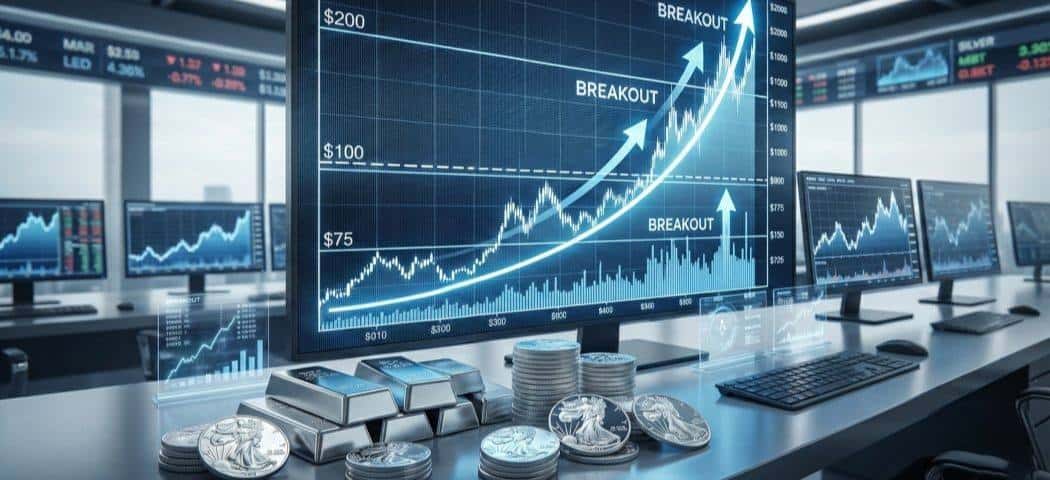
Silver Surges Over 105% in 2025 — A New Bull Market Era Begins
Silver’s explosive breakout above $60 per ounce has officially redefined the precious-metals landscape. After starting the year near $29/oz, the silver spot price has surged more than 105% year-to-date, marking one of the strongest annual performances in modern history. This dramatic rise has forced analysts to ask urgent new questions: Is silver heading toward $75? Could it hit $100? And under the right conditions, is $200 silver in 2026 actually possible?
What once sounded like unrealistic speculation has now become part of serious market debate. Tightening supply, accelerating industrial demand, rising inflation pressures, and shifting Federal Reserve policy have all contributed to silver’s powerful upward momentum. As investors reassess long-term strategy, the conversation has expanded beyond silver itself—toward the broader question of how a historic silver rally might impact gold, platinum, and palladium heading into 2026.
This analysis explores silver’s next potential resistance levels, the macroeconomic forces shaping its trajectory, and what investors should consider now that silver has entered a new era of price discovery.
What Are the Next Price Targets for Silver?
Silver’s breakout into the $60 range has opened the door to higher levels that once seemed distant. Here is where analysts are focusing next:
Next Technical Resistance: $75
A move to $75 would represent:
-
A continuation of current trend momentum
-
Another psychological and technical milestone
-
A reinforcement of silver’s emerging supercycle pattern
If silver consolidates between $60 and $70 without a major retracement, a test of $75 becomes highly probable.
Major Round-Number Target: $100
This level is generating the most investor attention.
Silver reaching $100 per ounce would reflect:
-
A persistent global supply deficit
-
Strong industrial demand from solar, EV, and semiconductor sectors
-
Rising investment flows into physical and ETF markets
-
A potential shift in monetary policy toward rate cuts
From a technical perspective, the $100 zone represents a macro breakout level that could reshape silver’s long-term trajectory.
Could Silver Reach $200 an Ounce in 2026?
While ambitious, the idea is no longer far-fetched. For the silver price to reach $200 per ounce, several powerful forces would need to converge:
1. A Deepening and Sustained Global Silver Supply Deficit
The world has already been drawing down above-ground supplies for years. A structural deficit—where demand outpaces supply by hundreds of millions of ounces—would create extreme upward pressure.
2. Explosive Growth in Clean Energy Demand
Silver is essential for:
-
Solar PV cells
-
Automotive electronics
-
Electric vehicle battery systems
-
5G infrastructure and advanced semiconductors
If global adoption accelerates faster than mine supply, industrial users could drive silver prices to unprecedented levels.
3. A Dovish or Accommodative Federal Reserve
Lower real interest rates and persistent inflation would create ideal conditions for silver to enter a parabolic phase.
4. Strong Investment Demand for Physical Silver
Silver bars, sovereign coins, and ETFs would need to see sustained inflows. Investor psychology matters—once silver breaks a major resistance level, momentum can create self-reinforcing demand.
Is $200 Silver Realistic?
Yes—if the above macro, industrial, and monetary forces align. While not guaranteed, the probability is significantly higher today than it was even a year ago.
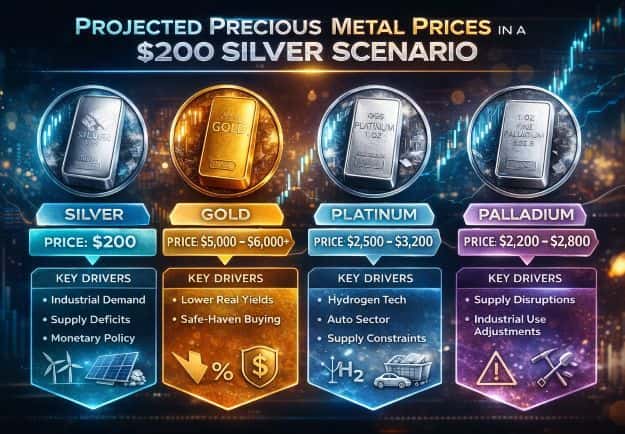
If Silver Hits $200, What Happens to Gold, Platinum, and Palladium?
Silver almost never rallies in isolation. If silver were to reach $200, it would signal a broader revaluation of precious metals, likely fueled by inflation, monetary policy shifts, supply shortages, or geopolitical instability.
Gold Price Projection in a $200 Silver Scenario
If silver reaches $200, the gold-to-silver ratio could compress toward 20:1–28:1, levels seen during past silver supercycles.
This implies:
➡ Gold likely trading between $5,000 and $6,000 per ounce
➡ In more extreme conditions, the price of gold could exceed $7,000
Platinum Price Projection
Platinum would likely benefit from:
-
Fuel cell expansion
-
Automotive-sector transformation
-
Supply limitations in South Africa
➡ $2,500–$3,200 per ounce is a projected range.
Palladium Price Projection
Despite long-term EV disruption to catalytic converter demand, a broad metals supercycle would still support palladium strength.
➡ Projected range: $2,200–$2,800 per ounce
Together, these movements reflect a synchronized metals rally led by silver and powered by global macro forces.
Is Silver Leading the 2026 Precious Metals Rally?
Increasingly, the answer appears to be yes.
Silver’s performance is outpacing gold, platinum, and palladium on a percentage basis—a hallmark of early-stage precious-metals bull cycles. Several trends support silver’s growing leadership role:
-
Industrial consumption is rising faster than new supply
-
Investment demand is strengthening
-
Mining development cycles remain slow
-
Inflation concerns are persistent
-
The Federal Reserve is signaling a shift toward policy easing
Silver is no longer trailing gold; instead, it appears to be leading the entire precious-metals complex into a new price regime, driven by structural forces that favor sustained long-term growth.
If this pattern holds, the rally could continue well into 2026.
Market Indicators Supporting Higher Silver Prices
Data suggests that silver’s upward momentum is backed by powerful structural forces:
-
Global silver deficit now exceeds ~140 million ounces
Silver Institute reported a 184 Moz deficit in 2022 and ~140 Moz in 2023–2024; deficits remain historically large. -
Solar panel demand set to rise 15–20% by 2026
PV demand continues to be the fastest-growing segment of silver consumption. -
ETFs report largest inflows since 2020
2020 was the last major silver “surge year,” when ETF inflows spiked during the pandemic metals run. -
Wholesale silver inventories at multi-year lows
COMEX + LBMA inventories continue trending downward year-over-year. -
Retail bullion premiums increasing across global markets
Indicates tightening supply and elevated buyer demand.
These metrics confirm that silver’s rally is not driven solely by speculation — it is supported by real, measurable pressure across global supply, industrial demand, and investor behavior.
What Should Investors Do Now?
1. Focus on Strategy, Not Emotion
Avoid buying during panic spikes. Consider scaling in at planned intervals.
2. Prioritize Physical Silver
Many investors are turning to:
-
1 oz silver bars
-
10 oz and 100 oz silver bars
-
Canadian Silver Maple Leafs
-
Pre-1965 90% silver coins
Physical silver offers direct ownership without counterparty risk.
3. Watch the Federal Reserve Closely
Rate decisions and inflation signals will heavily influence silver’s trajectory.
4. Use Market Pullbacks to Accumulate
Pullbacks are normal in bull markets—and they often present the best long-term entry points.
A New Era for Silver May Already Be Underway
Silver’s move above $60 marks the beginning of a new price discovery era—one driven by powerful structural forces rather than short-term speculation. Whether silver’s next stop is $75, $100, or something far more dramatic like $200, the metal is clearly leading a broader reawakening in precious metals.
As the global economy moves toward electrification, renewable energy, and a complex inflationary environment, silver’s dual role as both an industrial metal and a store of value makes it one of the most compelling assets heading into 2026.
Bullion Exchanges proudly offers a wide selection of silver coins, bars, rounds, and investment-grade bullion to help investors navigate this historic market shift with confidence.
Related reading you may find interesting:
Could Gold Reach $10,000? The Hyperinflation Breakout Scenario for 2026
Silver Surges Toward $62: What’s Driving the Breakout?