View Charts
Could Gold Reach $10,000? The Hyperinflation Breakout Scenario for 2026
 2
2
Gold’s Market Momentum: Why Extreme Price Targets Are Entering the Conversation
Gold has entered a powerful new phase as global markets shift, currencies weaken, and investors turn increasingly toward safe-haven assets. With silver more than doubling year-to-date — rising from roughly $29 to over $60, a 105% gain — many investors are now asking a larger question: What happens if gold follows the same explosive trajectory?
Gold has already broken multiple resistance zones, but growing macroeconomic pressure is pushing some analysts to explore a once-unthinkable scenario:
Could gold reach $10,000 per ounce in 2026?
While this gold price target is undeniably bold, the underlying economic conditions that might support such a move are far closer to reality than most investors realize.
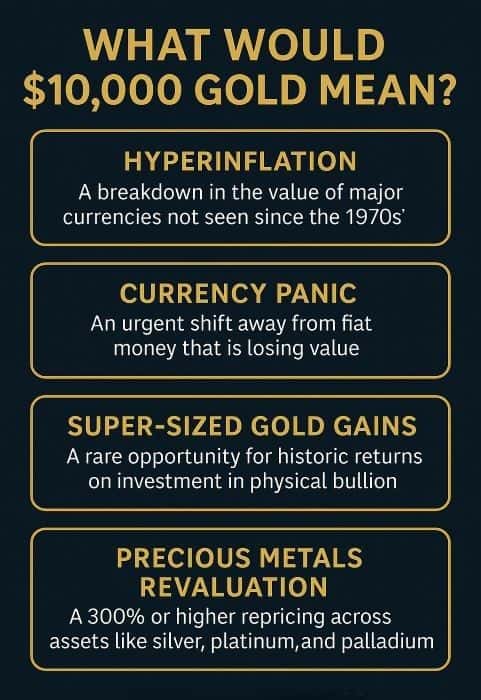
Why a $10,000 Gold Price Is No Longer a Fringe Projection
Gold’s recent performance reflects deeper structural forces that are reshaping global finance. A confluence of inflation, monetary policy shifts, geopolitical tension, and central bank behavior is pushing gold into a new era of price discovery.
Below are the five most important catalysts that could drive gold toward the $10,000 level.
1. A Severe Decline in Global Currency Purchasing Power
How Currency Erosion Could Reprice Gold Overnight
For gold to reach $10,000, fiat currencies — especially the U.S. dollar — would need to weaken significantly. This scenario does not require hyperinflation but rather a prolonged period of:
-
High inflation
-
Declining real wages
-
Lower real interest rates
-
Expansive fiscal policy
-
Persistent deficit spending
As currency purchasing power declines, gold — which cannot be printed — rises in nominal value.
Historical precedent:
During the 1970s inflationary era, gold surged more than 2,000% in under a decade.
2. Massive Central Bank Demand for Physical Gold
The Quiet Force Driving Gold Higher
Global central banks are now buying more gold than at any point in modern history. Recent years have shown:
-
Record-breaking annual gold acquisitions
-
Strategic diversification away from the U.S. dollar
-
Accumulation by emerging-market central banks
-
A growing preference for tangible reserves over debt instruments
If central banks accelerate this trend, gold’s supply could tighten dramatically — fueling a price surge well beyond traditional forecasts.
3. A Systemic Financial Shock or Sovereign Debt Crisis
Why Gold Historically Spikes During Monetary Stress
A major financial disruption could be the catalyst that turns gold’s steady upward trend into a vertical breakout.
Potential triggers include:
-
A sovereign debt default
-
Banking-system instability
-
Rapid de-dollarization
-
Breakdown in the bond market
-
Prolonged liquidity shocks
In times of financial uncertainty, gold becomes the anchor asset. Panic-driven buying can send gold sharply higher in a compressed timeframe.
4. A Gold-to-Silver Ratio Collapse in a Metals Supercycle
How Silver’s Rise Could Drag Gold Dramatically Higher
The gold-to-silver ratio historically narrows during extreme precious-metals bull markets.
-
Normal range: 60:1–80:1
-
Bull-market range: 30:1–40:1
-
Extreme shocks: 16:1–20:1
If silver rises to $200, ratio compression would imply:
-
25:1 → $5,000 gold
-
20:1 → $4,000 gold
-
16:1 → $3,200 gold
If silver enters the $300–$400 range (possible in a supply-deficit crisis), gold’s price could be mathematically pushed toward $7,000–$10,000.
5. A Global Monetary Reset or New Reserve Framework
The Most Extreme — But Increasingly Discussed — Scenario
A global realignment of currencies could require gold to be revalued significantly higher, especially if:
-
Reserve currencies shift toward commodity backing
-
International settlements diversify into multi-asset baskets
-
Central banks need stronger balance sheets to support their reserves
Under these scenarios, a gold price of $8,000–$12,000 becomes feasible as part of a formal revaluation rather than a speculative rally.
What Would Gold at $10,000 Mean for Other Precious Metals?
Silver’s Trajectory in a Hyper-Bull Environment
If gold reaches $10,000, silver prices would likely trade between:
-
$300 and $600 per ounce
This assumes normal ratio compression. In extreme metal shortages, silver could exceed even these levels.
Platinum’s Potential Breakout
A gold price shock could push platinum to:
-
$3,000–$4,000 per ounce
Driven by supply constraints and rising industrial use.
Palladium’s Upside
Despite EV headwinds, palladium could reapproach:
-
$3,000–$3,500 per ounce
As investment flows lift the entire metals complex.
Is $10,000 Gold Possible in 2026? A Realistic Assessment
Is it guaranteed?
No.
Is it possible?
Yes — and growing more plausible.
Gold could reach $10,000 if:
-
Inflation persists or accelerates
-
Real interest rates turn negative
-
Silver enters a hyper-bull phase
-
The Federal Reserve shifts toward easing
-
Central banks increase gold accumulation
-
Geopolitical or financial shocks weaken currency confidence
The probability rises dramatically if gold breaks above $3,500, then $5,000, and silver surges toward $200.
What Should Investors Do Now?
1. Focus on Accumulation, Not Timing
Trying to predict the exact top is less important than building a strong long-term position.
2. Hold Physical Gold
Bars, coins, and IRA-eligible bullion protect wealth without counterparty risk.
3. Maintain Precious-Metals Diversification
Silver offers torque.
Gold offers stability.
Platinum and palladium add optionality.
4. Monitor Central Bank and Federal Reserve Signals
Policy shifts will likely determine the pace of any breakout.
The $10,000 Gold Question Is More Than a Thought Experiment
Gold reaching $10,000 is not a fantasy — it is a scenario rooted in real economic dynamics. Whether or not it happens by 2026, the forces driving this projection are shaping the future of global finance right now.
For investors, the question isn’t just “Could gold reach $10,000?” but rather:
“Am I prepared if it does?”
Bullion Exchanges offers a world-class selection of gold bars, coins, and IRA-eligible products to help investors position themselves wisely in this rapidly changing environment.
Related reading you may find interesting:
How High Can Silver Go After $60? Could It Reach $200 in 2026?
Could Platinum Hit $5,000? The Most Undervalued Metal of 2026
If Bitcoin Hit $250K, What Would It Mean for Precious Metals?
2 Comments