View Charts
The Saint-Gaudens Set Closes a Historic U.S. Mint Series
 0
0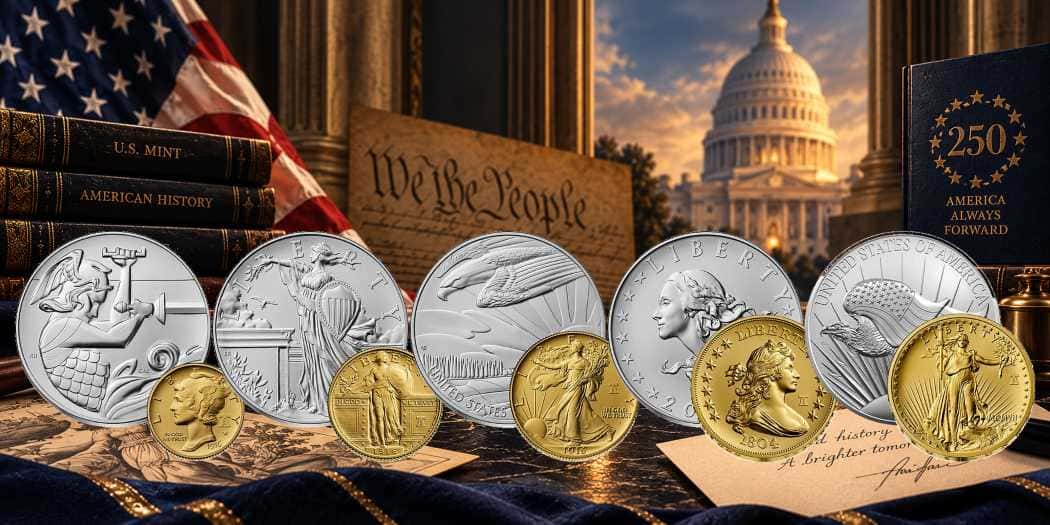
The Finale Reveals What Best of the Mint Was Really About
On September 24, the U.S. Mint will release the fifth and final Best of the Mint set, pairing a one-ounce, 24-karat gold reissue of the 1907 Saint-Gaudens High Relief $20 coin with a one-ounce silver companion medal. The finale itself is familiar territory: the Saint-Gaudens release has been known for months, and its famous design, Theodore Roosevelt connection, and High Relief production story have already received considerable attention. What is newly worth examining is the completed five-release series around it—and a collecting wrinkle the Mint has only recently publicized.
In its September Coins Online feature, the Mint disclosed that 250 handwritten notes from U.S. Mint Director Paul Hollis are randomly added to the inventory of each Best of the Mint product during fulfillment. They cannot be obtained separately. That surprise turns a retrospective on American coinage into something more contemporary: a program that not only revives historic designs, but also experiments with how collectors encounter modern Mint products.
Five Coins Chosen From More Than Two Centuries of U.S. Coinage
Best of the Mint did not begin as a predetermined group of five classics. For the Semiquincentennial, the Mint curated 21 historic coins spanning its history from 1792 into the 21st century. Public input and expert recommendations narrowed the field to the 1916 Mercury Dime, 1916 Standing Liberty Quarter Dollar, 1916 Walking Liberty Half Dollar, 1804 Silver Dollar, and 1907 Saint-Gaudens High Relief $20 Gold Coin.
The resulting lineup is revealing. Three designs come from 1916, an extraordinary period for American coin artistry. The 1804 dollar contributes a different form of numismatic significance: rarity, diplomatic history, and one of the most unusual origin stories in U.S. coinage. Saint-Gaudens then takes the series back to the artistic ambitions that helped transform American gold coins under President Theodore Roosevelt.
Rather than functioning as a chronological survey, the five selections form a curated argument about what makes a coin endure. Each represents a moment when design, history, scarcity, or cultural reputation made a coin larger than its denomination. That allowed the Mint to celebrate its archive without simply assembling a sequence of reproductions.
Historic Gold Coins Meet Modern Silver Interpretations
The most distinctive feature of Best of the Mint may be its two-part structure. Every set pairs a 99.99% fine gold reissue with a one-ounce, 99.9% fine silver medal inspired by its historic companion. The gold pieces preserve recognizable designs while adding the Semiquincentennial Liberty Bell “250” privy mark. The medals have considerably more artistic freedom.
That difference becomes clear across the three 1916 releases. The Mercury Dime companion medal expands the original coin’s symbolism into the turbulent 1916–1945 period, incorporating references to war, the Great Depression, and Dust Bowl. The Standing Liberty medal rearranges Liberty, her shield, olive branches, and eagle into a new visual exchange between the two sides. The Walking Liberty medal reinterprets Adolph A. Weinman’s imagery as a continuous, Art Deco-influenced scene extending across obverse and reverse.
The result is neither a conventional commemorative series nor a collection of replicas. The historic coin provides the anchor; the medal gives a contemporary artist room to respond to its legacy. Best of the Mint consequently operates almost like a miniature exhibition, placing an archival design beside a modern interpretation.
The Series Grew From Fractional Gold to Full-Ounce Releases
There is also a deliberate physical progression. The Mercury Dime contains one-tenth troy ounce of gold, the Standing Liberty Quarter one-quarter ounce, and the Walking Liberty Half Dollar one-half ounce. Each has a 30,000 mintage limit. The fourth release makes a substantial jump: the 1804 Silver Dollar is re-created in one full troy ounce of 24-karat gold and carries a 15,000 mintage limit.
The Saint-Gaudens finale continues that full-ounce format and 15,000 mintage limit. Its gold coin is struck at West Point and its silver medal at Philadelphia, with the Mint currently imposing a household order limit of one for the September 24 launch. The gold issue retains distinctive elements of the High Relief design, including the Roman-numeral “MCMVII” date and “E PLURIBUS UNUM” edge inscription, while adding the anniversary privy.
For anyone assembling all five releases, that progression matters. Completing Best of the Mint is not simply collecting five similarly configured sets; it moves from fractional gold through half an ounce before reaching two consecutive one-ounce gold issues.
Saint-Gaudens Brings the Series Back to Coinage as Art
The 1907 High Relief double eagle is an unusually logical finale because its history revolves around a question that also runs through Best of the Mint: how ambitious can American coinage be? Roosevelt wanted the nation’s coins to reach a higher artistic standard and enlisted Augustus Saint-Gaudens in that effort. The resulting High Relief double eagle became the celebrated expression of that campaign, although its ambitious relief created significant production difficulties. The Mint’s September feature specifically revisits Roosevelt’s early-20th-century effort to improve the artistic quality of U.S. coinage.
The 2026 pairing carries the idea forward rather than simply repeating it. On the gold coin, Liberty advances with torch and olive branch while the Capitol and sunrays occupy the background; the reverse retains the eagle flying above the rising Sun. The silver medal departs from direct reproduction. Its obverse presents Liberty anew among 13 stars, while the reverse transforms the eagle’s wings into an American-flag motif above the sun.
Ending with Saint-Gaudens therefore does more than save one of America’s most celebrated coins for last. It closes a series devoted to historic design with a coin originally born from an attempt to rethink what federal coinage could be.
Director Hollis Notes Turn Fulfillment Into Part of the Hunt
The newly publicized handwritten notes introduce a kind of scarcity that is not struck into a coin at all. According to the Mint, 250 notes from Director Paul Hollis are randomly placed into the inventory of each Best of the Mint product during fulfillment, and the notes are unavailable outside delivery of those products. Across a five-release program, the mechanism makes chance part of the collecting experience rather than offering the special item as something buyers can order independently.
A Director note does not alter a coin’s mintage, grade, or variety. Its potential collector interest instead comes from provenance, limited distribution, randomness, and direct association with the Semiquincentennial program. How the secondary market ultimately treats those notes will be determined by collectors rather than by the Mint.
Still, the mechanism fits a broader pattern visible across 2026 coinage. Privy marks, limited quantities, unusual product pairings, and special distribution methods increasingly make discovery part of the experience. The handwritten notes push that idea outside the coin itself: two customers can order the same Mint product, yet one package may contain an unexpected artifact of the program.
Best of the Mint Leaves a Model the Mint Could Revisit
Once the Saint-Gaudens set goes on sale Thursday, the five-part Best of the Mint experiment will be complete. Its more interesting legacy, however, may be the format it tested. Historic designs were not treated merely as images to reproduce. The gold coins preserve them in a new precious-metal and anniversary context, while the companion medals give contemporary artists space to interpret what those designs represent.
Nothing announced by the Mint establishes that this format will continue after 2026. Yet Best of the Mint demonstrates how the institution’s archive can function as creative source material rather than simply a catalog of past issues. Future programs could take a completely different direction, but collectors have now seen one method for revisiting classic U.S. coinage without pretending the originals can simply be recreated.
That makes Saint-Gaudens an especially appropriate last word. The original High Relief double eagle emerged from dissatisfaction with ordinary coinage. More than a century later, Best of the Mint has used that legacy to pose a related question: whether looking backward can itself become a form of numismatic experimentation.
Images sourced from: U.S. Mint
Related reading you may find interesting:
Supergirl Joins the U.S. Mint Comic Art Coin Series
The Most Anticipated Bullion Coin Releases of 2027