View Charts
Is 2026 the Start of a New Era for U.S. Mint Coin Collecting?
 0
0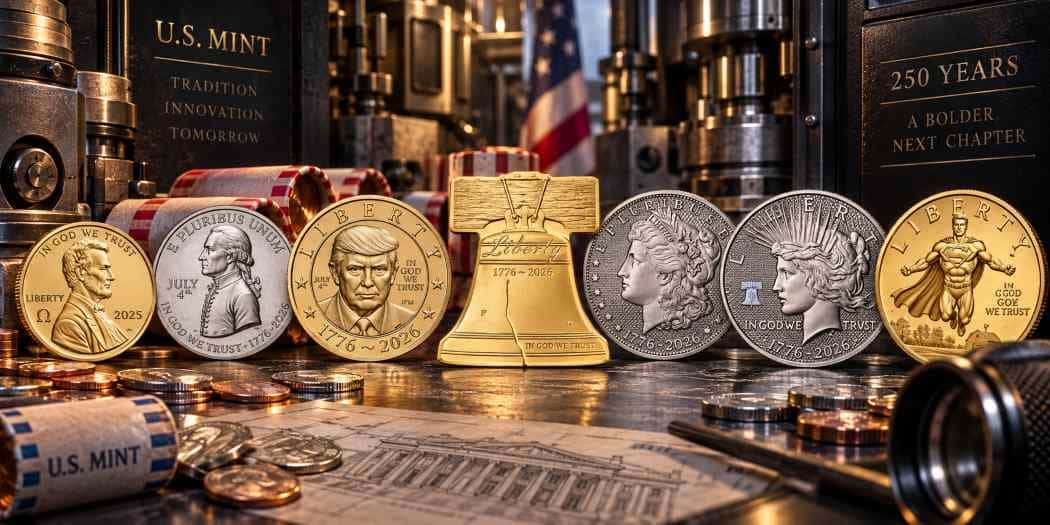
From the Omega Penny to a Very Different U.S. Mint
Something unusual has been happening at the U.S. Mint. The change became difficult to miss in November 2025, when production of circulating pennies ended after 232 years. Rather than allowing the final cents to disappear quietly into history, the Mint turned the occasion into a numismatic event.
The final circulating pennies were included in 232 specially assembled three-coin sets containing the last Philadelphia and Denver cents and, for the first time, a 24-karat gold cent. Each carried an Omega privy mark symbolizing the end of circulating penny production. The sets were sequentially numbered and offered through a public auction in December 2025 rather than through the Mint’s conventional catalog.
That could have remained an unusual farewell to a historic denomination. Instead, it now looks like an early example of a broader shift. Throughout 2026, the Mint has experimented with shaped coins, surprise privy marks, randomized rarities, new finishes, pop-culture subjects, historic designs struck in unexpected metals and formats, and one of the most unconventional presidential coins in U.S. history.
America’s 250th anniversary provides the occasion. The more interesting question is whether it has also given the Mint a new playbook.
Privy Marks Have Turned Collecting Into a Treasure Hunt
Perhaps the clearest change is how scarcity is being distributed. In June, the Mint announced that only 250,000 2026 Declaration of Independence quarters would carry a special “July 4” privy mark. Instead of packaging them as a premium collector product, the Mint randomly mixed the quarters into bulk bags before sending them through the Federal Reserve system.
The Mint also created an even rarer version of the concept on July 4, striking just 250 oversized 2.5 oz silver Declaration of Independence quarters at Philadelphia. Each carries the same special “July 4” privy, has no mint mark, and is individually edge-numbered from 1 through 250. Rather than offering them through its regular catalog, the Mint plans to send the entire limited edition to auction at a date still to be announced—a distribution strategy reminiscent of the 232 Omega Penny sets auctioned in 2025.
Suddenly, an ordinary bank roll or handful of change could contain a deliberately scarce U.S. Mint variety. The Mint later described the response as a nationwide treasure hunt, noting that the program was attracting people who had not previously searched coins. That is a different kind of engagement from announcing a limited product and opening online sales at noon. Scarcity became something collectors had to discover.
The concept did not end with the quarter. In September, the Mint shipped 250,000 West Point-struck Enduring Liberty Half Dollars carrying an “09-11-01 Always Remember” privy into random circulation. The coins commemorate the victims of the September 11, 2001, and February 26, 1993, terrorist attacks. By repeating randomized distribution on another denomination, the Mint has begun turning the hunt itself into part of the collecting experience.
The Trump Dollar Pushes the Experiment Further
The 2026 Semiquincentennial President Donald J. Trump $1 Coin occupies different territory. Its obverse depicts a sitting president, making the issue historically unusual and prompting discussion over the laws governing presidential portraits on U.S. coinage. The Mint states that the dollar is authorized under 31 U.S.C. §5112(y)(1)(C) and the Circulating Collectible Coin Redesign Act of 2020, which permit a new $1 coin for one year beginning in 2026 for the Semiquincentennial.
The collecting strategy is equally notable. The Mint struck 250,000 Trump dollars at Philadelphia on July 4 with a special “July 4th” privy, then randomly inserted them into the rolls and bags sold to collectors. Rather than knowing exactly what they purchased, buyers have an opportunity to discover the scarcer variety when opening a product. Bullion Exchanges previously examined the unusual release in our coverage of the 250,000 July 4th privy Trump dollars.
The program will move into precious metals on November 5, when the Mint currently plans to release a one-ounce .9999 fine 24K Trump Gold Proof Coin with a $250 denomination. Whatever collectors ultimately make of the program, its combination of a sitting president, randomized privy variety and one-ounce gold counterpart demonstrates how far the Mint is willing to move beyond a conventional annual release.
Even the Physical Form of U.S. Coins Is Changing
Experimentation in 2026 extends beyond subjects and distribution. The Freedom Ringing program released in July literally changed the shape of a modern U.S. coin.
Its Liberty Bell-shaped one-ounce and half-ounce gold coins and half-ounce silver medal were produced at Philadelphia, with only 2,026 of each product authorized. The Mint describes the gold pieces as its first non-round coins in more than a century, following the 1915 Panama-Pacific Exposition $50 gold coin. The pieces were handloaded and pressed in the Philadelphia Mint’s Research and Development Lab, reflecting the technical challenges behind the unusual form.
As explored in our earlier look at the Freedom Ringing Liberty Bell series, the innovation is immediately visible: instead of placing the Liberty Bell inside a conventional circular canvas, the Mint made the coin itself resemble the bell.
Another physical experiment arrives November 12. The 2026 Morgan and Peace Dollar Diamond Field Two-Coin Set introduces repeating diamond-patterned fields behind two of America’s most familiar silver dollar designs. The coins retain the familiar Morgan and Peace imagery, including the 2026 Liberty Bell “250” privy, while using their backgrounds as an active visual element rather than a conventional open field. The set is limited to 160,000 and represents another attempt to give established designs a presentation collectors have not previously seen from the Mint. The Liberty Bell privy is a confirmed feature of the 2026 Morgan and Peace Dollar program.
Familiar Designs Are Being Reworked for New Collectors
The Mint is also looking backward in order to make something new. Its Best of the Mint program selected five historic designs—the Mercury Dime, Standing Liberty Quarter, Walking Liberty Half Dollar, 1804 Dollar and 1907 Saint-Gaudens High Relief $20—and reissued them as 24-karat gold coins paired with newly designed silver companion medals.
Another feature tying many of these releases together is the Liberty Bell “250” privy mark, which has become a recurring visual signature of the Semiquincentennial program. It appears across the 2026 American Eagle and American Buffalo coins, Morgan and Peace Dollars, American Innovation $1 coins, and the five Best of the Mint gold coins, often alongside the dual date “1776 ~ 2026.” Unlike the scarce July 4 or “09-11-01 Always Remember” privies designed around particular varieties, the Liberty Bell mark serves as a common anniversary identifier across multiple established U.S. Mint series. The Mint’s Semiquincentennial resources specifically confirm its use across these programs.
The concept preserves recognizable American numismatic artwork while changing metal, size, or presentation. A similar approach can be seen in the scheduled 1/10 oz Anniversary Gold Buffalo, which revisits a fractional format that has appeared only once before in the series. In 2008, the U.S. Mint issued fractional Gold Buffalo coins in 1/2 oz, 1/4 oz, and 1/10 oz sizes alongside the standard one-ounce coin. The fractional versions were discontinued after that single year, making the planned 2026 1/10 oz anniversary issue the first return of a fractional Gold Buffalo in 18 years.
Even the Mint’s audience is broadening. The Comic Art Coin and Medal Program, which began with Superman in 2025 and continues with additional DC characters, places officially licensed popular culture on Mint-produced gold coins and silver medals. Someone drawn to Superman may arrive through comic collecting rather than numismatics, but the product still introduces that buyer to mintages, finishes, precious metals and coin production.
Is 2026 an Anniversary Exception or a New Direction?
No single product proves that the U.S. Mint has permanently changed. The Semiquincentennial provides an extraordinary historical backdrop and specific legal authority for one-year designs and special products, making 2026 unusually suited to experimentation.
What stands out is the number of experiments occurring at once. The Omega Penny turned the end of circulating cent production into an auction event. The Mint returned to that auction model with 250 individually numbered 2.5 oz silver quarters, while July 4 privies placed another form of rarity directly into collectors’ hands. July 4 privies made rarity something to hunt for, while the recurring Liberty Bell “250” privy gave established series a shared anniversary identity. The Trump dollar combined an unusual presidential portrait with randomized collector varieties and an upcoming gold issue. Liberty Bell coins changed the physical shape of U.S. coinage, while Diamond Field Morgan and Peace Dollars changed the visual character of familiar designs. Best of the Mint reinterpreted historic classics, and Comic Art opened another door into the hobby.
The lasting test will come after the anniversary. If future Mint programs return almost entirely to predictable annual formats, 2025–2026 may be remembered as an exceptional period created by two historic milestones: the end of the circulating penny and America’s 250th anniversary. If treasure hunts, unusual finishes, new formats, crossover subjects and more inventive distribution continue, these two years may instead mark the beginning of a different era.
Either way, the Mint has demonstrated something important: modern coin collecting does not have to rely only on another low mintage or another familiar Proof. Discovery, design, history, technology and even the way a coin reaches the collector can become part of the experience.
Images sourced from: U.S. Mint
Related reading you may find interesting:
The Saint-Gaudens Set Closes a Historic U.S. Mint Series