View Charts
Freedom Ringing: U.S. Mint Breaks Tradition With the Liberty Bell Series
 0
0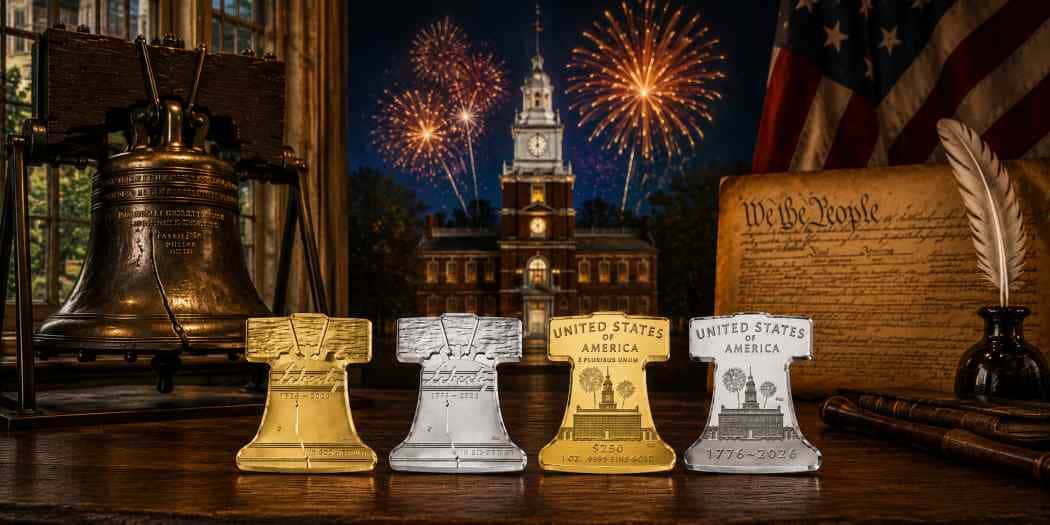
Sometimes a Coin's Shape Tells the Story Before Its Design
For more than two centuries, American coinage has shared one characteristic so familiar that most people rarely stop to consider it. Whether struck in copper, silver, gold, or modern clad alloys, nearly every United States coin has been round. The circular form has become so closely associated with money that it feels almost inseparable from the idea of coinage itself.
That tradition changes in 2026.
To commemorate the 250th anniversary of American independence, the United States Mint has introduced one of the most technically ambitious collector programs in its modern history. The Freedom Ringing – Liberty Bell series abandons the conventional round format in favor of a shape instantly recognizable to generations of Americans. Rather than adapting the Liberty Bell to fit a circular coin, the Mint reshaped the coin itself to faithfully capture one of the nation's most enduring symbols.
The result is more than an anniversary collectible. It is a demonstration of modern minting technology, artistic engineering, and historical symbolism brought together in a way that few recent U.S. Mint products have attempted. Produced in extremely limited quantities, the series consists of a one-ounce .9999 fine gold coin, a one-half ounce .9999 fine gold coin, and a one-half ounce .999 fine silver medal. Each carries its own mintage limit of just 2,026 pieces, immediately placing the collection among the most exclusive releases of the Semiquincentennial program.
Yet the story begins long before these pieces entered the presses at the Philadelphia Mint.
The Liberty Bell Has Become More Than a Historic Artifact
Few objects occupy the same place in the American imagination as the Liberty Bell. Although its famous crack has become one of its defining characteristics, the bell has never represented imperfection. Instead, it has come to symbolize resilience, independence, and the enduring pursuit of liberty itself.
Cast during the colonial era and later associated with the birth of the United States, the Liberty Bell has stood for generations as a reminder of the ideals expressed in the nation's founding documents. Its biblical inscription, 'Proclaim Liberty Throughout All the Land Unto All the Inhabitants Thereof,' has been quoted by abolitionists, suffragists, civil rights advocates, and countless others who viewed liberty as an ongoing national aspiration rather than a completed achievement.
That broader symbolism makes the bell a particularly fitting centerpiece for the Semiquincentennial. While many anniversary programs focus on historical events alone, the Freedom Ringing series centers on an object whose meaning has continued to evolve across nearly 250 years of American history.
The Mint's design reflects that philosophy. The obverse presents the Liberty Bell in remarkable detail, complete with its iconic crack and the word 'LIBERTY' prominently engraved across the shoulder. The dates '1776 ~ 2026' connect the nation's founding with its 250th anniversary, while the familiar inscription 'IN GOD WE TRUST' reinforces the coin's identity as an official United States issue.
Rather than relying on elaborate symbolism, the design allows the Liberty Bell itself to remain the focal point. Few American images require less explanation.
Recreating the Bell Required Rethinking How Coins Are Made
Designing a bell-shaped coin is one challenge. Manufacturing thousands of them to the standards expected of the United States Mint is another entirely.
Traditional coin production benefits from centuries of refinement. Circular blanks move efficiently through automated equipment, pressure is distributed evenly during striking, and quality control follows well-established procedures. A bell-shaped planchet introduces an entirely different set of engineering considerations.
Every curve, shoulder, and contour must be struck with consistent pressure while preserving the sharpness of the design. The irregular outline leaves far less room for manufacturing variation than a conventional round coin, particularly when the mirror-like surfaces of Proof finishes reveal even the smallest imperfections.
For that reason, the Freedom Ringing pieces were not produced on standard production lines. According to the Mint, every coin and medal was hand-loaded and struck in the Research and Development Laboratory at the Philadelphia Mint, where engineers and technicians were able to apply the level of precision required for such an unconventional project.
That detail may prove just as significant as the design itself. Collectors often focus on mintage figures, precious metal content, or historical themes, but manufacturing stories frequently become part of a product's long-term identity. In this case, the production method is inseparable from the finished pieces. Without the Mint's willingness to rethink its own processes, the Liberty Bell series simply could not exist.
Three Releases, One Vision
Although the Freedom Ringing program consists of three separate products, they were clearly conceived as a single artistic statement rather than independent releases. Each shares the same distinctive Liberty Bell silhouette, the same Proof finish, and the same extraordinary production limit of 2,026 pieces. What changes is the metal, weight, and intended audience.
The centerpiece of the collection is the Freedom Ringing – Liberty Bell one ounce gold coin. Struck in 99.99% fine gold, it represents the Mint's most substantial expression of the design, pairing a full troy ounce of gold with the technical achievement of the non-round format. Its reverse depicts Independence Hall, the Liberty Bell's historic home, illuminated by fireworks celebrating the nation's 250th anniversary. Along the bell's yoke appears the inscription 'UNITED STATES OF AMERICA,' with 'E PLURIBUS UNUM' positioned below. The lower portion of the bell identifies the coin's denomination, '$250,' along with its weight and purity.
The Freedom Ringing – Liberty Bell one-half ounce gold coin presents the same artwork in a more accessible format while preserving every defining characteristic of the larger issue. Collectors receive the identical Liberty Bell design, the same Proof finish, and the same Philadelphia Mint craftsmanship, but with one-half troy ounce of .9999 fine gold and a $125 denomination. For many buyers, this version may offer an appealing balance between precious metal content and affordability without sacrificing any of the historical or artistic significance that defines the series.
Completing the trio is the Freedom Ringing – Liberty Bell one-half ounce silver medal. Although it carries no denomination, it is no less ambitious. Struck in .999 fine silver, the medal reproduces the Liberty Bell shape and the same striking imagery while allowing collectors to participate in one of the Mint's most innovative Semiquincentennial releases through a different precious metal. Its reverse features Independence Hall beneath celebratory fireworks, while the dates '1776 ~ 2026' reinforce the connection between the nation's founding and its milestone anniversary.
Viewed together, the three pieces illustrate a thoughtful approach to modern collecting. Rather than producing multiple variations simply to expand the product line, the Mint has created complementary editions that appeal to different segments of the hobby while maintaining a unified artistic identity.
Why the Mintage May Matter More Than the Metal
Collectors naturally pay close attention to precious metal content, particularly when evaluating modern U.S. Mint releases. One ounce of gold, one-half ounce of gold, and one-half ounce of silver each carry their own intrinsic value, influenced by movements in the bullion market. Yet for the Freedom Ringing series, the production story may ultimately prove just as important as the metal itself.
Each release is limited to exactly 2,026 pieces—a figure chosen to commemorate the year of issue while simultaneously establishing extraordinary scarcity from the outset. In the context of contemporary U.S. Mint products, that is an exceptionally small production run, especially considering the national significance of the Semiquincentennial.
More importantly, these mintages are unlikely to be repeated. The unusual bell-shaped format, combined with the hand-loading process used in the Philadelphia Mint's Research and Development Laboratory, makes these products fundamentally different from conventional annual releases. They were created to celebrate a singular historical milestone using manufacturing techniques developed specifically for this project.
That combination of innovation and scarcity gives the series a character that extends well beyond its precious metal content. Future collectors may remember and treasure these pieces not simply because they contain gold or silver, but because they represent a rare moment when the United States Mint deliberately departed from established production methods to accomplish something entirely new.
Of course, limited mintage should never be viewed as a guarantee of future premiums. Long-term market performance will continue to depend on collector demand, certified populations, precious metals prices, and the broader reception of the Semiquincentennial program. Even so, the Freedom Ringing collection possesses several qualities that historically have attracted sustained interest: technical innovation, national significance, exceptional craftsmanship, and genuinely limited availability.
A New Chapter in Modern U.S. Mint History
The Liberty Bell has appeared on American medals, commemorative coins, and official Mint products before. What makes the Freedom Ringing series remarkable is not simply the subject, but the willingness to rethink how that subject should be presented.
Instead of forcing one of America's most recognizable symbols into the familiar boundaries of a circular coin, the Mint allowed the object itself to determine the form. That decision transformed the project from a commemorative issue into a demonstration of what modern engraving, engineering, and manufacturing can achieve when historical authenticity becomes the priority.
For collectors, these releases offer several different points of appreciation. Some will be drawn by the symbolism of the Liberty Bell during the nation's 250th anniversary. Others will focus on the exceptionally low mintages or the substantial precious metal content of the gold coins. Many will simply admire the craftsmanship involved in creating a bell-shaped Proof coin to the standards expected of the United States Mint.
Years from now, the Freedom Ringing series may be remembered as one of the defining collector releases of the Semiquincentennial—not because it celebrated the Liberty Bell, but because it demonstrated that even after more than two centuries of coinage, the United States Mint was still capable of surprising collectors. Sometimes honoring history requires preserving tradition. At other times, it requires the confidence to break it.
Image source: U.S. Mint