View Charts
U.S. Mint Confirms 250,000 July 4th Privy Trump Dollars
 0
0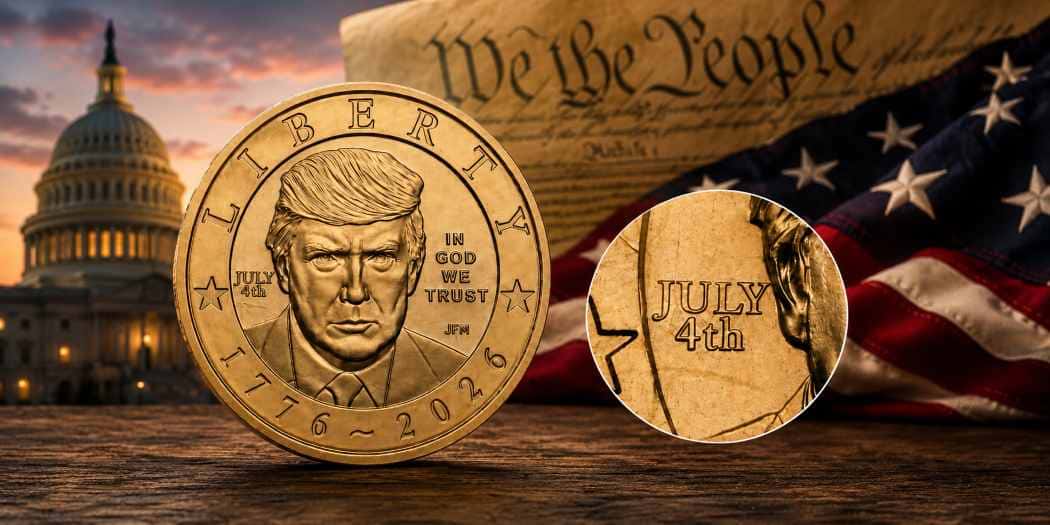
The Discovery Now Has an Official Mintage
For less than a day, the July 4th privy Trump dollar was a numismatic mystery. A coin had surfaced, CAC Grading had certified it, and collectors knew the small two-line privy was real. What they did not know was how many existed, when they were struck, or how the U.S. Mint intended to put them into collectors' hands. Late on August 27, the Mint supplied those missing pieces.
The answer turns the discovery into something more deliberate than an unexpected die variety. The Mint confirmed that 250,000 2026 Semiquincentennial President Donald J. Trump $1 coins were struck at the Philadelphia Mint on July 4 itself, each carrying the special 'July 4th' privy. They will not be sold as a separate issue. Instead, the coins will be randomly interspersed among Trump dollar rolls and bags offered beginning September 2. That distribution method transforms a commemorative detail into a search: buyers will know exactly how many privy coins exist, but not which Mint products contain them.
From Advanced Delivery Find to Mint Confirmation
The sequence is unusual because the coin reached the numismatic community before its full story did. Heritage Auctions senior numismatist Rene Alvarenga reportedly found the first publicized example in an Advanced Delivery roll. CAC Grading certified it MS64, with its holder identifying the piece as the 'July 4th Privy,' 'Discovery Coin' and an Advanced Delivery example. Heritage has said the discovery coin will be donated to the American Numismatic Association.
At that point, official information lagged behind the physical evidence. Collectors could see JULY above 4th to the left of Trump's portrait, but the Mint had not publicly disclosed a mintage or distribution plan for the variety. The August 27 announcement closed that gap: 250,000 were made, all on Independence Day in Philadelphia, and the privy pieces will be mixed into the same rolls and bags as standard coins.
A July 4th Coin Designed to Be Found
The Mint's distribution decision is central to the appeal. A fixed mintage of 250,000 establishes scarcity relative to the broader Trump dollar production, but random insertion means there is no dedicated July 4th product a buyer can simply order. The search becomes part of the collecting experience.
There is now a clear parallel with the 2026 Declaration of Independence quarters. The Mint also produced 250,000 July 4th privy quarters and placed them randomly into normal distribution. Before Thursday's announcement, that program offered only a possible precedent for the Trump dollar. It can now be understood as part of a broader Semiquincentennial strategy: use a limited privy tied directly to July 4, then make discovery rather than a separate sale the mechanism by which many collectors encounter it.
The Trump dollar remains a base-metal legal-tender coin rather than precious-metal bullion. Its potential premium therefore rests on numismatics: mintage, condition, certification, provenance and demand. A known population of 250,000 provides a firmer starting point for that market, but it does not determine future value. How evenly the coins are dispersed, how many high-grade examples emerge and how aggressively collectors pursue the variety will matter after distribution begins.
The Living President Question Makes This Dollar Different
The privy may be the newest twist, but the more consequential departure was already on the obverse. Donald Trump is a sitting president, and American coinage has long maintained a strong convention against placing living presidents on the nation's money. The issue reaches beyond modern collecting rules: American republican coinage developed in contrast to monarchies, where a reigning sovereign's portrait is commonplace.
Federal law makes the present case more complicated than a simple prohibition. The Presidential $1 Coin Program expressly barred images of living current or former presidents. The 2026 Trump dollar, however, is not being issued under that program. It derives from the Circulating Collectible Coin Redesign Act of 2020, which Trump signed during his first term. For the Semiquincentennial dollar, the statute specifically prohibits a head-and-shoulders portrait or bust of any person, or a portrait of a living person, on the reverse. It does not state the same restriction for the obverse, where Trump's portrait ultimately appears. Treasury has relied on that distinction in defending the design.
That reading has not ended the controversy. Critics have argued that depicting a sitting president conflicts with both federal restrictions elsewhere in currency law and the country's long aversion to treating presidents like reigning sovereigns. A federal lawsuit sought to stop Trump coin production, but a judge denied preliminary relief on standing grounds without deciding whether the coin itself is lawful. The legal merits therefore should not be described as conclusively settled merely because production has proceeded.
Calvin Coolidge Provides a Rare Historical Precedent
Trump is not the first sitting president to appear on a U.S. coin. That distinction belongs to Calvin Coolidge, whose portrait shared the obverse of the 1926 Sesquicentennial half dollar with George Washington. The comparison is especially apt: both coins were created around major anniversaries of American independence, one for the 150th and the other for the 250th.
Yet the Coolidge precedent also shows why the Trump dollar attracts attention beyond party politics. Living Americans have appeared on U.S. coins on rare occasions, but portraying a current president has never become normal practice. A century separates the Coolidge half dollar from the Trump dollar. In the meantime, Congress wrote explicit deceased-president requirements into other coin programs, reinforcing the expectation most modern collectors bring to presidential imagery.
The final 2026 design is more restrained than an earlier concept that would have shown Trump on both sides. U.S. Mint Chief Engraver Joseph Menna's obverse, inspired by an official White House photograph by Daniel Torok, places Trump's portrait with LIBERTY, IN GOD WE TRUST and the dual date 1776 ~ 2026. The reverse instead uses the Presidential Seal, adapted from former Chief Engraver Frank Gasparro's work, with 250 on the shield. The July 4th privy occupies a small space beside the portrait, but it further connects an already unconventional presidential coin to the anniversary that authorized it.
September 2 Turns the Story Over to Collectors
The Mint's announcement answers the question that dominated the discovery story: how many July 4th privy Trump dollars were made. It also creates the next question, which can be answered only after distribution begins. How difficult will one actually be to find?
Beginning September 2, the privy coins will be interspersed through the Philadelphia Mint rolls and bags containing circulating-quality Trump dollars. The Mint says the privy pieces themselves have a circulating finish and no mint mark. Collectors opening products will therefore need to inspect the obverse for the small JULY 4th device rather than rely on packaging or a separate product designation.
That hunt may ultimately define how the variety is remembered. The 250,000 mintage is limited enough to distinguish the privy from ordinary Trump dollars, while broad random distribution gives many buyers a chance at discovery. At the same time, the coin carries a historical question that will outlast the excitement of opening rolls: what does it mean for a republic to place a sitting president on its money? The July 4th privy makes the issue scarcer and more searchable. The portrait makes it part of a much older American debate.
Image source: CAC Grading
Related reading you may find interesting:
Trump Gold Proof Brings 2026 $1 Coin Design to 24K Gold
New Trump Dollar Error Reveals Copper Core Beneath Portrait