View Charts
New Trump Dollar Error Reveals Copper Core Beneath Portrait
 0
0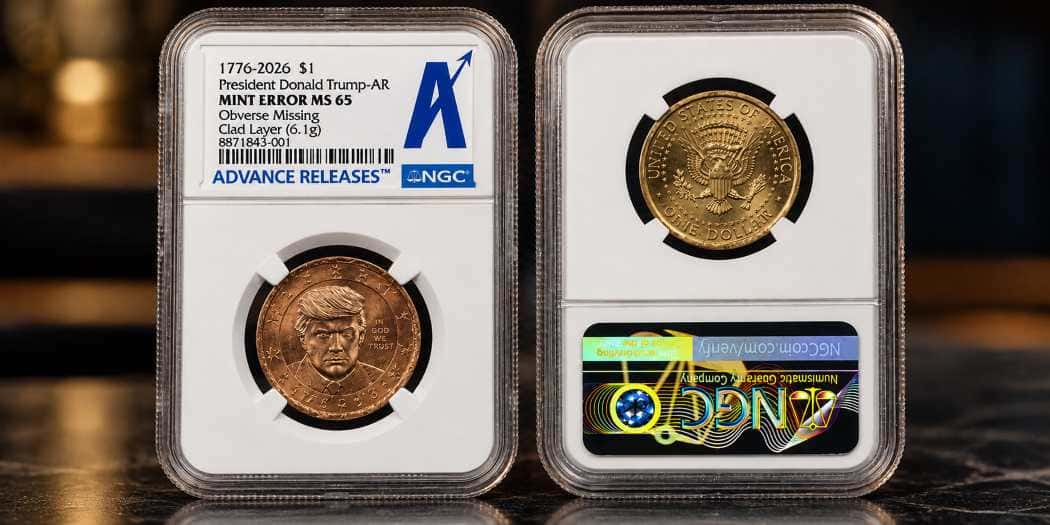
A $1 Coin With Two Different Faces
A newly discovered 2026 Trump dollar looks like two different coins depending on which side faces upward. The reverse retains the familiar golden appearance of the U.S. Mint's dollar coins, but the obverse displays an exposed copper surface beneath President Donald Trump's portrait. The difference is not an experimental finish or intentional design feature. An entire outer metal layer is missing.
The discovery, reported October 7 by Mint Error News and CoinWeek, has been authenticated and graded MS 65 by Numismatic Guaranty Company (NGC). Error-coin specialist Mike Byers has listed the piece for $25,000, although that figure represents an asking price, not a confirmed sale. Beyond its striking appearance, the coin offers an unusual example of how a manufacturing defect can transform a modern commemorative issue into a distinct numismatic discovery.
The Missing Layer Explains the Copper Portrait
The standard 1776–2026 President Donald J. Trump $1 Coin weighs 8.1 grams and has a golden appearance, but contains no gold. Its metallic structure consists of a pure copper core bonded between two manganese-brass outer layers. The exterior alloy provides the coin's characteristic color, while the underlying copper remains concealed during normal production.
On the newly discovered example, the obverse outer layer is absent, exposing the copper core directly beneath the portrait. The reverse retains its manganese-brass surface, creating a dramatic contrast between the two sides. The missing material also affects the coin's weight. According to the original discovery report from Mint Error News, the certified example weighs just 6.1 grams, approximately 24.7% less than a normal specimen.
That weight difference is important because discoloration alone cannot establish a genuine mint error. Environmental exposure, chemical treatment, and deliberate alteration can change a coin's appearance after it leaves the Mint. A substantial weight discrepancy, combined with the coin's physical characteristics, provides more meaningful evidence that an entire metallic layer is missing.
The reported defect also helps explain why the obverse may appear less sharply struck than a normal example. A planchet missing one of its outer layers is thinner than intended, changing how metal flows into the dies during striking. Some design details may consequently appear weaker even when the coin has never circulated.
How Does a Coin Lose Its Outer Clad Layer?
Clad coins are manufactured from bonded layers of different metals. These layers must remain properly joined as the material is processed into blanks, prepared for striking, and passed through the coining press. If an outer layer separates during manufacturing, the resulting coin can display the underlying core instead of its intended exterior.
The precise timing of the separation is not always obvious. In its educational guide to mint errors, NGC explains that missing-clad-layer errors can arise when a layer is absent before striking or when a poorly bonded layer separates afterward. Specialists examine the coin's surfaces, strike characteristics, and other physical evidence to determine whether the defect is consistent with an authentic manufacturing error.
The Trump dollar's reported weight loss and contrasting surfaces are consistent with a missing outer layer. NGC's authentication establishes the coin's status as a certified mint error, but collectors should avoid assuming that the layer necessarily detached at one particular stage unless the grading service specifically identifies that sequence.
This distinction separates missing-clad-layer errors from ordinary surface damage. A coin that has been chemically stripped or mechanically altered may resemble an error at first glance, yet its underlying evidence can tell a different story. Professional authentication becomes particularly important when a visually dramatic piece carries a substantial asking price.
Why NGC Assigned the Error an MS 65 Grade
The discovery was examined by Dave Camire, NGC's senior vice president of conservation and grading and a specialist in modern minting technology. Camire noted that MS 65 represents a strong grade for this particular error because the missing metal affects the planchet's thickness and the resulting strike.
Modern collectors often encounter newly issued coins certified MS 69 or MS 70, making MS 65 appear comparatively modest. Those expectations can be misleading when applied to major mint errors. A defective planchet may prevent the dies from producing the same sharpness found on a normal coin, even when the piece has otherwise been carefully preserved.
The grade therefore needs to be understood in the context of the manufacturing defect. NGC's assessment concerns the coin's condition and strike characteristics, while its error attribution identifies the missing outer layer. These are related but separate elements of the certification.
The holder also carries NGC's Advance Releases designation. Under NGC's designation requirements, qualifying coins must have been purchased by designated Mint customers before the publicly announced first sale date and submitted with appropriate documentation. The designation concerns distribution timing; it does not establish the error's rarity or independently increase its grade.
The $25,000 Asking Price Is Not a Market Record
Mike Byers Inc. has offered the certified Trump dollar error for $25,000. The figure has attracted attention because it places a newly issued, base-metal dollar in a price category more commonly associated with established numismatic rarities.
However, an asking price is not the same as an auction result or completed transaction. A dealer can establish an initial price based on perceived rarity, visual appeal, historical significance, and expectations about collector interest. The market ultimately determines whether buyers agree with that assessment.
Several factors make this discovery unusual. Its missing layer produces an immediately recognizable two-color appearance, the weight discrepancy is substantial, and the underlying coin belongs to a prominent 250th-anniversary release. NGC certification also gives prospective buyers an independent assessment of authenticity.
What remains uncertain is the number of comparable errors that may eventually surface. One publicly reported discovery does not establish that only one exists, nor does it provide enough evidence to predict long-term value. Additional certified examples, documented sales, and sustained collector demand would offer a stronger basis for evaluating the coin's market position.
For collectors, the distinction is essential: the discovery is confirmed, the certification is reported, and the $25,000 listing is documented. A realized value at that level has not been established by the available reporting.
A Manufacturing Error on an Unusual Anniversary Dollar
The underlying coin already occupies a distinctive place in the U.S. Mint's 2026 Semiquincentennial program. Its obverse, designed by Chief Engraver Joseph Menna, depicts President Trump alongside the dual date 1776–2026. The reverse, based on work by former Chief Engraver Frank Gasparro, features the Presidential Seal with the number 250 incorporated into the shield.
The Mint introduced the circulating-quality dollar through collector rolls and bags in September. Its golden color and 8.1-gram weight distinguish it from the separate one-ounce 24-karat gold Proof scheduled for November. Bullion Exchanges previously explored that relationship in Trump Gold Proof Brings 2026 $1 Coin Design to 24K Gold.
The missing-clad-layer discovery adds a different dimension to the program. Unlike an intentional anniversary privy mark or special finish, the exposed copper was never part of the approved design. Its appeal comes from the unexpected interaction between the Mint's manufacturing process and an already recognizable commemorative issue.
Future discoveries will help establish whether this example remains an exceptional individual piece or becomes part of a small group of known errors. Until then, its strongest numismatic significance lies in the documented defect itself: a modern dollar whose missing metal reveals the construction normally hidden beneath its golden surface.
Image source: CoinWeek