View Charts
Supergirl Joins the U.S. Mint Comic Art Coin Series
 0
0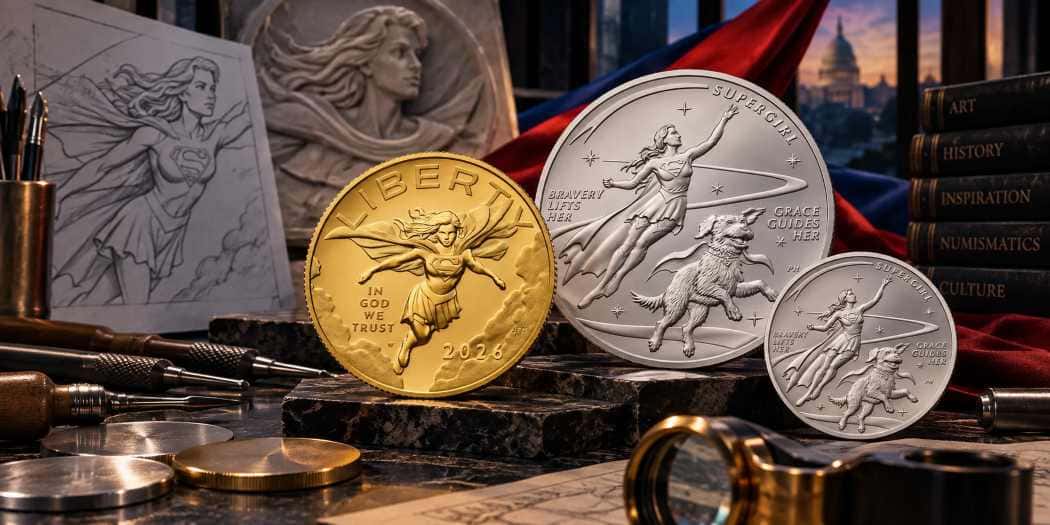
A New Kind of U.S. Mint Release Takes Flight October 1
Supergirl will become the fourth character in the U.S. Mint’s Comic Art Coin and Medal Program on October 1, when a 24-karat gold proof coin and two silver medals are scheduled for release. Following Superman, Batman, and Wonder Woman, the new issue moves the program beyond the three characters that introduced the series in 2025.
On the surface, this is a straightforward new release. Supergirl appears on a half-ounce gold proof coin, a 2.5 oz silver medal, and a 1 oz silver medal. But the larger story is what the U.S. Mint is attempting with the series. Comic Art brings the techniques of American coin and medal production to subjects that many buyers know first from comics, films, television, and popular culture rather than numismatics.
That makes Supergirl an interesting test. The character can appeal to established collectors interested in limited precious-metal issues while also giving DC fans who may never have followed a Mint release a different way into collecting.
One Character, Three Different Collectibles
Calling all three October releases “Supergirl coins” misses an important distinction. Only the gold version is a legal-tender United States coin.
The $50 gold proof Supergirl coin is struck at the West Point Mint from one-half troy ounce of .9999 fine gold. It carries the W mintmark and has a maximum mintage of 10,000 pieces. Because it is legal tender, its design also incorporates inscriptions required of a U.S. coin, including “LIBERTY,” “IN GOD WE TRUST,” the 2026 date, denomination, and precious-metal specifications.
The two silver releases are medals rather than coins. Both are struck in .999 fine silver at Philadelphia, with one containing 2.5 troy ounces and measuring two inches across and the other using the familiar 1 oz format. The larger medal has a 25,000-piece mintage limit, while the Mint currently lists no mintage limit for the 1 oz medal.
Those differences give the same artwork three distinct contexts. The gold proof fits naturally within modern precious-metal coin collecting. The 2.5 oz medal provides considerably more surface area for the sculpted design, while the 1 oz version presents the concept in a weight familiar throughout the bullion market. Rather than simply changing the amount of metal, the Mint is offering different interpretations of how the artwork can function as a collectible.
Supergirl Was Designed for Metal, Not Copied From a Comic
One of the more important details about the Comic Art program is that the Mint is not simply reproducing existing DC illustrations on precious metal. The artwork was developed specifically for coins and medals, requiring familiar characters to be translated into sculpted relief.
U.S. Mint Chief Engraver Joseph Menna designed and sculpted the obverse, showing Supergirl flying above the clouds with her cape trailing behind her. Medallic Artist Phebe Hemphill designed and sculpted the reverse, where Supergirl appears alongside Krypto within a starburst composition. On the silver medals, the reverse includes the phrases “BRAVERY LIFTS HER” and “GRACE GUIDES HER.”
That process helps distinguish the series from conventional licensed merchandise. Comic illustration and medallic art operate under different physical constraints. Depth must be translated into shallow relief, fine details have to survive striking, and the composition must remain readable on a relatively small circular surface.
The larger silver medal makes that translation particularly visible. At 50.8 mm across, it gives the sculpted artwork considerably more room than the smaller gold coin. Looking across the three formats therefore reveals something beyond differences in precious-metal content: the same character concept has to work at substantially different scales.
Supergirl Moves the Comic Art Program Beyond Its Opening Act
When Comic Art debuted in 2025, the Mint began with Superman, Batman, and Wonder Woman—three characters with recognition extending far beyond dedicated comic readers. They provided a natural foundation for introducing an unconventional U.S. Mint series.
Supergirl begins the next phase. She is the first of three characters joining the program in 2026, alongside Robin and Green Lantern. The Flash, Batgirl, and Aquaman are scheduled for 2027, bringing the planned DC lineup to nine superheroes across three years.
That progression subtly changes what the program is testing. The original trio established the concept; subsequent characters can show whether collectors are interested in following the series itself. Some may pursue every character in one format, while others may collect only the heroes they already follow. Gold-focused collectors and medal collectors can approach the same program very differently.
The defined three-year structure also gives buyers something open-ended licensed collectibles often lack: a visible endpoint. By the time Aquaman completes the announced lineup, collectors should have a much better sense of whether Comic Art has developed into a cohesive numismatic series or remains primarily a crossover between two collecting communities.
Can Comic Characters Create Coin Collectors?
This is where Supergirl becomes more interesting than an individual October release.
Traditional numismatics often introduces newcomers through history, mintmarks, varieties, precious-metal content, grading, or familiar American coinage. Comic Art reverses that path. A Supergirl fan does not need any previous interest in coins to recognize the subject. The character supplies the initial connection; exposure to medallic art and numismatics can come afterward.
The Mint has described Comic Art as celebrating comic books as a distinctly American art form. That framing matters because it places the characters within a cultural program rather than treating them simply as decorative additions to precious metal.
Whether buyers drawn in by Supergirl eventually become broader coin collectors is impossible to know. Some may never move beyond the character series. But numismatics does not necessarily need every new collector to enter through Morgan Dollars, Lincoln Cents, or American Eagles. Expanding the subjects capable of creating that first connection can broaden the hobby’s potential audience.
There will naturally be collectors who prefer the Mint to focus on Liberty, American history, national symbols, and traditional commemorative themes. Comic Art occupies a very different cultural space. That tension is part of what makes the program noteworthy: it tests how far the definition of a modern U.S. Mint collectible can stretch without abandoning the engraving and sculpting traditions behind it.
October 1 Is Part of a Larger Mint Experiment
Supergirl arrives during an unusually creative period for modern U.S. coinage. The 2026 Semiquincentennial has brought temporary designs, special privy marks, unconventional formats, and reinterpretations of historic American coins. Comic Art is separate from those anniversary programs, but together they show a Mint catalog currently extending well beyond routine annual issues.
The October 1 release adds another dimension. A legal-tender gold proof places Supergirl within traditional precious-metal coinage, while the silver medals give the artwork greater freedom from the requirements of a circulating or denominated coin. Original work by Mint artists keeps all three connected to the institution’s medallic tradition despite their origins in contemporary entertainment culture.
The more revealing question will take longer to answer. With Robin and Green Lantern still part of the 2026 lineup and three more characters scheduled for 2027, Comic Art is only approaching the midpoint of its announced run.
Supergirl therefore matters less as a one-day product launch than as another test of the series itself. If the program succeeds in attracting people who recognize the character before they recognize the Mint, it may demonstrate that the next generation of collectors does not have to discover numismatics through the same subjects as the last one.
Image source: U.S. Mint
Related reading you may find interesting:
2026 U.S. Mint Semiquincentennial Proof Set: Key Details
Are Unopened U.S. Mint Boxes Worth More to Collectors?