View Charts
Gold in Space: Satellites, Visors and Aerospace Demand
 0
0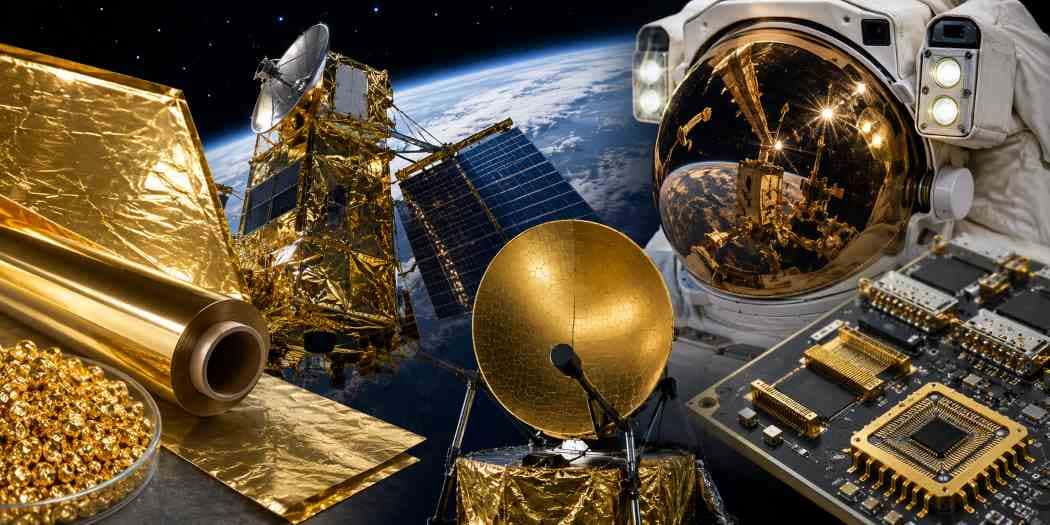
How Gold Helps Spacecraft Survive Extreme Heat, Radiation, and Risk
The gold space industry connection is more than a fascinating science fact; it is a practical example of why this metal remains valuable far beyond coins, bars, jewelry, and central bank reserves. As gold prices stay sensitive to inflation, interest-rate expectations, mining supply, and investment demand, industrial use in aerospace adds another layer to the metal’s long-term relevance. Spacecraft, satellites, astronaut helmets, and high-reliability electronics depend on materials that can perform under extreme radiation, temperature swings, vacuum exposure, and mechanical stress. Gold meets those requirements in ways few metals can.
Modern space activity is expanding rapidly through commercial satellite networks, defense systems, lunar missions, climate monitoring, deep-space probes, and private launch programs. That growth does not make aerospace the largest source of gold demand, but it highlights a premium use case where performance matters more than cost. In space, failure is expensive, dangerous, and often impossible to repair. Gold’s reflectivity, conductivity, corrosion resistance, and stability make it a small but important material in the infrastructure orbiting above Earth and supporting missions beyond it.
Gold Prices Meet High-Tech Demand in the New Space Economy
Gold is usually discussed through the lens of spot price, safe-haven demand, inflation hedging, and investor positioning. Those forces still dominate the market. Central bank buying, ETF flows, Treasury yields, and U.S. dollar movement can shift gold prices far more quickly than industrial demand from aerospace. Still, technology demand matters because it reinforces gold’s role as both a monetary metal and a functional material.
This is especially relevant when gold prices are elevated. In cost-sensitive consumer electronics, manufacturers often try to reduce or substitute gold where possible. Aerospace is different. Satellites and spacecraft use small quantities of gold in applications where reliability, signal integrity, and thermal protection are essential. When a component must withstand radiation, resist corrosion, and maintain performance for years in orbit, the price of a tiny gold layer may be easier to justify than the risk of failure. That makes space-related usage a high-value niche rather than a bulk-demand category.
Why Astronaut Visors Use Thin Gold Coatings
One of the most recognizable uses of gold in space is the gold-coated astronaut visor. Outside Earth’s atmosphere, astronauts face intense solar radiation, ultraviolet light, infrared energy, and harsh glare. A thin layer of gold helps filter harmful radiation while allowing visibility, giving astronauts eye and face protection during spacewalks and lunar surface operations.
The coating does not need to be thick to work. Gold’s optical properties allow it to reflect infrared radiation efficiently while helping reduce exposure to damaging wavelengths. That is why gold can appear in helmet visors, protective face shields, and specialized space optics. The same principle also explains why gold is valuable in certain scientific instruments and reflectors: it can help manage light and heat with exceptional reliability.
Astronaut equipment must balance visibility, protection, weight, and durability. Gold performs well because it is stable, does not tarnish easily, and can be applied in very thin layers. For investors, this use case is a reminder that gold’s value is not based on symbolism alone. Its physical behavior makes it uniquely useful in environments where ordinary materials fail.
Satellite Thermal Control Depends on Reflective Materials
Satellites experience brutal temperature extremes. One side may face direct sunlight while another side sits in shadow. Without proper thermal control, electronics, batteries, sensors, and communication systems can overheat or freeze. Gold-colored thermal blankets and reflective coatings help spacecraft manage that energy by reflecting infrared radiation and reducing unwanted heat transfer.
Many satellites use multilayer insulation, often seen as shiny gold or metallic foil on spacecraft surfaces. The visible outer appearance is not always pure gold, but gold coatings and gold-colored thermal materials are part of the broader thermal-control toolkit. Gold is particularly valuable where high reflectivity, stability, and resistance to environmental degradation are required.
This function is different from decorative shine. In orbit, surface materials are engineering decisions. Reflectivity, emissivity, mass, durability, and mission life all matter. Gold’s ability to help protect sensitive systems from solar heating connects directly to satellite longevity and mission reliability. As satellite constellations expand for communications, navigation, military surveillance, weather data, and broadband connectivity, thermal management remains a core engineering challenge.
Conductivity and Corrosion Resistance Make Gold Mission-Critical
Gold is also used in spacecraft electronics because it conducts electricity well and resists corrosion. In terrestrial environments, a tarnished or degraded connection may be inconvenient. In space, a failed connection can compromise an entire mission. Gold-plated connectors, bonding wires, contacts, switches, and circuit components help maintain stable electrical performance under demanding conditions.
The metal’s resistance to oxidation is especially important. Many metals degrade over time when exposed to moisture or reactive environments, but gold remains highly stable. Even though space is a vacuum, components may face contamination, radiation, thermal cycling, and launch-related stress. Gold’s dependability makes it suitable for high-reliability systems where failure tolerance is extremely low.
This does not mean spacecraft are filled with large amounts of gold. Most uses involve thin plating, coatings, or small electronic components. The value lies in performance density: a small amount of gold can protect a critical function. That principle also appears in medical devices, defense electronics, AI infrastructure, telecommunications, and other advanced technologies.
Gold’s Scarcity Gives Aerospace Uses Added Strategic Weight
Gold is scarce, difficult to mine, and expensive to refine. New mine production grows slowly, and major discoveries take years to develop into producing assets. That scarcity is one reason gold remains a financial reserve asset, but it also matters for advanced manufacturing. When high-reliability sectors need gold, they are competing within a global supply chain influenced by mining output, recycling, jewelry consumption, investment demand, and central bank accumulation.
Aerospace demand is not large enough to control the gold market on its own. However, it belongs to a group of advanced applications that reinforce gold’s strategic importance. High-performance chips, satellites, defense electronics, artificial intelligence infrastructure, and secure communications all rely on materials that prioritize durability and reliability. Gold’s role in these systems adds industrial credibility to a metal already known for monetary strength.
For bullion buyers, this distinction is useful. Physical gold ownership is still primarily about value preservation, liquidity, and diversification. Yet the metal’s practical use in aerospace shows that gold is not simply held because people believe in it. It is used because it works.
From Apollo-Era Engineering to Modern Satellite Networks
Gold’s association with space is not new. The Apollo era made gold visors and reflective thermal materials visually famous, but the engineering logic continues today. Modern missions are more varied, with commercial satellites, lunar exploration, planetary science, Earth observation, space-based internet, and defense systems all contributing to demand for advanced materials.
The space sector has also become more commercial. Private launch companies, satellite manufacturers, and communication networks are reducing costs and increasing mission frequency. More spacecraft means more electronics, more thermal-control challenges, and more demand for reliable materials. Gold’s presence may be small in each unit, but its use reflects a broader trend: advanced industries are becoming more material-intensive and more dependent on specialized metals.
This institutional and technological positioning strengthens gold’s narrative beyond bullion markets. Mints transform gold into coins and bars for investors. Refineries prepare gold for industrial and investment use. Aerospace manufacturers apply it where performance is essential. ETFs create financial exposure for traders and institutions. Central banks hold it as a reserve asset. Each role is different, but together they explain why gold maintains relevance across so many parts of the economy.
Gold Bullion Value Versus Industrial Gold Use
Gold used in space technology should not be confused with bullion or numismatic value. Bullion coins and bars are valued primarily for metal content, weight, purity, and market recognition. Numismatic coins may carry additional premiums based on rarity, condition, mintage, historical importance, or collector demand. Industrial gold, by contrast, is valued for performance within a manufactured component.
This distinction matters because aerospace demand does not directly change the value of a specific gold coin or bar. A one-ounce bullion coin tracks the gold spot price and product premium. A rare historic coin may trade well above melt value because collectors value more than gold content. A gold-coated visor or satellite connector has value because of engineering function, not investment liquidity.
Still, all three categories draw from the same underlying metal. Gold’s monetary, collectible, and technological roles support a broader understanding of why demand remains diversified. That demand mix is one reason gold continues to appeal to investors even when market conditions shift.
Space Technology Adds a Future-Facing Layer to Gold Demand
The future of gold in space will likely be shaped by miniaturized electronics, lunar exploration, satellite constellations, defense systems, and increasingly sophisticated spacecraft materials. As missions become more complex, engineers will continue looking for materials that reduce risk, withstand harsh conditions, and extend equipment life. Gold’s combination of reflectivity, conductivity, chemical stability, and reliability keeps it relevant in that discussion.
This does not mean space demand will suddenly overtake jewelry, central banks, investment bars, coins, or ETFs. Instead, space reinforces gold’s premium-material status. It shows that the same metal investors hold for wealth preservation also supports some of the most advanced technology humans have built. In a market often driven by inflation data, interest rates, and investor sentiment, that industrial role gives gold a deeper story: it is both ancient money and modern engineering material.
As space infrastructure expands, gold’s presence in satellites, visors, reflectors, and electronics will remain a powerful reminder that this metal’s value is not limited to what happens on Earth.
Related reading you may find interesting:
30 Gold Questions Every Buyer and Investor Should Understand
Gold Medical Uses in Arthritis, Cancer Research and Nanotech