View Charts
Gold Death Cross vs Golden Cross: 50/200 MA Signals
 0
0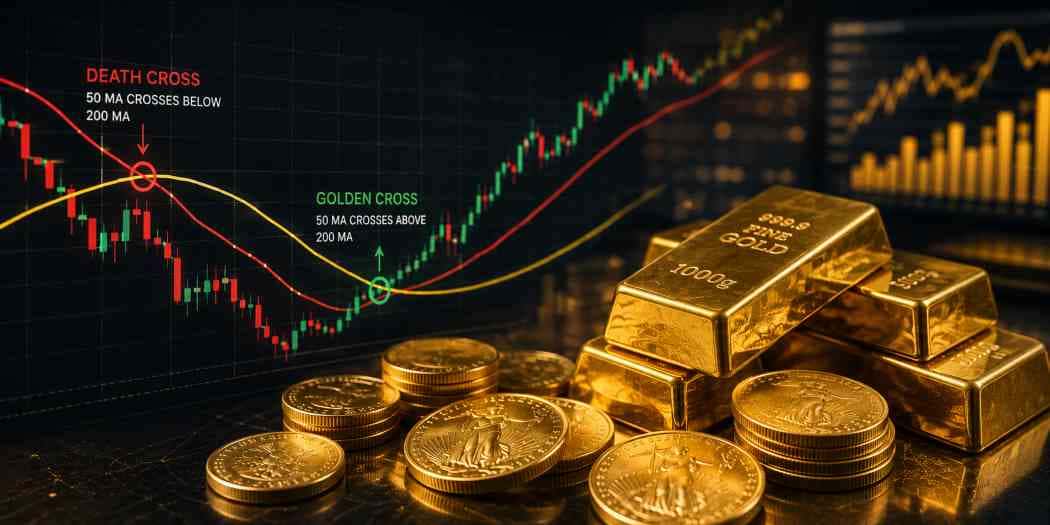
Moving Average Crossovers Can Reveal Gold’s Trend Shift
A gold death cross can sound dramatic, but it is best understood as a technical warning signal, not a guaranteed forecast. The pattern appears when gold’s 50-day moving average falls below its 200-day moving average, suggesting short-term momentum has weakened enough to break below the longer-term trend. The opposite pattern, known as a golden cross, occurs when the 50-day moving average rises above the 200-day moving average, often signaling improving trend strength.
These signals matter because gold trades on both macro fundamentals and market psychology. Interest rates, the U.S. dollar, inflation expectations, central bank buying, ETF flows, geopolitical risk, and safe-haven demand all influence spot prices. Moving average crossovers help buyers organize that noise into a cleaner trend signal. They do not predict the future by themselves, but they can help identify whether gold is shifting from strength to weakness, or from weakness back toward a more constructive trend.
The 50-Day and 200-Day Averages Create the Signal
The 50-day moving average tracks gold’s shorter-term trend by smoothing roughly two and a half months of daily prices. The 200-day moving average captures a longer trend, often used by traders to separate broader bull and bear phases. When the 50-day average is above the 200-day average, the market is generally viewed as having stronger intermediate momentum. When it is below the 200-day average, the market may be losing trend support.
A death cross forms when the shorter average crosses below the longer average. A golden cross forms when the shorter average crosses above the longer average. The simplicity of this structure is one reason these patterns are widely followed across equities, currencies, crypto, and commodities. In gold, they are especially useful because the metal can experience long trend cycles shaped by monetary policy, inflation, and safe-haven positioning.
The key is that both moving averages are based on past prices. They smooth volatility, but they also lag. By the time a crossover appears, gold has already moved significantly from a recent high or low. That makes the signal more useful as confirmation than prediction.
A Bearish Crossover Does Not Always Mean a Breakdown
A death cross in gold is often interpreted as bearish because it shows short-term momentum has deteriorated beneath the longer trend. Traders may read it as a sign that sellers have gained control, especially if gold is also breaking below support, the U.S. dollar is strengthening, Treasury yields are rising, or ETF outflows are accelerating.
However, the signal is not automatically a sell command. Gold can form bearish crossovers after a sharp correction, only to stabilize once the market has already priced in higher rates, a stronger dollar, or lower safe-haven demand. In those cases, the signal may mark the late stage of a pullback rather than the beginning of a major decline.
This is why context matters. A bearish crossover confirmed by rising real yields and weaker investment demand is more concerning than one that forms while central banks are buying, inflation remains sticky, or geopolitical stress is rising. Gold is not a single-driver market. Technical signals should be read beside macro conditions, not in isolation.
A Golden Cross Can Confirm Renewed Momentum
A golden cross is typically viewed as bullish because it shows the shorter-term trend has recovered above the longer-term trend. In gold, that can signal improving momentum after a correction, renewed safe-haven demand, falling real yields, dollar weakness, or stronger investment flows. It often attracts attention because many trend-following traders, algorithmic systems, and momentum funds monitor the 50/200-day crossover.
The most constructive golden crosses usually appear when price is already holding above the 200-day moving average and volume or ETF flows confirm stronger demand. If gold is also benefiting from lower yields, persistent inflation concerns, central bank accumulation, or geopolitical risk, the signal may support a more durable uptrend.
Still, a golden cross can also fail. If the crossover appears after a fast rally but macro conditions turn against gold, prices may reverse. A stronger dollar, hawkish Federal Reserve signals, or reduced safe-haven demand can weaken the setup. Buyers should treat the golden cross as a trend confirmation tool, not as proof that prices must continue higher.
Gold’s Fundamentals Can Override the Chart Pattern
Gold is unusual because it can react strongly to forces that are not visible on a simple moving average chart. Central bank purchases, sovereign debt concerns, financial stress, war risk, currency weakness, ETF demand, and inflation expectations can all affect prices quickly. A crossover may show trend direction, but fundamentals often explain why the trend is changing.
For example, a bearish crossover may appear while the Federal Reserve is signaling tighter policy, Treasury yields are climbing, and the dollar is firming. In that case, the technical signal aligns with macro pressure. But if the same crossover forms during a period of rising geopolitical risk or heavy central bank demand, the downside may be limited.
The same logic applies to a golden cross. A bullish crossover supported by falling real yields and stronger ETF inflows carries more weight than one that occurs during a thin technical rebound. Traders look for confirmation because gold often reverses when the underlying macro story shifts. The chart shows behavior; the fundamentals explain conviction.
Moving Averages Help Buyers Separate Noise From Trend
Gold can be volatile day to day, especially around inflation reports, Fed meetings, employment data, Treasury auctions, geopolitical headlines, and currency moves. Moving averages help filter this short-term volatility. A single weak trading session may not matter much if gold remains above its 50-day and 200-day averages. A repeated failure below those levels may tell a stronger story.
For physical buyers, moving averages can be useful without becoming overly technical. A price below the 200-day average may indicate a weaker trend and potentially better accumulation opportunities. A price above both the 50-day and 200-day averages may suggest stronger momentum, but possibly less attractive entry points for buyers waiting for dips.
This does not mean long-term buyers should trade every crossover. Many physical gold buyers build positions over time to hedge inflation, currency risk, or financial uncertainty. For them, the 50/200-day signal can help with timing, but it should not replace allocation discipline. A technical signal is most useful when it supports a broader plan.
False Signals Are Common in Sideways Gold Markets
Moving average crossovers work best when gold is entering a strong trend. They are less reliable when the market is range-bound. In choppy conditions, the 50-day average may move above and below the 200-day average multiple times without producing a meaningful trend. These false signals can frustrate traders who treat crossovers as automatic buy or sell triggers.
Sideways markets often appear when opposing forces are balanced. Gold may be supported by central bank buying and inflation concerns while pressured by high yields and a strong dollar. If neither side dominates, price can move in a range long enough to make moving averages flatten. Crossovers that occur during these periods may reflect indecision rather than a major shift.
This is why confirmation matters. Traders often look for a break of support or resistance, stronger volume, ETF flow direction, real-yield movement, or dollar confirmation before acting. A crossover is more meaningful when it appears alongside a clear change in market behavior.
Silver and Mining Stocks May Confirm or Challenge the Signal
Gold does not trade in isolation. Silver, gold mining stocks, gold-backed ETFs, and the U.S. dollar can all provide confirmation. If gold forms a golden cross while silver is also strengthening and miners are outperforming, the signal may show broader precious metals momentum. If gold forms a death cross while silver and miners are weakening faster, it may point to a more defensive shift.
Mining stocks can be especially useful because they often react more dramatically to gold spot price expectations. If miners fail to confirm gold strength, traders may question the durability of a rally. If miners stabilize ahead of gold, they may hint at improving sentiment before the metal itself fully turns.
Silver adds another layer because it responds to both investment demand and industrial activity. If silver lags during a gold golden cross, buyers may be seeing a defensive gold-only move. If silver outperforms, the broader metals complex may be gaining strength. Cross-market confirmation can make technical signals more useful and less isolated.
A Better Framework for Using Crossovers
The best way to use gold moving average crossovers is to combine them with macro and market confirmation. Start with the signal: is the 50-day average crossing above or below the 200-day average? Then check price location: is gold above both averages, below both, or caught between them? Next, evaluate the macro backdrop: are yields rising or falling, is the dollar strengthening or weakening, and are inflation expectations changing?
After that, look at demand signals. ETF inflows may confirm investment appetite. Central bank buying can reinforce long-term support. Physical premiums may show retail demand. Mining stocks and silver can reveal whether the move is broad or narrow. The stronger the confirmation, the more useful the crossover becomes.
This framework helps avoid overreaction. A crossover is a signal to investigate, not a final answer. Gold’s trend is shaped by a mix of monetary policy, reserve demand, investor psychology, and market liquidity. The 50/200-day moving average crossover helps identify trend pressure, but buyers still need to judge whether the move is supported by real market drivers.
What These Signals Mean for Gold Buyers Ahead
A gold death cross can warn that momentum has weakened, while a golden cross can confirm that the market is regaining strength. Neither signal should be treated as perfect. Both are lagging indicators that work best when paired with price action, yield trends, dollar direction, ETF flows, central bank activity, and physical demand.
For long-term buyers, these patterns can be practical timing tools. A bearish crossover may create caution, but it can also reveal lower-price accumulation windows if gold’s structural case remains intact. A bullish crossover may confirm improving sentiment, but buyers should still watch whether the rally is extended. The goal is not to chase every signal. The goal is to understand whether gold’s trend is strengthening, weakening, or waiting for a new catalyst.
Gold remains a market where technical analysis and fundamentals overlap. Moving averages show how traders are behaving. Macro drivers explain why they are behaving that way. When both point in the same direction, the signal becomes more meaningful. When they conflict, patience and confirmation become more important than the crossover itself.
Related reading you may find interesting:
Gold-to-Silver Ratio Trading: 3 Practical Bullion Strategies
Gold Confiscation 1933: Could Executive Order 6102 Return?
Gold Backwardation and Physical Scarcity Signals