View Charts
Gold Confiscation 1933: Could Executive Order 6102 Return?
 0
0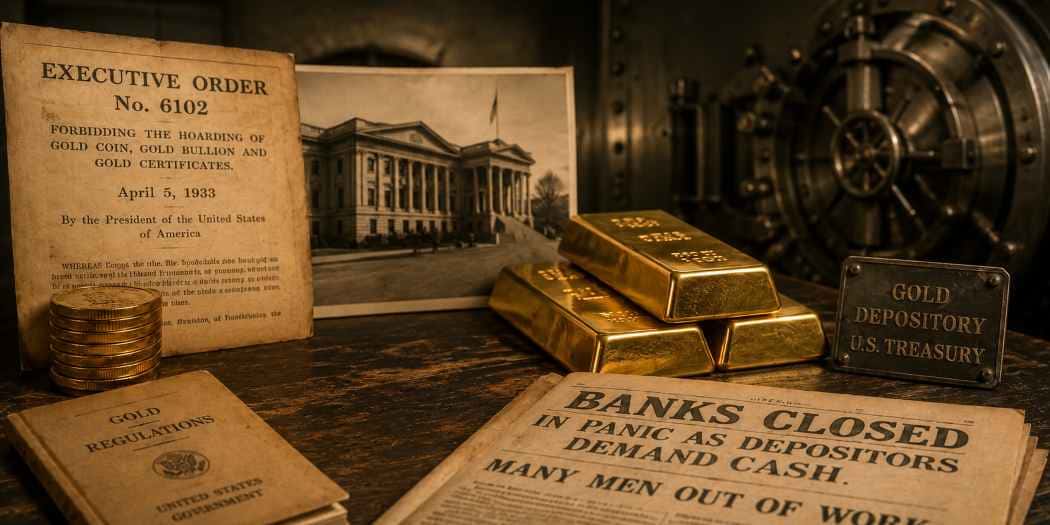
The Gold Ownership Shock That Still Shapes Investor Fear
Gold confiscation 1933 remains one of the most debated episodes in American financial history because it changed the relationship between citizens, money, and the federal government almost overnight. On April 5, 1933, President Franklin D. Roosevelt issued Executive Order 6102, restricting the “hoarding” of gold coin, gold bullion, and gold certificates during the banking crisis of the Great Depression. Americans were required to deliver most monetary gold to the Federal Reserve by May 1, 1933, in exchange for paper currency at $20.67 per ounce.
The question investors still ask is not only what happened then, but whether it could happen again. Gold prices remain sensitive to inflation expectations, central bank buying, geopolitical uncertainty, currency confidence, and interest-rate policy. That makes the 1933 precedent more than a historical curiosity. It is a reminder that gold is both a private asset and a monetary metal, which means government policy can shape its market role during periods of stress.
A Banking Panic Turned Gold Into a Policy Target
Executive Order 6102 was not written in a normal market environment. It arrived during a national banking emergency, when depositors were pulling money from banks and the government was trying to stabilize confidence in the financial system. At the time, the United States still operated under a gold-linked monetary structure, which limited how aggressively the government and Federal Reserve could expand credit.
Gold was therefore not treated like an ordinary investment. It was part of the monetary base. When citizens withdrew gold or held gold certificates outside the banking system, policymakers viewed that behavior as a direct obstacle to monetary expansion and bank stabilization. The order defined hoarding as withdrawing and withholding gold from “recognized and customary channels of trade,” a phrase that shows the government’s concern was monetary circulation, not collector enjoyment.
This distinction matters. The 1933 action was not simply about private wealth. It was about controlling the monetary system at a time when gold convertibility still constrained policy. That context makes a modern replay less straightforward because today’s U.S. dollar is not redeemable for gold, and the Federal Reserve no longer needs private bullion to back the currency.
What Executive Order 6102 Actually Required
Executive Order 6102 ordered individuals, partnerships, associations, and corporations to deliver most gold coin, gold bullion, and gold certificates to the Federal Reserve by May 1, 1933. In exchange, holders received payment at the official gold price of $20.67 per troy ounce. The order included penalties for violations, including fines and potential imprisonment, giving it strong enforcement power.
However, it was not an unlimited seizure of every object containing gold. The order allowed exemptions for gold used in industry, profession, or art, including uses by jewelers, dentists, and similar trades. It also allowed individuals to retain a small amount of gold coin and exempted gold coins recognized as having special value to collectors of rare and unusual coins. That numismatic carveout remains one of the most important details for modern collectors studying the order.
The rule created a practical difference between monetary bullion and rare collectible coins. Ordinary gold coins and bullion were treated as monetary metal. Rare coins with collector value were treated differently because their worth was not based solely on melt value. That distinction still matters when investors compare common bullion products with certified numismatic coins.
The Gold Reserve Act Made the Shift Permanent
The following year, the Gold Reserve Act of 1934 transferred title to gold held by the Federal Reserve to the U.S. Treasury and gave the government stronger control over the nation’s gold stock. Soon after, the official gold price was raised from $20.67 to $35 per ounce, effectively devaluing the dollar against gold and increasing the value of government-held reserves.
This sequence explains why the 1933 order remains controversial. Citizens surrendered gold at one official price, and the government later revalued gold at a higher price. From a policy perspective, the move helped expand monetary flexibility during the Depression. From an investor perspective, it demonstrated how quickly legal ownership rules and official pricing can change when gold is tied to currency policy.
The broader lesson is that gold’s role changes depending on the monetary system. Under a gold standard or gold-linked regime, private gold ownership can be seen by policymakers as competing with official reserves. Under a fiat system, gold is more often treated as a commodity, investment asset, reserve diversifier, and inflation hedge.
Private Gold Ownership Was Restored After Four Decades
For modern investors, one of the most important facts is that the U.S. ban on private gold ownership did not last forever. Public Law 93-373 permitted U.S. citizens to purchase, hold, sell, or otherwise deal in gold in the United States or abroad. The repeal became effective on December 31, 1974, and Executive Order 11825 formally revoked earlier executive orders regulating gold acquisition, holding, and transactions.
That restoration coincided with a very different monetary world. By the early 1970s, the United States had already ended dollar convertibility into gold for foreign official holders, and the Bretton Woods system had effectively collapsed. Once gold no longer anchored the dollar in the same way, the policy reason for restricting private ownership weakened.
This is why a direct repeat of the 1933 framework would face a very different backdrop today. Gold is still strategically important, but it is no longer the legal foundation of everyday U.S. currency. The government holds gold as a reserve asset, while private investors buy coins, bars, ETFs, jewelry, and collectible pieces in a market shaped by global pricing rather than domestic convertibility.
Could a 1933-Style Gold Order Happen Again?
A 1933-style gold surrender order is possible in theory only under extraordinary emergency conditions, but it appears far less likely under today’s monetary structure. The federal government retains broad emergency powers in certain contexts, but a modern attempt to restrict private gold ownership would likely face intense legal, political, logistical, and market resistance.
The biggest difference is that the original order served a specific monetary purpose: removing gold from private circulation while the government was managing a gold-linked currency system. Today, confiscating privately held bullion would not solve the same problem because the dollar is fiat money and Federal Reserve policy does not depend on gathering household gold.
That does not mean policy risk is zero. Governments can regulate reporting, taxation, imports, exports, anti-money-laundering compliance, dealer activity, and financial-market products tied to gold. Those tools are more realistic than a broad physical surrender order. Investors asking “could it happen again?” should separate dramatic confiscation fears from more ordinary regulatory risks.
Bullion and Numismatic Gold Face Different Risk Profiles
The 1933 order’s rare-coin exemption is a critical detail for collectors. Gold coins recognized as having special value to collectors of rare and unusual coins were treated differently from ordinary monetary gold. That does not mean all old coins were automatically protected, but it shows that numismatic value mattered even during a sweeping emergency order.
Bullion products, by contrast, are valued primarily by metal content. Gold bars, common bullion coins, and generic rounds tend to track the spot price closely, plus premiums. Their simplicity makes them highly liquid, but it also means their value is easier to identify as monetary metal.
Certified rare coins occupy a different category. Their value can reflect rarity, grade, population reports, mint history, demand among collectors, and provenance. Pre-1933 U.S. gold coins, scarce type coins, and historically important issues may carry collector premiums well above melt value. That does not eliminate all policy risk, but it changes the investment profile and explains why many buyers diversify across bullion and numismatic categories.
Modern Gold Demand Is Global, Not Just Domestic
Another reason the 1933 comparison has limits is that today’s gold market is globally integrated. Central banks, sovereign wealth managers, ETFs, private investors, refiners, miners, jewelers, and futures traders all contribute to price discovery. Gold trades around the clock across major financial centers, and physical supply moves through international refining and vaulting networks.
Central bank buying has become one of the most important modern demand drivers. Many governments hold gold to diversify reserves, reduce currency concentration, and strengthen confidence during geopolitical stress. Private investors buy gold for similar reasons: inflation protection, financial insurance, and portfolio diversification.
In that environment, a unilateral U.S. restriction on private gold ownership would likely create global market disruption, legal uncertainty, and possibly stronger offshore demand. Gold is no longer a narrowly domestic monetary issue. It is a worldwide reserve asset with deep institutional participation.
Inflation, Debt, and Currency Confidence Keep the Debate Alive
The reason gold confiscation 1933 continues to attract attention is simple: investors worry about the stability of paper money. High government debt, inflation cycles, banking stress, geopolitical conflict, and currency volatility all increase interest in hard assets. When gold spot prices rise sharply, old fears about government intervention tend to return.
Still, concern should not replace analysis. The 1933 action happened because gold directly constrained monetary policy. Today’s risks are different. Investors are more likely to encounter tax changes, reporting requirements, capital gains treatment, import restrictions, or compliance rules than outright confiscation. Those risks are less dramatic but more practical.
Gold’s appeal has always rested on independence from counterparty risk. Physical metal does not depend on a bank deposit, corporate balance sheet, or software protocol. That independence is exactly why investors value it and why governments have historically paid attention to it during crises.
A Practical Ownership Framework for Today’s Gold Buyers
Modern gold investors should not base their decisions on fear alone. A stronger approach is to understand the history, diversify intelligently, and own gold in forms that match personal goals. Bullion coins and bars may suit investors focused on liquidity and metal exposure. Certified rare coins may appeal to buyers seeking historical significance, scarcity, and collector-driven value. Gold ETFs may offer convenience but do not provide the same direct physical possession as coins or bars.
Documentation also matters. Receipts, grading certificates, inventory records, insurance documentation, and reputable dealer relationships all help establish ownership history and product authenticity. In a market where premiums, authenticity, and liquidity matter, organization is a practical advantage.
The 1933 episode should be treated as a warning about monetary stress, not a prediction of inevitable repetition. It shows that gold policy can change during emergencies, but it also shows that details matter: exemptions, legal authority, monetary structure, and market conditions shaped the outcome.
The Future of Gold Ownership Looks More Regulated Than Confiscated
The more realistic future for gold ownership is not another sweeping 1930s-style surrender order, but a more regulated marketplace. Investors should expect continued attention to reporting, tax compliance, anti-money-laundering rules, and financial transparency across precious metals markets. Those developments would fit the modern regulatory environment better than a physical confiscation campaign.
Gold remains a powerful asset because it sits outside the ordinary promises of paper finance. That strength is also why it attracts policy scrutiny when financial systems are stressed. For today’s buyers, the best response is not panic. It is education, diversification, and a clear understanding of the difference between bullion exposure, numismatic value, and legal history.
Executive Order 6102 still matters because it proves that gold is never just another commodity. It is a store of value, a political symbol, a reserve asset, and a form of financial independence. Whether or not a similar action ever returns, the history remains essential for anyone serious about owning physical precious metals.
Related reading you may find interesting:
Gold Standard vs Fiat: Stability, Inflation, and Tradeoffs