View Charts
5 Signs Silver May Be Undervalued
 0
0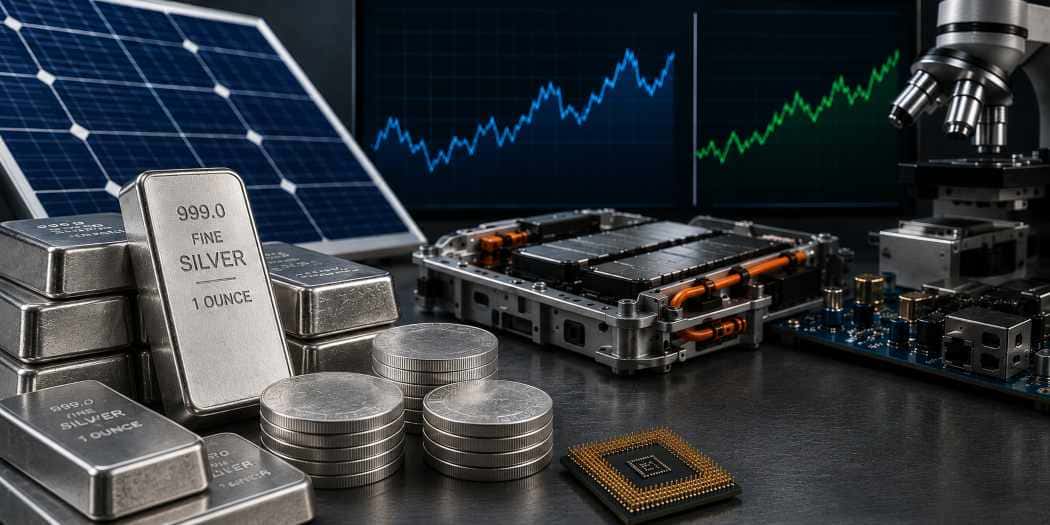
Why the Market May Not Be Fully Pricing Silver's Long-Term Fundamentals
Gold has dominated precious metals headlines over the past two years, repeatedly reaching new highs as investors responded to persistent inflation, record central bank buying, and geopolitical uncertainty. Silver has participated in that rally, but not to the same extent. The result is a market that continues to divide analysts: has silver merely lagged gold, or is it trading below what its underlying fundamentals suggest?
That question has become increasingly relevant as silver's industrial importance expands. Unlike gold, whose value is driven primarily by investment demand, jewelry, and official-sector purchases, silver occupies a unique position within the global economy. It remains a monetary metal sought during periods of uncertainty while simultaneously serving as an essential industrial material in solar energy, semiconductors, electric vehicles, medical technology, and advanced electronics.
Because of that dual role, silver's valuation reflects the interaction of industrial demand, mine supply, investor sentiment, and broader macroeconomic conditions. While no single indicator proves the metal is undervalued, several are currently pointing in the same direction.
Silver Continues to Trade at a Wide Discount Relative to Gold
One of the oldest valuation tools in the precious metals market remains the gold-to-silver ratio. Rather than measuring whether either metal is expensive or cheap in absolute terms, the ratio compares their relative value by showing how many ounces of silver equal the price of one ounce of gold.
Historically, extreme readings have often coincided with periods when one metal substantially outperformed the other. During financial crises, investors typically favor gold's role as a safe-haven asset, causing the ratio to climb as silver lags behind. As economic conditions stabilize and broader demand improves, silver has frequently recovered more rapidly, narrowing that gap.
While history does not establish a target ratio, today's elevated relationship suggests silver remains inexpensive relative to gold compared with many previous precious metals bull markets. That doesn't necessarily mean gold is overvalued. Instead, it may indicate that silver has yet to receive the same level of investor recognition despite improving fundamentals elsewhere in the market.
Industrial Demand Has Become a Structural Growth Story
Silver's investment case increasingly extends beyond inflation hedges and monetary policy. Over the past decade, the metal has become an indispensable component in industries expected to expand well into the coming decades.
Solar power represents perhaps the clearest example. Modern photovoltaic cells rely on silver's exceptional electrical conductivity, and despite ongoing efforts to reduce silver content per panel, rapidly growing installation volumes have continued to support overall consumption. Governments across North America, Europe, and Asia continue investing heavily in renewable energy infrastructure, reinforcing demand from one of silver's largest industrial sectors.
The same pattern is unfolding across advanced manufacturing. Electric vehicles require substantially more silver than conventional automobiles because of their extensive electronic systems, battery management components, and electrical connections. Semiconductor production, artificial intelligence infrastructure, telecommunications equipment, medical devices, and next-generation consumer electronics have all increased reliance on a metal whose conductive properties remain difficult to replicate economically.
Unlike speculative investment demand, many of these applications reflect long-term technological trends rather than short-term economic cycles. That expanding industrial base increasingly distinguishes silver from gold, whose value depends far more heavily on investor demand and central bank activity.
Supply Has Struggled to Keep Pace With Consumption
Demand alone rarely determines commodity prices. Equally important is how quickly producers can respond when consumption rises.
Silver faces a unique challenge because most global production does not come from mines dedicated exclusively to silver. Instead, much of the world's supply is recovered as a byproduct of mining copper, zinc, lead, and other industrial metals. As a result, production decisions often depend more on the economics of those primary metals than on silver spot prices.
Even sustained price increases may not produce an immediate surge in mine output. Developing new projects requires years of exploration, permitting, financing, and construction, while existing operations continue facing declining ore grades, higher operating costs, and increasing regulatory requirements in many jurisdictions.
These structural limitations have contributed to recurring physical market deficits in recent years, highlighting a market where consumption continues to outpace newly mined and recycled supply. While deficits alone don't guarantee higher prices, they provide a stronger fundamental backdrop when combined with expanding demand.
Investor Participation Has Not Matched the Fundamentals
Fundamental improvements alone rarely drive commodity prices. Markets respond when investors begin recognizing those changes, and that is one area where silver may still have room to catch up.
Gold has attracted exceptional institutional interest in recent years, supported by record central bank purchases, resilient exchange-traded fund (ETF) demand, and its established role as a portfolio hedge. Silver has shared some of those inflows, but historically it has tended to attract significant investment later in a precious metals cycle. Retail buyers often return only after strong price advances capture broader attention, while institutional allocations typically remain more measured during the early stages of a rally.
That lag matters because silver's market is considerably smaller than gold's. Even modest increases in investment demand can have a proportionally larger impact on prices. If broader investor participation begins aligning with already-strong industrial consumption, silver would benefit from two independent sources of demand rather than relying primarily on one.
Silver's dual role also contributes to greater volatility than gold. Economic expectations can shift prices sharply in either direction, but that same volatility has historically allowed silver to outperform during certain stages of precious metals bull markets.
The Strongest Signal Is That Multiple Indicators Are Aligning
What makes today's market particularly interesting is not one isolated data point but the convergence of several independent trends.
Relative valuation continues to favor silver compared with gold. Silver’s industrial demand is supported by structural investment in renewable energy, electrification, and advanced manufacturing rather than a single cyclical industry. Supply growth remains constrained by the economics of byproduct mining and the long lead times required to develop new projects. At the same time, investor participation has yet to reach the enthusiasm that characterized previous silver bull markets.
No single factor guarantees higher prices, and markets often remain disconnected from fundamentals longer than investors expect. Even so, when historical valuation, industrial demand, supply dynamics, and investor sentiment all begin supporting the same thesis, the case for silver becomes increasingly difficult to dismiss.
What Could Reprice Silver Next?
Whether silver ultimately proves to be undervalued will depend less on a single economic report than on how several market forces evolve together. A sustained decline in interest rates, renewed investment inflows into precious metals, continued expansion of renewable energy, or further evidence of physical supply tightness could each strengthen the market's existing foundation.
Silver is unlikely to move in a straight line. Its sensitivity to both industrial activity and financial markets means periods of elevated volatility will remain part of the investment landscape. Yet history has repeatedly shown that silver's strongest advances often occur when improving fundamentals and investor sentiment begin reinforcing one another.
Rather than asking whether silver is definitively undervalued today, investors may be better served by considering whether the market is fully reflecting the combined influence of supply, industrial demand, historical valuation, and investor sentiment. The answer remains uncertain, but the evidence suggests the discussion is far from over.
Related reading you may find interesting:
Why Platinum Deserves More Attention From Investors
Why Silver Is Known as the People's Precious Metal