View Charts
Why Platinum Deserves More Attention From Investors
 0
0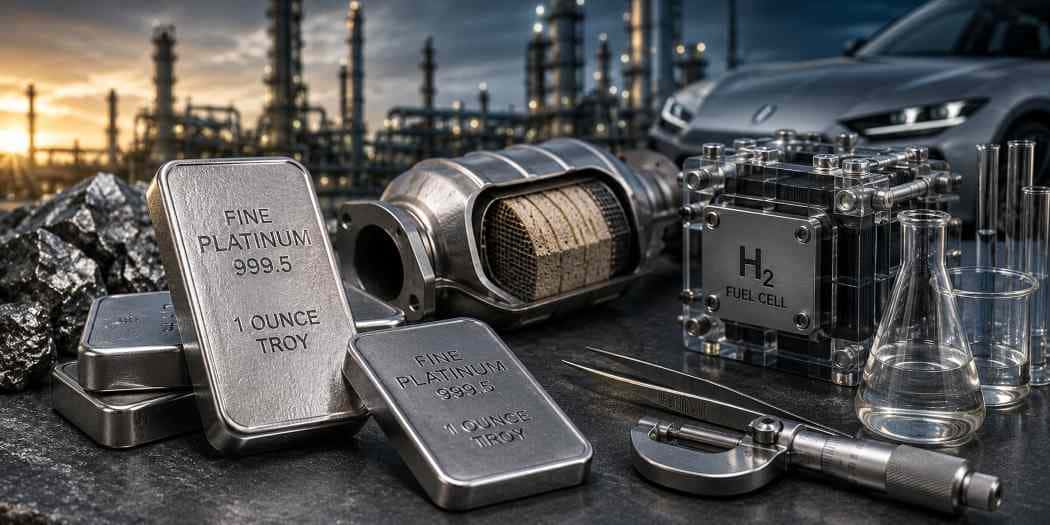
Gold Has Dominated the Headlines, but Platinum's Fundamentals Tell a Different Story
Gold has captured much of investors' attention in recent years, reaching successive record highs as central bank buying, persistent inflation concerns, and geopolitical uncertainty reinforced its role as a safe-haven asset. Silver has benefited from some of that momentum, but platinum has remained largely absent from the broader investment conversation despite possessing one of the most unusual supply-and-demand profiles in the precious metals market.
That disconnect has led some market analysts to question whether platinum deserves a closer look. While its price has historically been more volatile than gold's and more closely tied to industrial activity, the metal is also significantly rarer, produced in far smaller quantities, and sourced from a remarkably concentrated group of mining regions. Those characteristics create a market where relatively small shifts in supply or demand can have an outsized impact on platinum’s spot price.
Unlike gold, platinum is not driven primarily by investment demand. It occupies a unique position as both a precious metal and an essential industrial resource, meaning its long-term outlook depends on developments that extend well beyond financial markets. For investors willing to look beyond traditional safe havens, that combination makes platinum one of the more compelling contrarian opportunities in the metals sector today.
Platinum's Market Is Smaller Than Many Investors Realize
One reason platinum receives less attention is simply its size. The global platinum market is only a fraction of the gold market, both in annual production and total above-ground supply. That scarcity is often overlooked because gold dominates headlines, yet platinum is considerably rarer in nature and far more difficult to produce.
Geography also plays an unusually important role. The overwhelming majority of newly mined platinum originates in South Africa, with Russia supplying much of the remaining global production. Such concentration leaves the market vulnerable to disruptions that investors rarely encounter with gold. Labor strikes, electricity shortages, political instability, sanctions, or operational challenges at just a handful of mines can influence worldwide supply.
That concentration has become increasingly relevant in recent years. South African producers have faced recurring power constraints, rising operating costs, and declining profitability as aging mines become more expensive to develop. New platinum projects require substantial capital investment and often take years to reach commercial production, limiting the industry's ability to respond quickly when demand strengthens.
For investors, this creates an important distinction. Gold benefits from enormous above-ground inventories accumulated over centuries, which help cushion short-term production changes. Platinum's much smaller market leaves less room for supply shocks to be absorbed, making the balance between production and demand considerably tighter.
Industrial Demand Gives Platinum a Different Investment Profile
Platinum's value cannot be understood through investment demand alone. Industrial consumption has long represented one of the defining characteristics of the metal, creating a market that often behaves differently from gold during changing economic conditions.
Automotive manufacturing remains one of platinum's largest sources of demand. The metal plays a critical role in catalytic converters, where it helps reduce harmful vehicle emissions. While changing vehicle technologies have altered demand patterns over time, increasingly stringent global emissions standards continue supporting platinum's importance in heavy-duty diesel vehicles and a growing number of gasoline applications where manufacturers substitute platinum for more expensive palladium.
The metal's industrial relevance extends well beyond transportation. Platinum is widely used in petroleum refining, chemical manufacturing, medical devices, laboratory equipment, and specialized electronics because of its exceptional resistance to corrosion and its catalytic properties. Emerging hydrogen technologies have added another area of long-term interest, with platinum playing an important role in certain fuel cell systems and electrolyzers used to produce green hydrogen.
This broad industrial footprint gives platinum characteristics that differ from both gold and silver. During periods of strong economic expansion, manufacturing demand can provide meaningful support for prices. During economic slowdowns, that same exposure may contribute to greater volatility. For long-term investors, however, industrial demand also represents a structural source of consumption that extends beyond traditional investment cycles.
Platinum Bullion Offers Diversification Beyond Gold
Platinum's industrial importance often overshadows another reason investors consider the metal: diversification. While gold is widely viewed as the foundation of many precious metals portfolios, platinum has historically followed a different set of market drivers, allowing it to perform differently during various stages of the economic cycle.
That distinction can be valuable. Gold prices are heavily influenced by interest rates, inflation expectations, central bank purchases, and investor sentiment. Platinum responds to many of those same forces but is also shaped by automotive production, industrial activity, mining supply, and manufacturing demand. As a result, the two metals do not always move together, creating opportunities for investors seeking broader exposure within the precious metals sector.
Physical platinum bullion remains the most direct way to gain that exposure. Investors can choose from government-issued bullion coins such as the American Platinum Eagle, Canadian Platinum Maple Leaf, and Australian Platinum Platypus, along with investment-grade bars produced by internationally recognized refiners. Like gold bullion, these products derive most of their value from metal content rather than collectibility, making them suitable for investors focused on long-term ownership.
Liquidity is another factor often overlooked. Platinum does not trade with the same daily volume as gold, but recognized bullion products remain widely accepted throughout the global precious metals market. Purchasing well-known coins and bars from established dealers helps preserve resale flexibility while providing confidence in authenticity and quality.
For investors accustomed to thinking only in terms of gold and silver, platinum offers a way to diversify not only across metals but also across the economic forces that influence their prices.
Platinum's Supply Outlook May Be More Important Than Its Price Today
Contrarian investing often involves identifying markets where current prices fail to fully reflect longer-term fundamentals. Platinum has attracted attention in that regard because its supply picture remains unusually constrained while several sources of demand continue evolving.
Industry analysts have periodically projected platinum market deficits as mine production struggles to keep pace with fabrication demand and investment consumption. Unlike many industrial metals, increasing platinum supply is neither quick nor inexpensive. The concentration of global production, combined with aging mines and rising operating costs, means additional output cannot simply appear in response to higher prices.
Demand has also become more diversified than many investors realize. Automakers continue adapting platinum use within emission-control systems, jewelry demand remains significant in several international markets, and interest in hydrogen technologies has introduced another potential source of long-term consumption. None of these sectors alone guarantees sustained price appreciation, but together they create a broader demand base than platinum has historically enjoyed.
That combination of constrained supply and multiple demand drivers helps explain why platinum periodically attracts renewed attention after spending long periods outside the spotlight. The market rarely moves in a straight line, but smaller commodity markets often experience sharper repricing when sentiment begins shifting alongside improving fundamentals.
Looking Beyond Today's Headlines
Platinum may never command the same level of attention as gold. It lacks gold's centuries-old monetary role, receives far less media coverage, and generally attracts a smaller share of investment capital. Yet those characteristics are precisely what make it worthy of closer examination.
Investors willing to look beyond the most popular precious metals will find a market defined by genuine scarcity, concentrated mine supply, diverse industrial demand, and growing strategic importance. Those factors also contribute to greater price volatility, making platinum less predictable than gold over shorter periods. For patient investors, however, volatility is not necessarily a disadvantage when supported by constructive long-term fundamentals.
No precious metal should be viewed in isolation, and platinum is unlikely to replace gold as the cornerstone of a defensive portfolio. Instead, it offers something different: exposure to a rarer metal whose value reflects both industrial innovation and precious metals demand. As supply constraints persist and new technologies continue expanding platinum's role in the global economy, the question may become not whether platinum deserves more attention, but why more investors have overlooked it for so long.
Related reading you may find interesting:
The Role of Recycling in Platinum and Palladium Supply