View Charts

SHIELD NICKEL (1866-1883)
Five-cent pieces have been produced by the US Mint since 1792. These earlier five-cent coins were called “Half Dimes” and contained more than 89% pure silver. In 1866, the US Mint began minting the first-ever United States five-cent piece to be composed of copper-nickel. These coins, called “Shield Nickels” were designed by James Longacre and were composed of 75% Copper and 25% Nickel, with an approximate weight of 5 grams.
Shield Nickel History
Background:
When the Civil War broke out in 1861, the US Mint was forced to cease production of physical coins. During the war, gold and silver coins were hoarded in large numbers, leading many American coins to vanish from circulation. The gap left by the lack of coins was soon filled by merchant tokens, encased postage stamps, and also United States fractional currency representing “cent” amounts. The fractional currency was issued in denominations as low as three cents and as high as fifty cents.
Clark’s Currency Confusion:
In 1864, Congress began the process of putting coins back into circulation. Since there was still such a great shortage of metal coins, Congress also authorized a third series of fractional currency notes which was to include a five-cent note. Congress wrote that the five-cent note should bear a portrait of William Clark, the famous explorer of “Lewis and Clark fame. However, the legislation simply said "Clark", and not the explorer’s full name. Spencer M. Clark, the head of the US Currency Bureau, took advantage of the ambiguity and had his own portrait printed on the five-cent currency note. Congress was understandably appalled when the issue came out featuring the wrong Clark. Spencer Clark, already on thin ice with Congress due to previous scandals from years past, only kept his job thanks to the intervention of Salmon Chase, the US Treasury Secretary at the time. Congress's immediate and enraged response was to pass legislation retiring the 5¢ denomination, as well as forbidding the portrayal of any living person on federal coins or currency. Instead, it was decided that a five-cent coin will be struck from copper-nickel, the same alloy used for the popular three-cent piece.
Initial Production:
Joseph Wharton, an influential industrialist who controlled the majority of nickel mining in the US, advocated heavily for the production of coins containing the copper-nickel alloy. Wharton even published a pamphlet that proposed that all non-precious metal coins consist of 75% copper and 25% nickel. Mint Director James Pollack saw the success of the three-cent copper-nickel price and was swayed by Wharton and his supporters. Pollack then drafted a bill authorizing a five-cent piece, and after a slight adjustment to the weight (from 3.9 grams to 5.0 grams), the bill passed in May 1866.
The Mint's chief engraver, James B. Longacre was tasked with preparing a design as quickly as possible, since the coin’s production was to begin immediately. After releasing several different coin patterns, a final design was chosen by Treasury Secretary Hugh McCulloch.
Shield Nickel Circulation:
By late 1869, the production of nickels, as the coin came to be called, dropped off. This was due to the fact that enough nickels had been manufactured to meet the needs of commerce at the time. In late 1876, Shield Nickel production was halted under the Mint Act of 1873, which gave the mint director authority to suspend the production of any coin denomination if they were deemed necessary or not needed. In 1877 and 1878, no Shield Nickels were struck, except for proof versions specifically for collectors. Over the next few years, only small numbers of the coin were struck, with full-scale production beginning again on December 12, 1881. The year before, only 16,000 pieces were struck for circulation, making the 1880 Shield Nickel the rarest non-proof variety today. The Shield Nickel was struck until Feb 6th, 1883. That year, on Jan 30th, the Liberty Head Nickel designed by new Chief Engraver Charles Barber, was struck for the first time. The Liberty Head Nickel effectively replaced the Shield Nickel and was struck until 1912.
Shield Nickel Design and Varieties
James Longacre created several different coin patterns for the Shield Nickel. One of them depicted the first US President George Washington, while another showed the recently assassinated president, Abraham Lincoln. Neither one was selected by Treasury Secretary Hugh McCulloch, who opted for the shield design on the obverse. Longacre put for a few different designs for the reverse as well, including a numeral within a wreath. This idea was rejected in favor of the number 5 within a circle of thirteen stars with rays of light separating each star.
Unfortunately, the design was soon met with widespread criticism during its first year of production. The Shield Nickels were difficult to manufacture due to the hardness of the planchets. In 1867, Longacre revised the design, removing the rays from between the stars to make the coins easier to strike.
Because dies for the coins wore out so quickly and were often carelessly produced, the Shield Nickel series yielded a plethora of minor varieties. The most notable difference in the Shield Nickel design originates from its first year of production: The reverse With Rays (struck in 1866 and 1867) vs. the reverse Without Rays (struck 1867-1883).
1866-1867 Shield Nickel With Rays
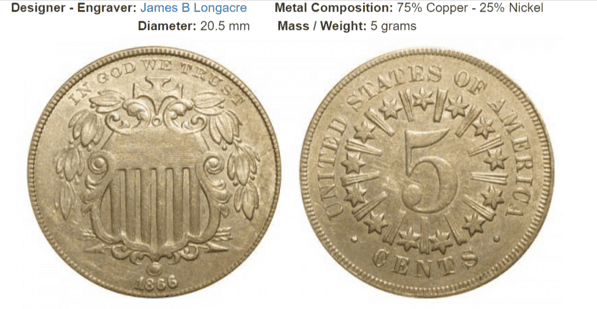
Image source: https://www.usacoinbook.com
1867-1883 Shield Nickel Without Rays
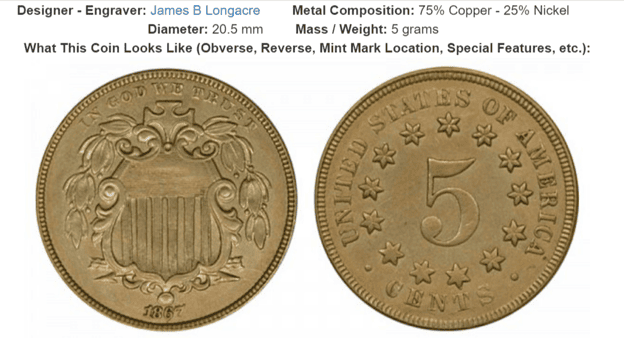
Image source: https://www.usacoinbook.com
Shield Nickel Value
Depending on the year of mintage and the condition of the coin, the Shield Nickel can be worth a significant amount. However, only about 8 varieties of this coin have been valued above $1,000 (in certain conditions). They are listed below:
1866 Shield Nickel: With Rays
Value: Between $25 and $2,100, depending on condition
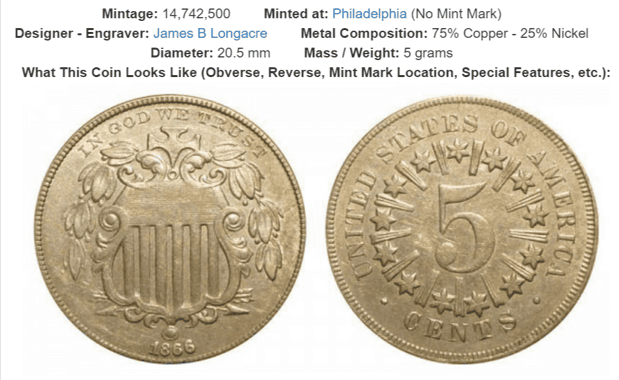
Image source: https://www.usacoinbook.com
1867 Shield Nickel: Type 1 - With Rays
Value: Between $35 and $40,600, depending on condition
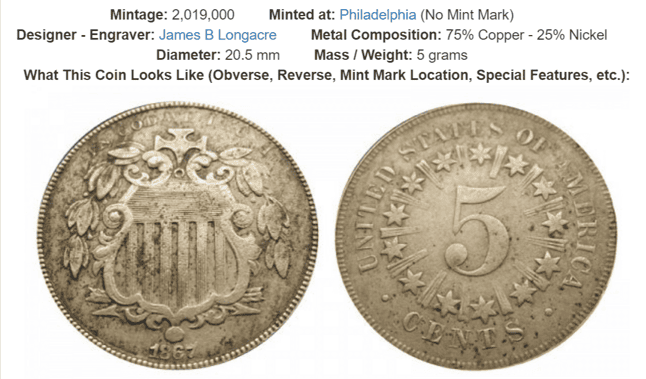
Image source: https://www.usacoinbook.com
1877 Shield Nickel: Proof Only
Value: Between $1,160 and $3,650, depending on condition
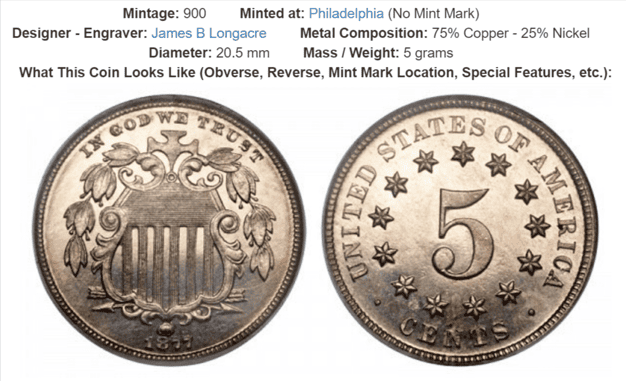
Image source: https://www.usacoinbook.com
1878 Shield Nickel: Proof Only
Value: Between $620 and $2,100, depending on condition
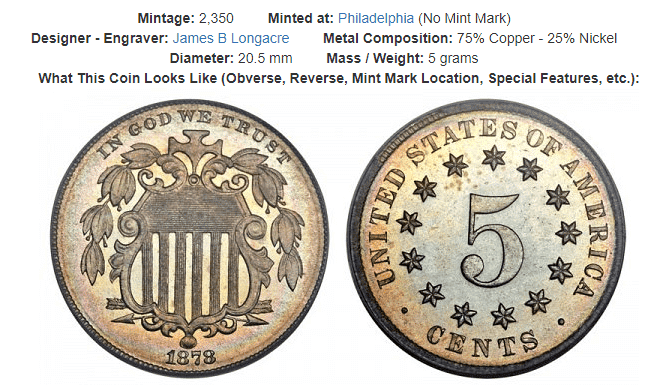
Image source: https://www.usacoinbook.com
1879 Shield Nickel: Proof Only
Value: Between $400 and $1,000, depending on condition
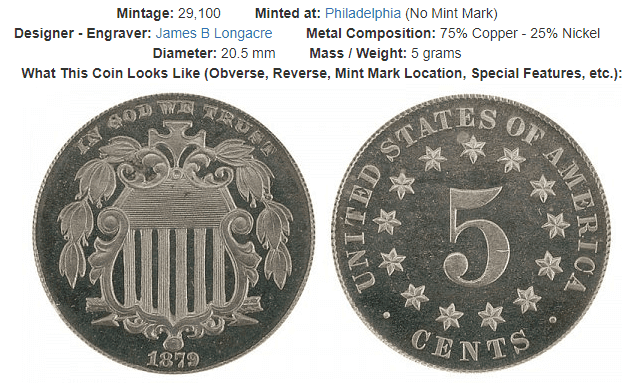
Image source: https://www.usacoinbook.com
1880 Shield Nickel: Proof Only
Value: Between $500 and $8,000, depending on condition. PR-65 valued less than VG-8
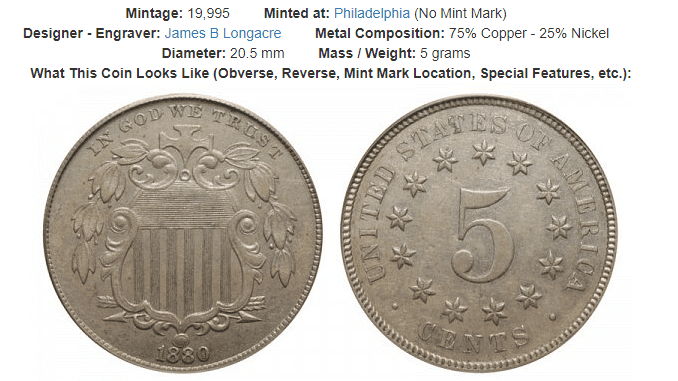
Image source: https://www.usacoinbook.com
1881 Shield Nickel: Proof Only
Value: Between $270 and $1,000, depending on condition. PR-63 valued less than EF-40
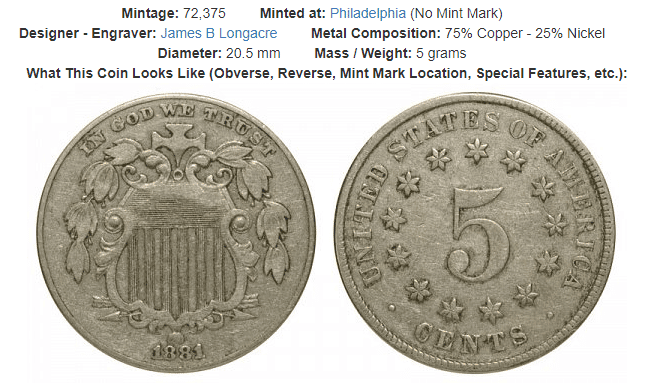
Image source: https://www.usacoinbook.com
1883 Shield Nickel: 3 Over 2
1883 date was stamped on top of the 1882 date
Value: Between $270 and $2,900, depending on condition.
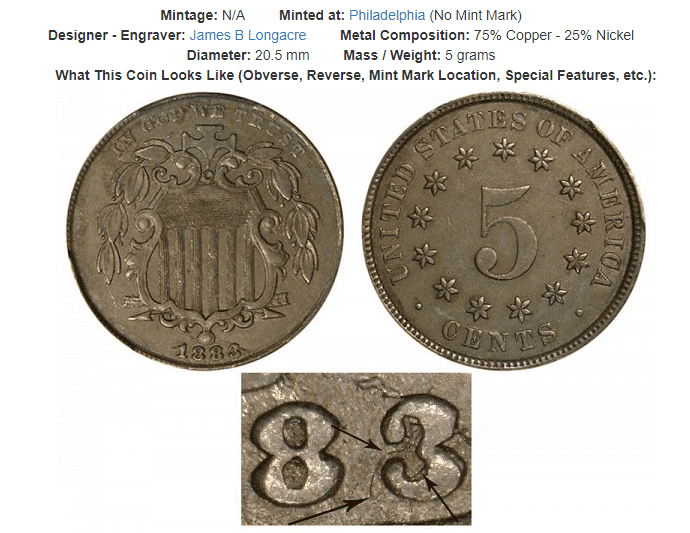
Image source: https://www.usacoinbook.com
Shield Nickels are relatively inexpensive compared to other early American coinage, and are therefore a popular acquisition for many collectors. Values for the common dates may range from $20 in good condition up to $200 or more in uncirculated condition. In some cases, Shield Nickels designated as Extremely Fine or even Very Fine condition can be worth more than the Proof versions from the same year. As always, when determining the worth of your coin, we advise you to seek out the assistance of a numismatic professional.