View Charts

Large Cents (1793-1857)
Among the first coin styles ever produced in US coinage, Large Cents were nearly the size of a modern-day half-dollar. Made with 100% copper and weighing between 10 and 13 grams depending on the variety, each Large Cent coin was valued at 1/100th of a dollar, similar to that of a modern-day penny. There were a total of six varieties produced between the years 1793 and 1857, with the exception of 1815. They include: Flowing Hair, Liberty Cap, Draped Bust, Classic Head, Coronet Liberty Head, and Braided Hair Liberty Head.
Large Cent History
During the Revolutionary War, the Continental Congress issued a paper currency called “Continentals” to help fund the war. This specific paper currency quickly lost value after the war ended, which resulted in all forms of a paper currency losing their worth. The lack of a national coinage system soon proved to be a critical problem for our young, newly independent nation. In order to help rectify the situation, the US Constitution provided Congress with the exclusive authority to coin money. Soon, Congress passed The Coinage Act of 1792, establishing the United States Mint and ordering the production of gold, silver, and copper coins of various denominations and sizes. Subsequently, the first Large Cent was minted in 1793 along with the first Half Cent coins. These copper coins were minted until 1857 before they were retired from circulation.
Large Cent Design Varieties
Large Cents underwent a series of design changes throughout the years, and therefore provide collectors with the challenging yet rewarding task of acquiring them all. The six varieties are as follows, along with a brief description of each:
1793 Flowing Hair: Chain Reverse and Wreath Reverse
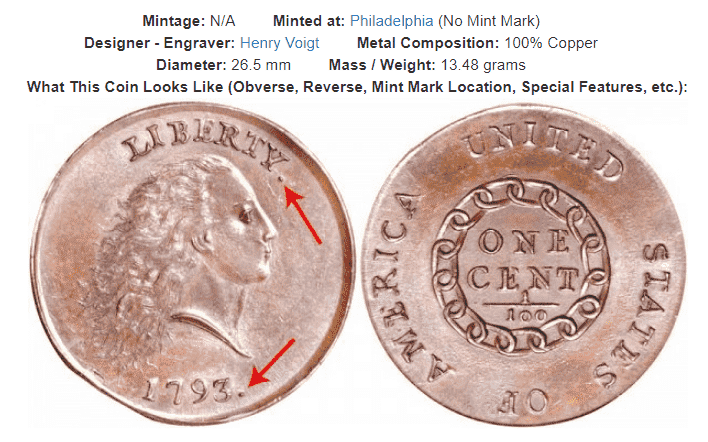
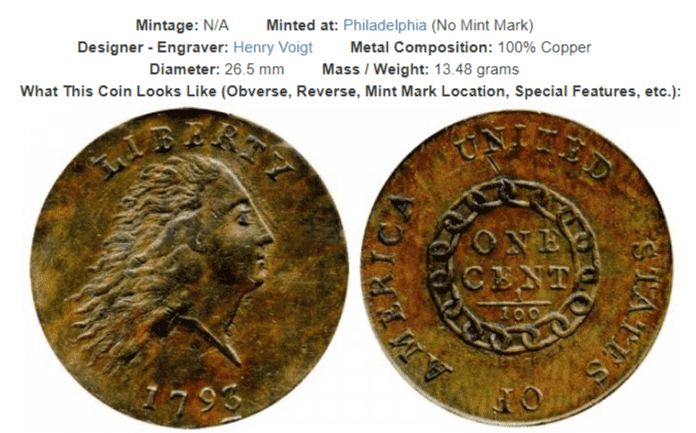
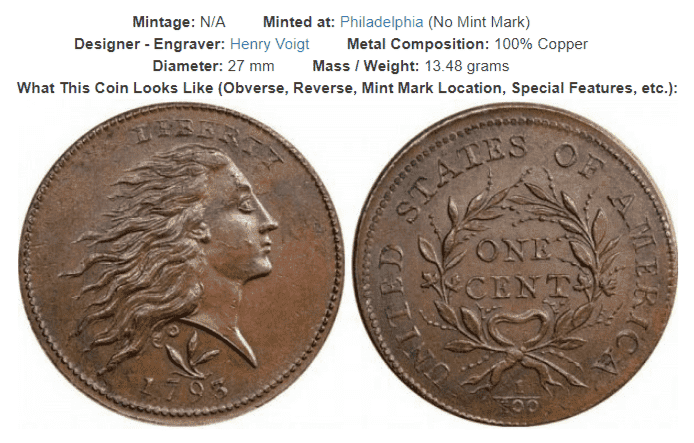
The first Large Cent release was the “Flowing Hair” design by Henry Voigt, Chief Coiner of the first United States Mint. While this particular coin notably was the first official US coin minted by the government on its own equipment and premises, the design itself was the subject of much criticism. The depiction of Lady Liberty on the obverse was deemed unattractive and the chains on the reverse seemingly alluded to the support of slavery. Adam Eckfeldt, the second chief coiner of the US Mint, redesigned Lady Liberty and also substituted a wreath for the chain, but the design did not capture the hearts of the American public.
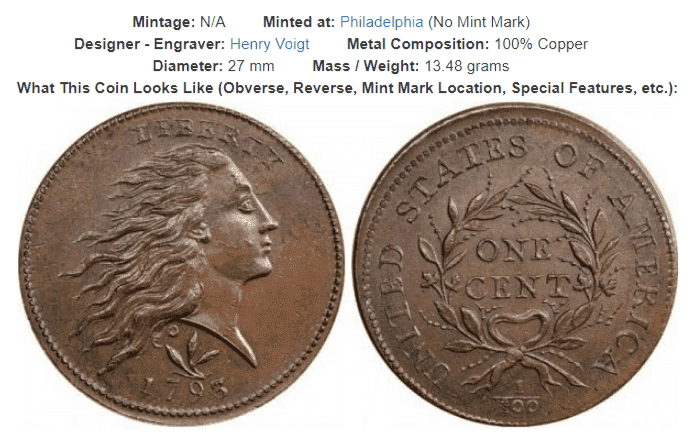
Images source: https://www.usacoinbook.com
1793-1796 Liberty Cap
Following the prickly reception of the Flowing Hair design, Mint Director David Rittenhouse hired designer Joseph Wright to modify the design of the coin. He “tamed” Liberty’s wild hair to make it look healthier and fuller, and also added a Phrygian cap behind her. Thus the design was named the “Liberty Cap”. Wright also changed the reverse to a recognizable laurel wreath image.
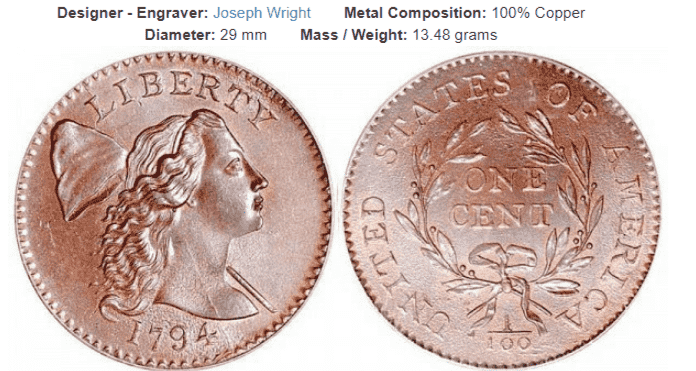
Image source: https://www.usacoinbook.com
1796-1807 Draped Bust
In 1796, US Mint designer and engraver Robert Scot redesigned all of the US coinage, including the Large Cent coins. His design featured a bust of Lady Liberty wearing loose drapery near her neckline, drawing attention to the bosom area. Hence the name “Draped Bust” for this series. He also added a ribbon to Liberty’s flowing hair. The reverse displayed an olive wreath instead of a laurel one.
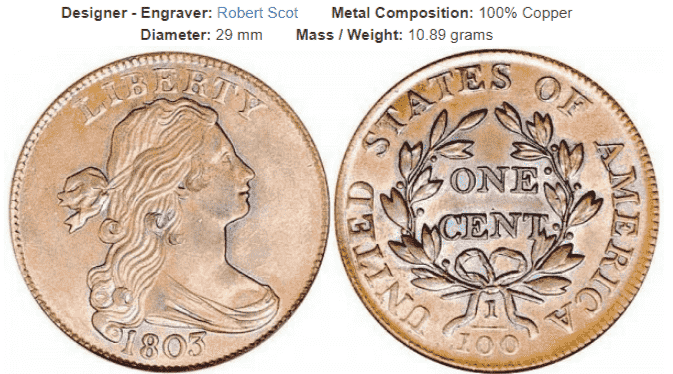
Image source: https://www.usacoinbook.com
1808-1814 Classic Head
In 1808, new US Mint Director Robert Patterson assigned Scot’s assistant engraver John Reich with the task of redesigning all circulating coinage. The new design, the “Classic Head” drew its name from the headband or “fillet” worn by Lady Liberty. She now faced right instead of left, and 13 stars representing the 13 colonies bordered her bust.
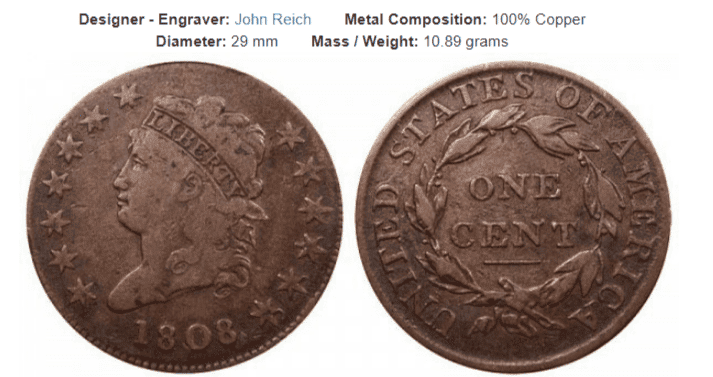
Image source: https://www.usacoinbook.com
1816-1839 Coronet/ Matron Head
During the War of 1812, England imposed a trade embargo on the US. Because England had been supplying the United States with copper planchets for coins, the US’s planchet supply was exhausted by 1814. Once the embargo was lifted, production of copper cents was resumed, which is why there was a 1-year gap in Large Cent production. The new design, named the “Coronet” Large Cent, was later split into two subcategories: The Matron Head and the Braided Hair. Robert Scot redesigned the Classic Head motif in 1816 to reveal the new, more mature image of Lady Liberty. This led to the coin being nicknamed the “Matron Head”. This Matron Head/Coronet design was minted from 1816-1839.
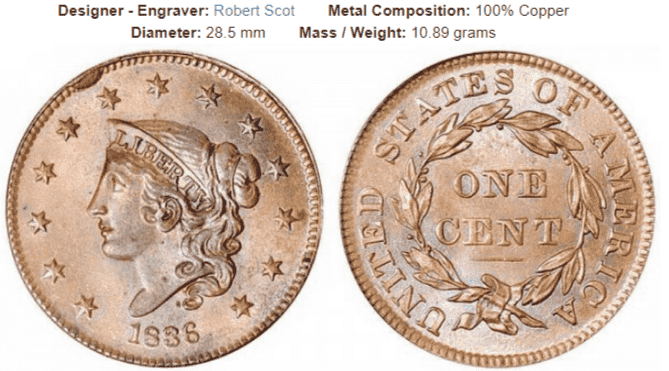
Image source: https://www.usacoinbook.com
1839-1857 Braided Hair
In 1839, following criticism regarding Liberty’s appearance, new Chief Engraver Christian Gobrecht redesigned the Coronet Large Cent. He bestowed a more youthful and slimmer look upon Lady Liberty, which received a warmer public reception. This design was dubbed “Braided Hair”, even though the hairstyle looked similar to the one shown on the Matron Head coin.
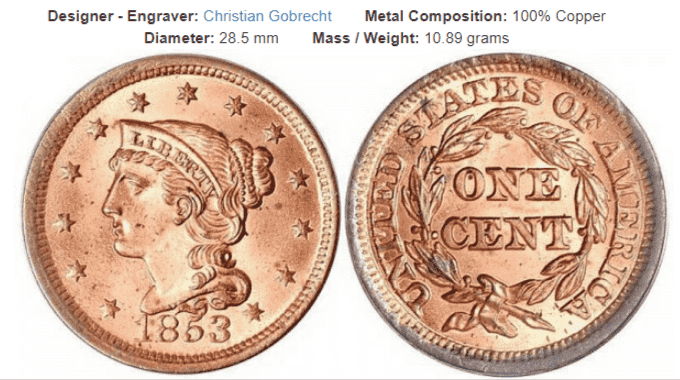 Image source: https://www.usacoinbook.com
About 11 years after the Large Cent was retired, an employee at the mint coined
several Large Cents dated 1868. About 18 or 19 of these unofficial mint issues are confirmed to have survived until present day.
Large Cent Value
Large Cents are often desirable acquisitions for any coin collector. Depending on their condition and variety, Large Cent coins can be worth on average between $20 and $5,000. However, several Large Cents have been valued at over $50,000, though they are incredibly rare. Here are some of the more valuable varieties of Large Cents deriving their worth from low mintages, their condition, their type, or a combination of the three.
1793 Chain Reverse
Value: Between $8,000 and $1,000,000, depending on condition and variety
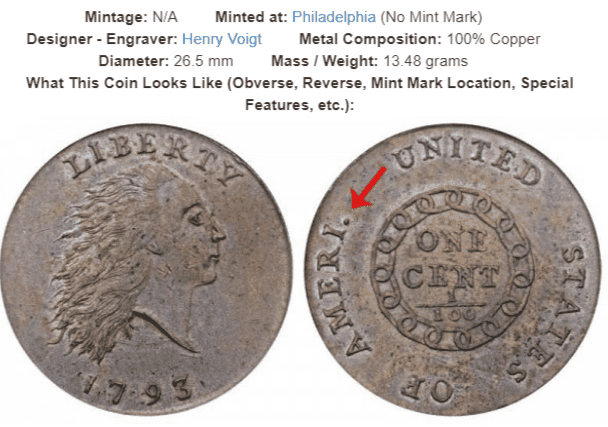
Three varieties were produced for the 1793 Chain Reverse: “AMERI” in legend, “AMERICA” with periods, and “AMERICA” without periods. Examples are shown below:
Images source: https://www.usacoinbook.com
1793 Wreath Reverse
Value: Between $3,000 and $300,000, depending on condition and variety.
Three varieties were produced for the 1793 Chain Reverse: “Vines and Bars Edge”, “Lettered Edge”, and “Strawberry Leaf”. Examples are shown below:

Images source: https://www.usacoinbook.com
1793 Liberty Cap
Value: Between $6,000 and $740,000, depending on condition and variety.
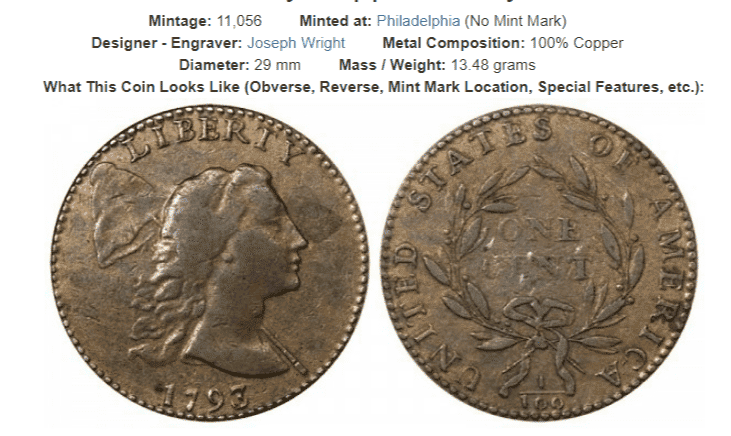
Image source: https://www.usacoinbook.com
1743 Liberty Cap: Starred Reverse (Around Rim)
Value: Between $12,000 and $660,000, depending on condition and variety.
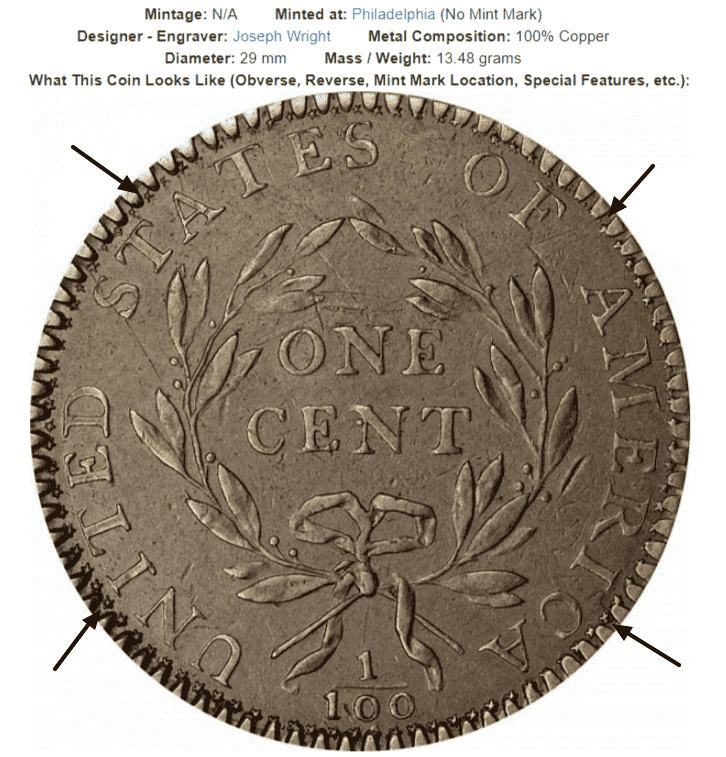
Image source: https://www.usacoinbook.com
1799 Draped Bust: Normal Date
Value: Between $2,900 and $75,000, depending on condition and variety.
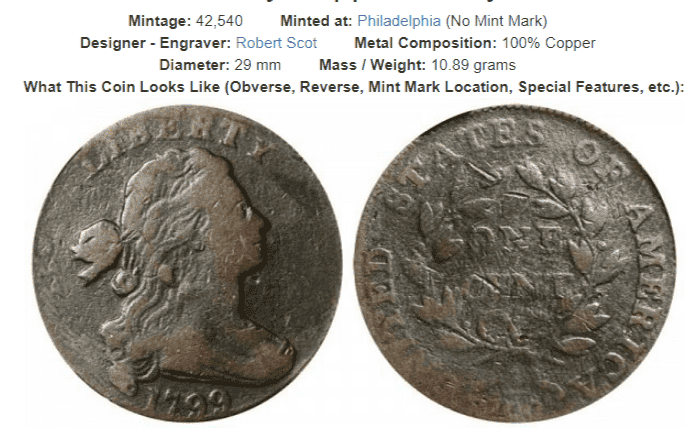
Image source: https://www.usacoinbook.com
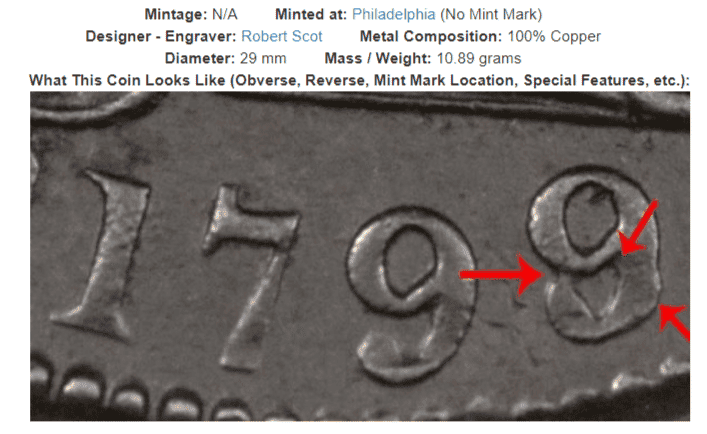
1799 Draped Bust: 9 Over 8
Value: Between $3,500 and 85,000, depending on condition and variety.
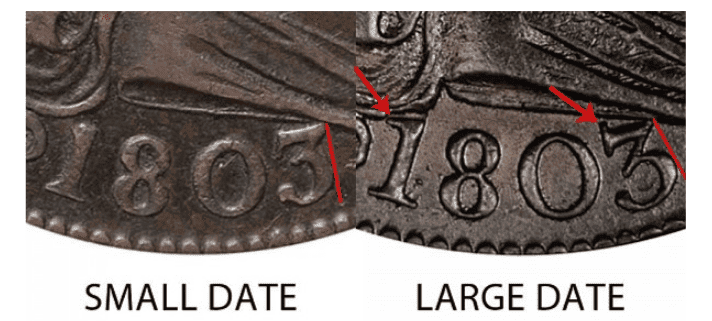
1803 Draped Bust: Large Date - Small Fraction
Value: Between $4,800 and $85,000, depending on condition and variety.
Images source: https://www.usacoinbook.com
1804 Draped Bust
Value: Between $1,000 and $208,000, depending on condition and variety.
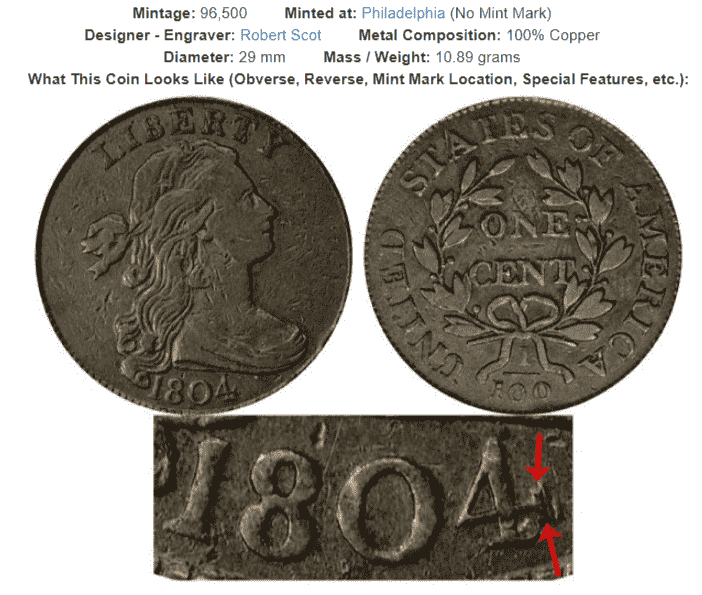
Images source: https://www.usacoinbook.com
1811 Classic Head: Last 1 Over 0
Value: Between $89 and $5,550, depending on condition and variety.
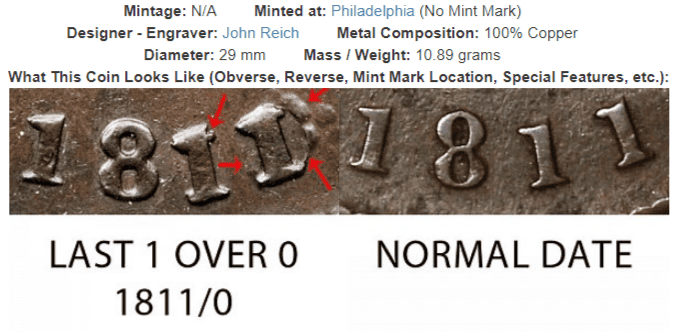
Image source: https://www.usacoinbook.com
1830 Coronet Head: Medium Letters
Value: Between $25 and $27,000, depending on condition and variety.
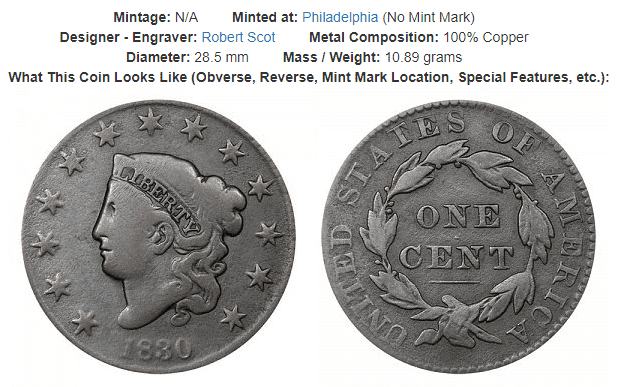
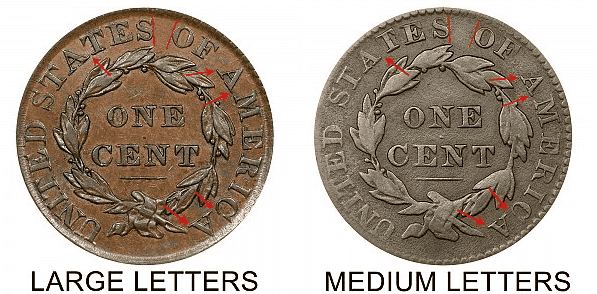
Images source: https://www.usacoinbook.com
1839 Coronet Head: 9 Over 6: Plain Cords
Value: Between $240 and $95,000, depending on condition and variety.
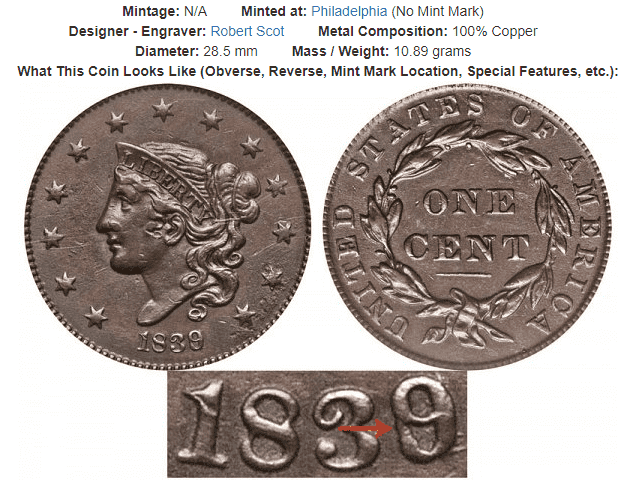
Image source: https://www.usacoinbook.com
1844 Braided Hair: 44 Over 81
Value: Between $30 and $28,000, depending on condition and variety.
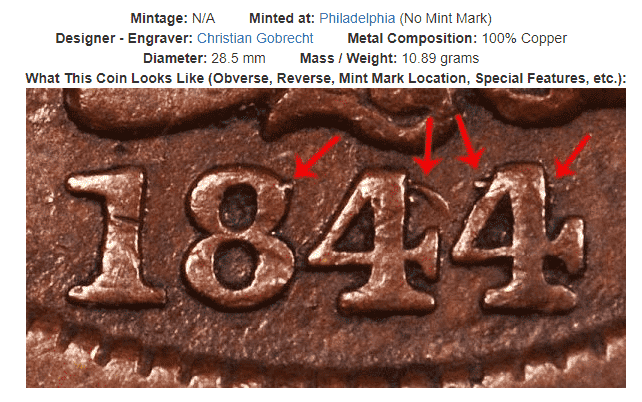
Image source: https://www.usacoinbook.com
Because Large Cents are somewhat difficult to come across, the above examples are just a few of the many valuable varieties collectors can come across. As always, when attempting to determine the value of your Large Cent, it is best to consult a numismatic professional. Usually, the clearer the details of the coin, the higher the coin’s value. However, many other components affect each individual coin’s value as well.