View Charts
Will Palladium Climb Back Toward $4,000 in 2026?
 0
0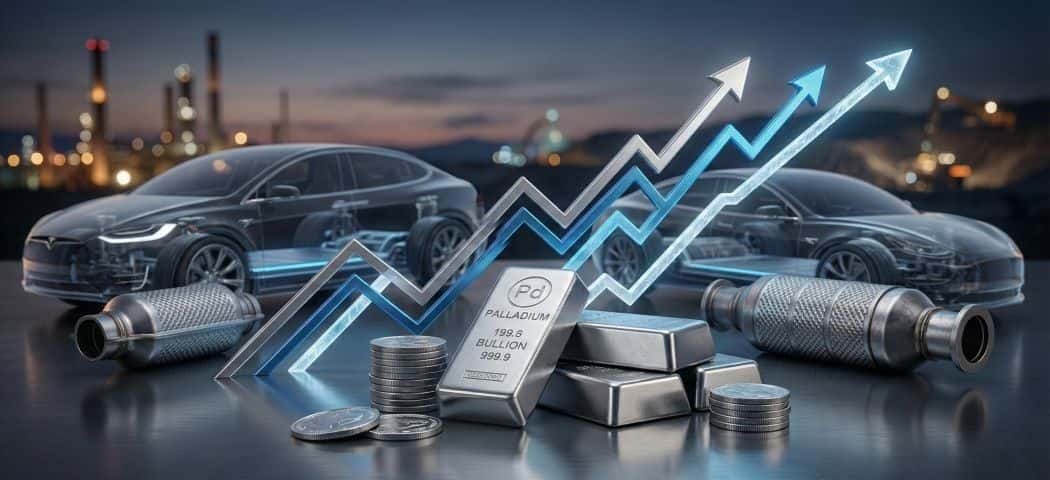
Could Palladium Really Return to $4,000?
Palladium was once the undisputed star of the precious-metals world, soaring above $3,000 per ounce during its historic bull run in 2019–2022. Now, after a dramatic multi-year decline driven by shifting automotive demand and substitution trends, palladium trades far below its previous highs — leaving investors wondering whether the metal’s best days are behind it.
But beneath the surface of today’s low palladium spot prices, new data suggests an unexpected possibility: palladium may be setting up for a powerful rebound, potentially even approaching $4,000 per ounce under the right conditions. As the global economy pivots toward electrification and new catalytic-converter technologies, a surprising supply-demand imbalance may be forming — one Wall Street has not fully priced in.
This raises a bigger question for 2026:
Is palladium poised for a record-breaking short squeeze?
Why Investors Are Asking: “Will Palladium Rebound?”
After years of decline, palladium appears deeply undervalued relative to its long-term fundamentals. While the shift toward electric vehicles initially pressured demand, several overlooked trends now hint at a potential pivot.
The Gold-to-Palladium Ratio Signals Extreme Undervaluation
One of the clearest indicators of palladium’s mispricing is the gold-to-palladium ratio, which measures how many ounces of palladium equal the value of one ounce of gold. Historically, palladium has traded close to or above the price of gold during periods of tight supply and strong automotive demand.
Today, the ratio has flipped dramatically: gold is valued at nearly triple the price of palladium, one of the widest spreads in decades. When this ratio reaches extreme levels, it has historically preceded powerful palladium rallies — including the explosive run that propelled prices past $3,400 per ounce in 2019–2022.
The current ratio indicates that palladium may be one of the most undervalued major metals in the entire precious-metals complex, especially if supply constraints intensify or hybrid demand remains stronger than expected.
1. Hybrid Vehicles Still Dominate the Automotive Market
Despite EV momentum, fully electric vehicles are not yet the global standard. Hybrids — which still require catalytic converters — remain the fastest-growing segment in multiple markets, including the U.S., Japan, and parts of Europe.
Many of these systems continue to rely on palladium-rich catalysts, especially in newer high-temperature combustion designs. Analysts expecting palladium demand to collapse may have underestimated how long internal-combustion hybrids will remain on the road.
2. China and India Are Driving Fresh Auto Demand
Two of the world’s largest automotive markets are increasing vehicle production, and many models still use catalytic converters requiring palladium. As emission standards tighten, catalyst loadings increase — creating silent but significant new demand.
3. A Supply Crunch May Be Building
Palladium supply is heavily concentrated in just two regions:
-
Russia (one of the world’s largest producers)
-
South Africa (where palladium is often a byproduct of platinum mining)
Both face challenges:
-
sanctions, export complications, and restricted logistics (Russia)
-
energy shortages, mine closures, and unstable production schedules (South Africa)
If either region experiences further disruption, palladium supply could tighten abruptly — a scenario that has historically triggered extreme price spikes.
4. The Market Is Historically Overshort
Palladium has one of the highest short-interest levels in the commodity space due to long-term bearish sentiment. If physical shortages appear unexpectedly — particularly through auto-sector restocking or renewed investment demand — shorts could be forced to cover rapidly.
This is the exact setup that triggered palladium’s last record-breaking rally.
How the EV Transition Could Help Palladium, Not Hurt It
While full EV adoption reduces catalytic converter demand, the transition is slower and more uneven than early forecasts predicted.
Unexpected supportive factors include:
Hybrid demand increasing catalyst consumption
Hybrids use sophisticated emissions systems that often require higher palladium loadings than older gasoline models.
Transitional technologies rely on palladium
Many nations are adopting plug-in hybrids as a stepping stone to full electrification — further extending palladium's relevance.
Industrial demand is expanding quietly
Palladium remains key in:
-
chemical processing
-
electronics and memory storage
-
hydrogen purification
-
high-performance alloy production
This diversification supports a firm demand floor even as EV adoption grows.
Could Palladium Really Return to $4,000 in 2026?
While not guaranteed, several scenarios could ignite a powerful rally:
Bull Case Scenario
-
Global hybrid sales rise faster than expected
-
Russia experiences export disruptions
-
South African mining faces prolonged power instability
-
Short sellers begin covering positions
-
Investors rotate into undervalued metals after gold and silver peak
This combination could push palladium into deficit, forcing a rapid repricing similar to previous squeezes.
Extreme Case: A Short Squeeze
If industrial users begin restocking while supply tightens, palladium — one of the world’s smallest and thinnest-traded precious metals — could experience a violent upward shock, sending prices back toward $4,000.
Base Case Scenario
Even without a squeeze, analysts acknowledge that current palladium pricing is disconnected from long-term fundamentals. A rebound to more normalized levels would not be surprising.
Investor Strategy: How to Approach Palladium Now
For investors watching palladium’s volatility, several strategic considerations stand out:
1. Treat Palladium as a High-Conviction, High-Volatility Asset
Small market size = big price swings. Position sizing is crucial.
2. Monitor Auto and Hybrid Sales Data
These numbers are leading indicators for palladium demand.
3. Keep an Eye on Russia and South Africa
Geopolitical or energy disruptions can move the entire market overnight.
4. Diversify With Platinum
Platinum and palladium often trade inversely; holding both can stabilize risk.
5. Favor Physical Palladium for Scarcity Exposure
Bullion coins and bars allow investors to benefit directly from potential supply crunches.
A Sleeping Giant in the Precious Metals Market
Palladium may be one of the most misunderstood metals of the decade. After an extended downturn, market sentiment is deeply bearish — yet underlying fundamentals suggest a very different picture. With supply concentrated, demand evolving, and short interest building, palladium could be positioned for one of the most explosive rebounds in the precious-metals space.
If a short squeeze emerges or automotive demand surprises to the upside, palladium’s journey back toward $4,000 per ounce may not be as far-fetched as it sounds.
For investors willing to embrace volatility and seek asymmetric opportunity, palladium could be the unexpected standout of 2026.