View Charts
Why Gold Has Outlasted Every Paper Currency
 0
0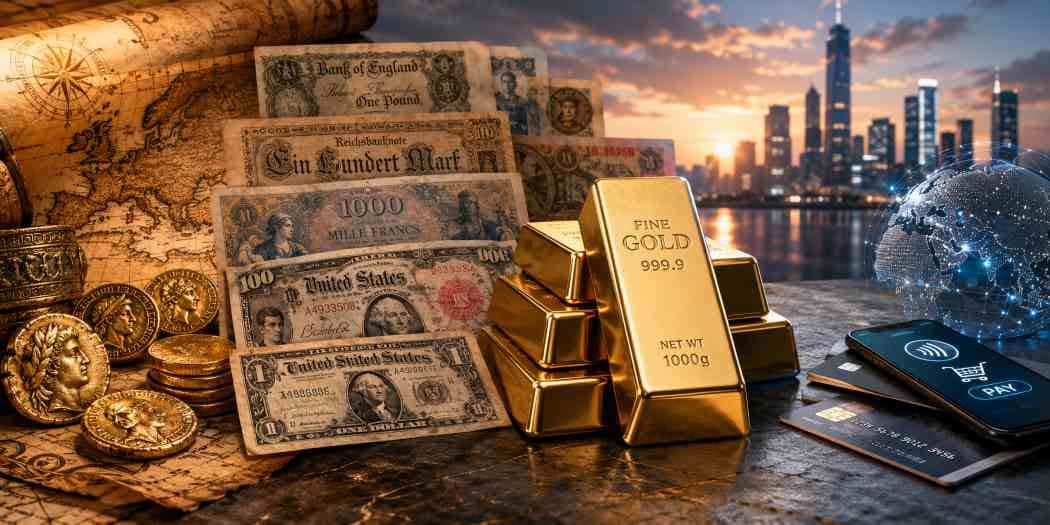
Every Currency Changes, but Gold Endures
Every paper currency has a story. Some lasted for centuries before being replaced, while others unraveled quickly as inflation, political upheaval, or economic mismanagement eroded public confidence. Even the world's strongest currencies have changed through redenominations, policy shifts, or new monetary frameworks.
Gold tells a different story. For thousands of years, it has remained scarce, recognizable, and widely accepted across cultures and financial systems. Today, even in an era dominated by digital payments and fiat currencies, central banks continue holding gold reserves, and investors still turn to physical bullion during periods of economic uncertainty.
That raises an important question: Why has gold outlasted every paper currency while no fiat monetary system has remained unchanged?
The answer is not that modern currencies have failed. Fiat money serves an essential purpose by supporting commerce, credit, and monetary policy. Gold serves a different role. Currencies circulate; gold preserves. That distinction helps explain why gold has endured through empires, gold standards, floating exchange rates, and the rise of digital finance.
When Money Was Measured by Metal
Long before paper money became commonplace, civilizations relied on precious metals because they possessed qualities that made them naturally suited for commerce. Gold was durable, portable, difficult to counterfeit, and scarce enough to retain value without being so rare that it became impractical for trade.
Ancient kingdoms across Europe, Asia, the Middle East, and North Africa independently adopted gold as a medium of exchange, long before today's interconnected financial markets existed. While the coins, rulers, and empires changed, the underlying trust in gold remained remarkably consistent. Its value did not depend on a government's promise to redeem it or on confidence in a central bank. Ownership itself represented wealth.
As economies expanded, however, carrying large quantities of precious metals became increasingly inefficient. Merchants, banks, and eventually governments began issuing paper certificates that represented claims on gold held in reserve. Those certificates gradually evolved into the paper currencies that shaped the modern financial system, setting the stage for one of history's most significant monetary transformations.
From the Gold Standard to Fiat Money
For much of modern history, paper currency represented something tangible. Under various forms of the gold standard, banknotes could be exchanged for a fixed amount of gold, giving people confidence that the paper in their pockets was backed by a scarce physical asset. While countries adopted different versions of the system, the underlying principle remained the same: governments limited the amount of currency they could issue by the gold they held in reserve.
That relationship began to change during the twentieth century. Two world wars, the Great Depression, and the growing complexity of global trade placed enormous pressure on gold-backed monetary systems. Governments needed greater flexibility to finance spending and respond to economic crises than a fixed gold supply could reasonably provide.
Following World War II, the Bretton Woods Agreement established a new international framework in which the U.S. dollar became the world's primary reserve currency and remained convertible into gold for foreign governments at $35 per ounce. Other major currencies were then pegged to the dollar, creating a system that brought relative stability to international trade for more than two decades.
By the late 1960s, however, growing U.S. spending and increasing foreign demand for gold placed significant strain on that arrangement. On August 15, 1971, President Richard Nixon suspended the dollar's convertibility into gold, an event commonly known as the 'Nixon Shock.' The decision effectively ended the Bretton Woods system and ushered in the modern era of floating fiat currencies.
Although gold no longer served as the foundation of the international monetary system, it did not lose its importance. Instead, its role evolved. Rather than circulating as everyday money, gold increasingly became a reserve asset held by governments and a store of wealth sought by investors during periods of inflation, financial uncertainty, or geopolitical tension.
Why Central Banks Still Hold Gold
If fiat currencies replaced the gold standard more than fifty years ago, an obvious question follows: Why do central banks still own so much gold?
The answer lies in diversification and confidence.
Unlike government bonds or foreign currencies, gold is not the liability of another nation or financial institution. It carries no default risk, cannot be created by monetary policy, and has historically maintained purchasing power over long periods despite changing political and economic conditions.
That helps explain why central banks have remained active buyers in recent years. Countries including China, India, Poland, Turkey, and several emerging-market economies have expanded their official gold reserves as part of broader efforts to diversify away from an overreliance on any single reserve currency. Rather than signaling the end of fiat money, these purchases reflect the continued value of holding an internationally recognized reserve asset alongside traditional foreign exchange holdings.
Gold's Role Changed, but Its Purpose Did Not
The end of the gold standard did not diminish gold's importance—it simply changed how the metal functions within the global financial system. Today, people no longer use gold to buy groceries or pay their mortgage, yet it continues to play a unique role that modern currencies cannot fully replace.
Gold is no longer money in the transactional sense; instead, it serves as monetary insurance. Investors often purchase physical bullion not because they expect it to outperform every other asset every year, but because it has historically helped preserve purchasing power during periods of inflation, currency depreciation, financial market stress, and geopolitical uncertainty. While its spot price fluctuates in the short term, gold has repeatedly demonstrated an ability to retain value across decades rather than months.
Paper currencies, by contrast, are designed to facilitate spending and economic activity. Moderate inflation is not considered a flaw of the modern monetary system—it is often an intended outcome of central bank policy, encouraging investment and consumption instead of long-term cash hoarding. As a result, the purchasing power of virtually every major currency gradually declines over time, even in healthy economies.
That difference explains why many long-term investors own both. Cash provides liquidity for everyday needs, while gold is held as a long-term store of value that exists outside the banking system and is not dependent on the fiscal or monetary policies of any single country.
What History Suggests About the Future of Money
History does not suggest that paper currencies will disappear overnight. It shows that monetary systems continually evolve. The currencies people use today look different from those used a century ago, and future innovations—including central bank digital currencies, faster payment networks, and new financial technologies—will likely continue reshaping how money moves.
Gold's role is different. It has survived monarchies, republics, empires, gold standards, floating exchange rates, and digital banking because its value is not tied to the policies of any single issuer. Governments still hold it, investors still buy it, and global markets still recognize it as a store of value.
That enduring relevance is not based on nostalgia for the gold standard or distrust of all fiat currency. It reflects a practical reality: a scarce, tangible asset with no issuer can complement a financial system built on confidence and credit. Every major paper currency has changed because economies and governments change. Gold has endured because the traits that made it valuable thousands of years ago—scarcity, durability, divisibility, and universal recognition—remain valuable today.
Related reading you may find interesting:
5 Facts Most Investors Don’t Know About Gold