View Charts

What Is the Oldest U.S. Coin You Can Own?
 0
America's Earliest Coins Are Still Within Collectors' Reach
The oldest American coins are not necessarily locked away in museums or reserved for wealthy collectors. Copper pieces from the colonial and early federal periods still appear in auctions and dealer inventories, sometimes at prices far below those associated with famous American rarities.
The answer to which is the oldest U.S. coin you can own, however, depends on what counts as a United States coin. Colonial currency predates independence, the Continental Congress authorized coinage before the federal Mint existed, and the first Mint issues followed several years later. Understanding those distinctions opens up a surprisingly broad range of collecting opportunities.
Before the U.S. Mint, America Already Had Coins
Long before the first federal Mint opened, Americans conducted business using an assortment of foreign and locally produced coins. Spanish silver circulated alongside British and other European money, while colonial governments and private businesses attempted to address chronic shortages of small change. The resulting pieces form an important part of early American numismatics, although they were not all issued by the government that would become the United States.
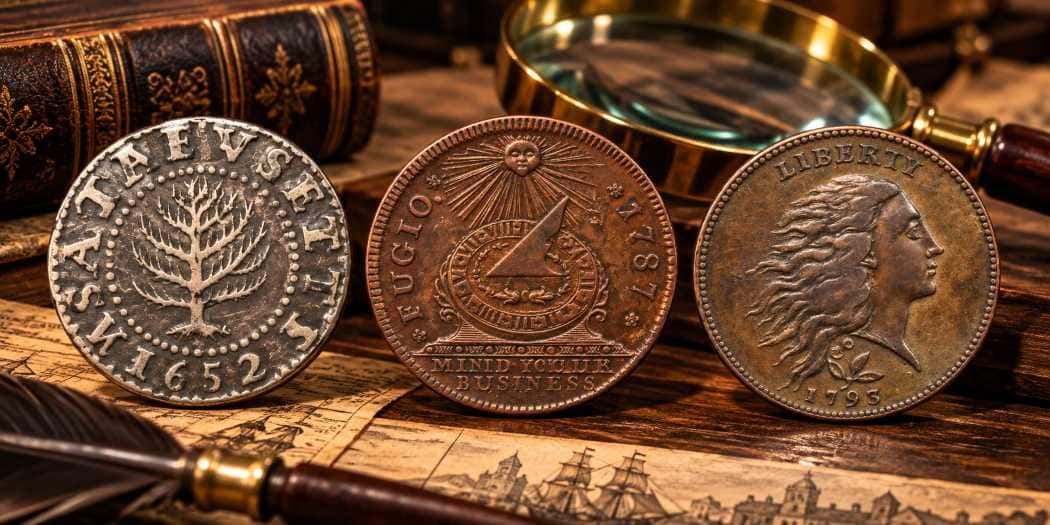
One of the earliest collectible examples is the Massachusetts silver coinage of 1652. Its denominations included the threepence, sixpence and shilling, with designs that evolved from relatively simple markings to the better-known Willow Tree, Oak Tree and Pine Tree types. These coins were produced under colonial authority, not by a United States government that did not yet exist.
The distinction matters when evaluating claims about America's oldest coins. A Massachusetts Pine Tree shilling is older than any federal coin, but describing it as the first U.S. Mint issue would be incorrect. Its historical importance comes from colonial monetary independence and the circumstances of its production.
Original Massachusetts silver pieces remain collectible today, though prices can be substantial, especially for desirable types and well-preserved examples. They are better suited to buyers prepared for specialized authentication and the premiums associated with seventeenth-century American history.
The 1787 Fugio Cent: A Strong Claim to Being First
For collectors seeking an early coin authorized at the national level, the 1787 Fugio cent provides one of the most compelling answers. Congress authorized the copper coinage under the Articles of Confederation, before the Constitution established the present federal government and before the Philadelphia Mint was created.
The Fugio cent features a sundial and the word FUGIO, commonly understood as a reference to time's passage. The reverse shows thirteen interlocking rings representing the states, accompanied by a national inscription. Its design reflects the political challenge of building unity among states that had only recently won independence.
The coin's classification has attracted considerable numismatic discussion. Professional Coin Grading Service recognizes the Fugio cent as the first regular-issue United States coin, emphasizing its congressional authorization and intended role as circulating currency. Other historical presentations reserve the beginning of federal Mint coinage for 1792 or 1793. Those positions use different definitions of first, rather than necessarily disagreeing about when the coins were made.
Crucially, Fugio cents survive in enough numbers to remain obtainable. Worn examples of more common varieties can cost hundreds or a few thousand dollars, while scarce varieties and high-grade specimens command considerably more. Their combination of age, recognizable design and documented national authorization makes them an appealing starting point for collectors interested in America's earliest coinage.
What About the Experimental Coins of 1792?
Congress established the United States Mint through the Coinage Act of April 2, 1792. The legislation authorized a national system of copper, silver and gold denominations, but establishing a mint and producing circulating coinage were separate undertakings. Equipment, personnel and facilities had to be assembled before regular production could begin.
During this transitional period, several experimental and early pieces appeared, including the 1792 silver half disme. The U.S. Mint's history of circulating coins states that approximately 1,500 half dismes were made while the new facility was still under construction, probably for distribution to dignitaries and acquaintances rather than general circulation.
These pieces occupy an unusual place in American coinage history. Their relationship to the developing Mint gives them greater official significance than an ordinary private token, yet they precede the Mint's established circulation program. Specialists have also debated how individual 1792 issues should be classified, with distinctions among experimental pieces, patterns and regular issues depending on the particular coin.
A genuine 1792 half disme can be privately owned, but it is a major numismatic acquisition rather than an economical entry into early American collecting. Surviving examples are scarce, and authentication, condition and provenance strongly influence their value.
The First Circulating Coins of the Federal Mint Arrived in 1793
If the question specifically means the oldest coins released into circulation by the United States Mint, the answer begins with the 1793 copper cent. The Mint records its first delivery of circulating coins on March 1, 1793, consisting of 11,178 cents. That milestone established regular federal coin production after years of relying on colonial, state and foreign money.
The first cents carried the Flowing Hair portrait of Liberty and a chain of fifteen links on the reverse. The design quickly became controversial, partly because some observers associated the chain with slavery rather than national unity. The Mint replaced it with a wreath design, creating two distinctive and highly collectible types from its inaugural year.
A 1793 Chain cent is a significant rarity, and even heavily circulated examples can require a substantial budget. Wreath cents are also valuable, although their availability and prices vary by variety and condition. The year matters enormously to specialists because it marks the beginning of regular coinage at the national Mint.
The 1793 half cent offers another early federal collecting possibility. Like the cent, it belongs to the Mint's first year of circulation production, but it represents a different denomination and collecting market. Surviving examples can be expensive, yet they provide a historically meaningful alternative for buyers researching the first federal issues.
Which Early American Coin Is Most Realistic to Buy?
For many collectors, the 1787 Fugio cent offers a practical balance between age, historical significance and availability. It predates the federal Mint, has a direct connection to congressional authorization and exists in varieties accessible below the prices typically associated with 1792 silver pieces or 1793 Chain cents.
Collectors with smaller budgets can explore other colonial and state-issued copper coins from the 1780s, including Connecticut and New Jersey coppers. These pieces connect directly to America's early monetary difficulties and often survive with considerable wear. Their condition, attribution and authenticity require attention, but some common varieties can offer an accessible route into eighteenth-century numismatics.
The purchase decision should not rest on the date alone. Corrosion, cleaning, repairs and uncertain authenticity can materially affect an early copper coin's desirability. A certified, problem-free example may justify a higher price than a superficially sharper coin with undisclosed damage, while collectors who accept imperfections may find opportunities at lower price points.
Resources such as PCGS CoinFacts help buyers research varieties, images and documented auction results. Comparing multiple sales of the same attribution and approximate condition is more informative than relying on a single asking price.
Buying History Without Confusing Age and Rarity
The oldest coin a collector can own depends on the definition being used. Colonial Massachusetts silver reaches back to the seventeenth century, the 1787 Fugio cent has a strong claim as the first congressionally authorized national coin, and 1793 cents mark the beginning of regular circulating production at the federal Mint.
Each represents a different chapter in American monetary history. None is automatically the best purchase simply because it carries an earlier date. Scarcity, preservation, authenticity and collector demand determine what an individual specimen is worth.
For someone beginning an early American collection, a well-attributed Fugio cent or a common state copper may offer a more satisfying purchase than stretching for a damaged example of a famous rarity. The opportunity is not merely to own an old coin, but to hold a surviving piece of the nation's transition from colonial money to a unified currency.
The key historical distinction is supported by the U.S. Mint's account of the first 1793 circulation delivery and PCGS's detailed case for recognizing the 1787 Fugio cent as the first regular-issue national coin.
Related reading you may find interesting:
Coin Restrike vs. Reproduction: What Does COPY Mean?
Why Do Some U.S. Coins Have Words on Their Edges?