View Charts

Why Do Some U.S. Coins Have Words on Their Edges?
 0
The Third Side of a Coin Has Its Own History
Most collectors examine a coin's obverse and reverse before looking anywhere else. Yet on certain American coins, revealing details appear along the narrow edge, where inscriptions can identify a denomination, express a national ideal, or disclose how the coin was manufactured.
Edge lettering has served different purposes throughout U.S. monetary history. Early federal coins used it to identify value and help expose the removal of precious metal. Augustus Saint-Gaudens later incorporated a national motto into his celebrated gold double eagle, while modern dollar programs use the same surface for dates and mint marks.
Unlike the grooves known as reeding, edge lettering consists of words, numbers, or symbols. Understanding that distinction helps collectors identify historical varieties, recognize minting errors, and avoid mistaking normal production characteristics for unusual features.
Early American Coins Used Lettering to Protect Their Value
When the United States established its federal coinage system in the 1790s, precious-metal content was fundamental to the value of gold and silver coins. Removing metal from their edges created opportunities for fraud, particularly when altered coins continued circulating at their original denominations.
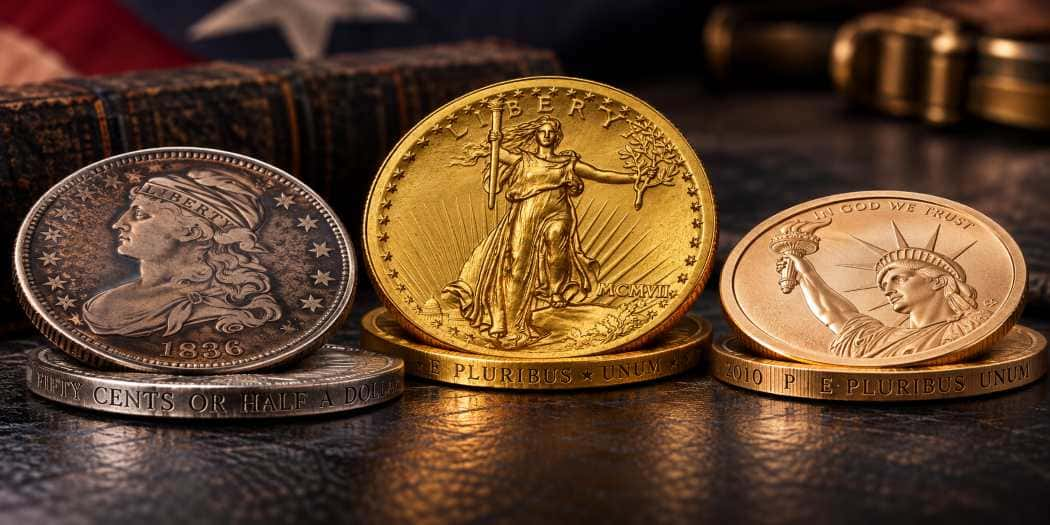
Early American half dollars carried the inscription FIFTY CENTS OR HALF A DOLLAR. The lettering appeared on Flowing Hair, Draped Bust, and Capped Bust issues before reeded edges replaced it during the 1830s. Early silver dollars used HUNDRED CENTS ONE DOLLAR OR UNIT, with variations in punctuation and spacing.
These inscriptions reinforced the coin's monetary identity while making the removal of precious metal easier to detect. Clipping or filing an edge could damage its lettering, providing visible evidence of possible alteration.
The manufacturing process introduced characteristics that interest collectors today. Early edge lettering was generally impressed before the obverse and reverse were struck, using a device called a Castaing machine. A coin blank passed between engraved steel bars that transferred lettering to its circumference. Imperfect alignment occasionally produced overlapping characters, incomplete inscriptions, or unusual spacing.
Such irregularities offer clues about historical manufacturing rather than automatically indicating valuable errors. Numismatic Guaranty Company has documented an 1836 half dollar with doubled edge lettering, illustrating how the equipment itself could produce distinctive results. These details help specialists distinguish production varieties from later damage.
Saint-Gaudens Transformed the Edge Into an Artistic Feature
By the late nineteenth century, most familiar American denominations had plain or reeded edges. Lettering returned prominently in 1907 with the Saint-Gaudens $20 gold double eagle, celebrated for its sculptural depiction of Liberty.
Its edge carried E PLURIBUS UNUM, separated by stars.
Augustus Saint-Gaudens sought to elevate American coinage through designs inspired by classical art. Placing the motto on the edge preserved the visual impact of the obverse and reverse without sacrificing an important national inscription. The Latin phrase, meaning “Out of Many, One,” served a different purpose from the denomination statements on early silver coins: it communicated a national ideal while contributing to the artistic composition.
The inscription remained a defining characteristic of the double eagle through the series' final year in 1933. It demonstrates why the edge cannot always be considered secondary. On this coin, lettering formed part of the original design concept, helping establish the uncluttered appearance collectors continue to admire.
Presidential Dollars Made Edge Lettering Relevant Again
When the Presidential $1 Coin Program began in 2007, edge lettering returned to modern American dollar coinage on a significant scale. The series honored former presidents in the order of their service, pairing presidential portraits with the Statue of Liberty on the reverse. Moving inscriptions to the edge provided additional space for the main designs.
The original arrangement placed the year, mint mark, E PLURIBUS UNUM, and IN GOD WE TRUST around the circumference. Although the motto remained present, its less visible location prompted controversy among people who believed it had been omitted. Beginning in 2009, IN GOD WE TRUST moved to the obverse, while the other inscriptions remained on the edge.
The separate edge-lettering operation also introduced opportunities for manufacturing errors. Some early Presidential dollars passed through production without receiving their intended inscriptions, leaving their edges plain. These missing-edge-lettering coins attracted considerable collector attention. Other examples display doubled, partial, or abnormal lettering, although their significance depends on the issue and production circumstances.
Distinguishing genuine errors from damaged coins is essential. Filing, abrasion, and deliberate alteration can distort inscriptions after a coin leaves the Mint, sometimes resembling a production mistake. Collectors evaluating questionable examples should consider recognized varieties, authentication, condition, and documented populations.
American Innovation Dollars Carry the Tradition Forward
The American Innovation $1 Coin Program demonstrates how edge lettering became an established design choice. Its coins recognize innovations and innovators associated with individual states and territories, pairing a common Statue of Liberty obverse with changing reverse designs.
Like later Presidential dollars, American Innovation coins place the year, mint mark, and E PLURIBUS UNUM on the edge. This arrangement leaves more room for detailed reverse designs depicting inventions, technological developments, and historical achievements.
It also changes how collectors must examine the coins. An obverse-and-reverse photograph can show the complete artwork while omitting information necessary to identify the precise issue. Two coins that appear identical in conventional photographs may carry different mint marks on their edges, making that third surface essential when distinguishing production facilities.
How Collectors Should Examine Lettered Edges
Edge lettering deserves attention before assigning a variety, evaluating an unusual feature, or determining condition. On early silver issues, wording, punctuation, spacing, and completeness may help identify a particular type. On modern dollars, the edge often supplies the date and mint mark needed to establish the exact issue.
Lettering orientation is frequently misunderstood. Because edge inscriptions can be applied separately from the main strike, their direction relative to the obverse may vary during normal production. Words that appear upside down when a portrait faces the viewer are not necessarily evidence of an error. The relevant question is whether the lettering differs from accepted manufacturing characteristics for that series.
Collectors should also examine the edge's physical condition. Circulation wear, cleaning, filing, and intentional alteration can affect inscriptions in ways that resemble minting irregularities. Professional grading services evaluate these features in the context of the entire coin, including their consistency with known production methods.
The historical relationship between lettering and reeding is worth remembering. Both treatments helped address concerns about precious-metal removal, but they developed different functions. As explained in Why Do Coins Have Reeded Edges?, reeding consists of narrow grooves rather than inscriptions and remains familiar on modern quarters and dimes.
Edge lettering reveals how coin design adapted to changing priorities. What began partly as a safeguard for precious-metal currency became an artistic device on the Saint-Gaudens double eagle and later a way to organize information on modern dollars. Examining the edge can therefore reveal a coin's manufacturing history, identity, and design intentions in ways its two main faces cannot.