View Charts
U.S. Gold Reserves Top $1 Trillion: Will This Spark a Fort Knox Audit?
 0
0
U.S. Gold Reserves Hit $1 Trillion Milestone
For decades, America’s vast gold reserves have captured the imagination of economists, investors, and everyday citizens. With gold currently trading around $3,840 per ounce, the U.S. Treasury’s official holdings of 261,498,926 troy ounces (≈8,133.5 metric tons) now carry an estimated market value of over $1 trillion for the first time in history.
Interestingly, those same reserves are still carried on government books at just $11 billion, using a statutory valuation of $42.22 per ounce set in 1973. This milestone not only reignites the age-old debate about whether the government should conduct a comprehensive, independent audit of Fort Knox, but also raises fresh questions about the way America accounts for—and manages—its most enduring tangible asset.
America’s $1 Trillion Gold Cache
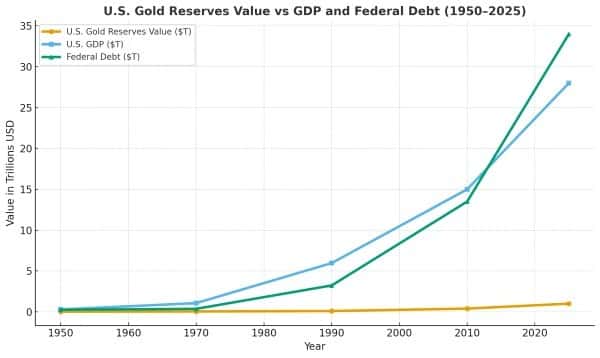
The U.S. gold reserves—primarily stored at Fort Knox, the Denver Mint, and West Point—have remained virtually unchanged for decades. At today’s record prices, these holdings are worth about $1.004 trillion. While staggering in absolute terms, their relative impact on the U.S. economy tells another story:
-
U.S. GDP (2024 est.): $28 trillion → Gold = ~3.6% of GDP
-
U.S. National Debt (2024): $34 trillion → Gold = ~2.95% of debt
Despite reaching the trillion-dollar mark, gold reserves still cover only a sliver of America’s economic output and debt obligations.
The Push for Transparency: Legislation in Play
In June 2025, Representative Thomas Massie (R-KY) introduced the Gold Reserve Transparency Act of 2025 (H.R. 3795). The proposed law would:
-
Require the Comptroller General (GAO) to conduct a full, independent audit and assay of all U.S. gold holdings within one year of enactment.
-
Mandate recurring audits every five years.
-
Examine security protocols, confirm the authenticity of gold bars, and investigate any encumbrances (such as swaps or leases).
-
Review all gold transactions over the last 50 years.
Currently, the bill sits in committee and has yet to reach a floor vote. Supporters argue that reaching the $1 trillion mark underscores the urgency of full transparency. Skeptics highlight logistical challenges, costs, and national security concerns.
Fort Knox: Mystery and Symbolism
Fort Knox is more than just a vault; it’s a symbol of America’s financial strength and stability. Yet, public audits of the facility have been rare. The last meaningful inspections occurred in the 1970s, when officials opened a fraction of the sealed vaults to confirm presence, but not to assay each bar.
Why advocates want a new audit:
-
A trillion-dollar national asset deserves independent verification.
-
Transparency could boost global confidence in the U.S. dollar.
-
Periodic audits would align with best practices in both government and corporate finance.
Why opponents resist:
-
Full audits could expose security vulnerabilities.
-
The cost and complexity of verifying hundreds of thousands of bars is immense.
-
Current internal reviews by the Treasury and Mint may already suffice.
The $11 Billion Book Value and Its Origins
Although the market value of U.S. gold reserves now exceeds $1 trillion, the Treasury still records them at about $11 billion. This stems from a statutory rate of $42.2222 per ounce, set in 1973, which remains the official “book value” to this day. Importantly, this figure does not reflect what the government originally paid for its gold—much of it was accumulated decades earlier through domestic production, foreign trade surpluses, and monetary operations. Rather, the $11 billion number is an accounting convention that has never been updated to match market reality. The result is a striking gap: at current spot prices, the reserves are worth more than 90 times their book value, underscoring how much their market significance has grown even as the official ledger has stood still.
Have U.S. Gold Reserves Changed Since 1973?
Another important fact often overlooked in the debate is that the tonnage of America’s gold reserves has not changed since the early 1970s. Here are four key points that put this in context:
-
No net additions since the early 1970s. U.S. reserves peaked at about 20,000 metric tons in the 1950s before decades of outflows reduced them to today’s level of ~8,133.5 metric tons.
-
1971–1973: Nixon closes the gold window. When President Nixon ended dollar convertibility in 1971, foreign governments could no longer redeem dollars for gold, effectively halting further outflows.
-
Stable since 1973. Since then, the official figure of 261,498,926 troy ounces has remained unchanged for more than 50 years.
-
Only minor transfers. Movements since then have been limited to internal storage adjustments and assays; there have been no significant purchases or sales.
In short, America’s trillion-dollar gold valuation is due entirely to price appreciation, not new acquisitions. This fact strengthens the argument that transparency is needed—not just to verify the presence and authenticity of the bars, but also to account for why such a vast asset base has remained static for half a century.
Global Comparisons: How the U.S. Stacks Up
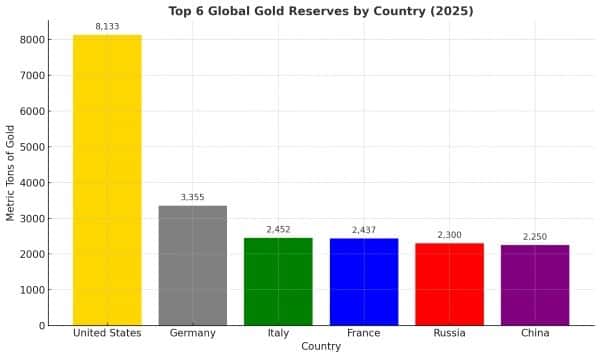
The U.S. holds the largest official gold reserves in the world at ~8,133 metric tons. For comparison:
-
Germany: ~3,355 tons
-
Italy: ~2,452 tons
-
France: ~2,437 tons
-
Russia: ~2,300 tons
-
China: ~2,250 tons (official, though analysts believe it may be higher)
Many of these nations have ramped up gold buying in recent years as a hedge against currency volatility and geopolitical risk. America’s trillion-dollar gold reserve thus remains a cornerstone of global monetary stability, but questions linger about transparency that many peer nations have begun to address more openly.
Investor Takeaways: Why This Matters to You
For retail and institutional investors, the debate over Fort Knox isn’t just political theater—it has direct implications:
-
Market Sentiment: A credible, independent audit could boost investor confidence in U.S. financial stability.
-
Gold Prices: Transparency might dampen conspiracy theories and volatility, or, conversely, reveal issues that send gold higher.
-
Portfolio Strategy: As central banks diversify into gold, individual investors can view this as reinforcement of gold’s role in a balanced portfolio.
In other words, the trillion-dollar milestone serves as a reminder that gold remains more than a commodity—it’s a foundation of trust.
Could the $1 Trillion Threshold Be a Turning Point?
Crossing the trillion-dollar valuation threshold could provide the political and public pressure needed to revisit gold audits. In an age of mounting federal debt and eroded trust in government institutions, tangible reserves like gold carry symbolic and strategic weight.
Investors and citizens alike may ask: if America’s gold holdings are worth more than ever before, shouldn’t we know with certainty that they are fully present, accounted for, and unencumbered?
Fort Knox Transparency and the Future of U.S. Gold Reserves
The soaring valuation of U.S. gold reserves to over $1 trillion may serve as a catalyst for long-overdue transparency. Whether Congress acts on legislation like H.R. 3795 remains uncertain, but the debate itself reflects a growing awareness that in today’s economy, both numbers and trust matter. And with the reserves still carried on the books at just $11 billion and the tonnage frozen since 1973, the disconnect between accounting and reality only sharpens the case for an independent audit.
For investors, this serves as a powerful reminder: gold’s value does not depend on government bookkeeping—it comes from its role as a store of wealth, hedge against uncertainty, and foundation of trust.
FAQ: U.S. Gold Reserves
Why hasn’t Fort Knox been audited recently?
Only limited inspections have occurred since the 1970s. Full, independent audits have never been conducted.
How much gold does the U.S. own?
Officially, 261,498,926 troy ounces (≈8,133.5 metric tons), primarily at Fort Knox, Denver, and West Point.
What is the Gold Reserve Transparency Act?
A 2025 congressional bill (H.R. 3795) requiring independent audits and assays of U.S. gold reserves every five years.
Could auditing Fort Knox impact gold prices?
Yes. A transparent audit could influence market confidence and either stabilize or accelerate demand, depending on findings.
Where are U.S. gold reserves stored?
Most are held at Fort Knox, with additional reserves at the West Point Bullion Depository and the Denver Mint.
Why is transparency in gold reserves important?
Independent audits build trust in the U.S. financial system, reassure global investors, and confirm the integrity of America’s largest tangible asset.
Another article that may interest you:
U.S. Government Shutdown Looms: What It Means for Gold, Silver & Crypto