View Charts
The Royal Mint Reimagined: Navigating Losses & Shaping the Future of Bullion
 0
0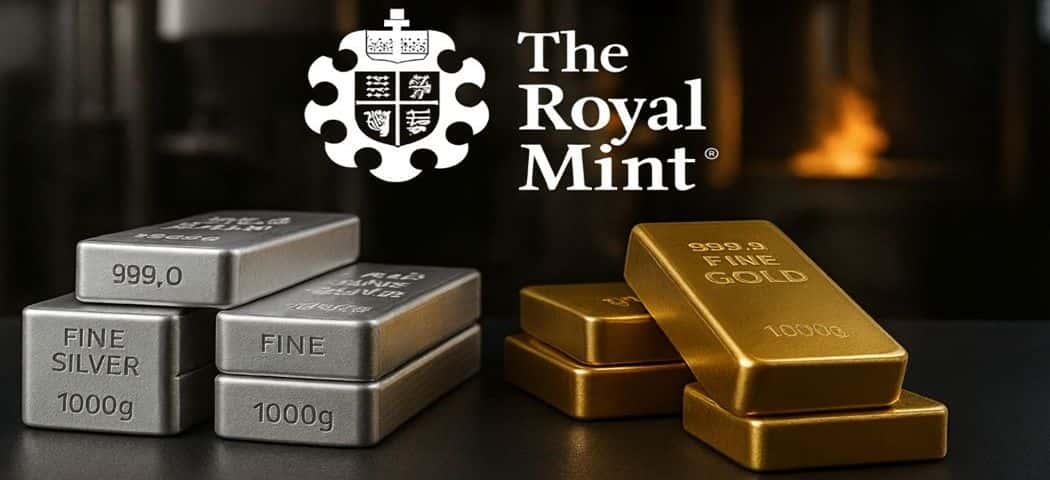
The Changing Face of a Global Mint
The Royal Mint, one of the world’s most historic coin producers, is entering one of the most transformative periods in its 1,100-year history. Once synonymous with sovereign coinage, the Mint now stands at a crossroads — redefining its role in a rapidly evolving global bullion and digital economy.
The 2024–2025 fiscal year marked both turbulence and transformation. Despite posting significant losses, the Mint is pursuing a bold pivot toward innovation, sustainability, and precious metals recovery. This shift, though costly in the short term, signals a strategic evolution from traditional coinage to a diversified, technology-driven enterprise.
Financial Performance and Structural Losses
The Royal Mint reported a post-tax loss of £36.3 million for fiscal 2024–25, primarily due to extraordinary restructuring costs of approximately £31.7 million. Revenue declined slightly year-over-year, from roughly £1.35 billion to £1.32 billion, as both its Currency and Consumer divisions faced weaker demand and higher costs.
Net assets fell to £119.5 million, reflecting the impact of the operating loss despite gains from revaluation and hedging adjustments. While the short-term picture looks challenging, the Mint describes these losses as “transitional” — an investment in reshaping the business model for the next century.
Transformation and Strategic Realignment
The Mint’s transformation plan centers on operational efficiency, innovation, and sustainability. A major element of this overhaul is the cessation of overseas coin production, a line once responsible for a large share of international revenue but now deemed unsustainable amid declining global demand for physical currency.
Instead, the Mint is directing resources toward new ventures such as Precious Metals Recovery (PMR) — a high-tech initiative that extracts gold and other metals from electronic waste. More than 1,500 tonnes of e-waste have already been processed through this pioneering facility.
To reinforce this initiative, the Mint acquired an 8% equity stake in its technology partner Excir, ensuring long-term access to proprietary refining methods and future growth opportunities in sustainable metallurgy.
Performance Across Key Business Segments
The Precious Metals Investment division — which includes bullion bars, coins, and exchange-traded products — remained one of the Mint’s most profitable segments, generating roughly £15.7 million in operating profit before central costs.
Conversely, the Consumer and Collector businesses saw softer sales amid record gold prices and shifting consumer behavior. The Mint responded by merging its commemorative and collector units into a streamlined “Collect” division, designed to reduce duplication, improve digital engagement, and align production with collector trends.
This consolidation reflects a broader industry reality: modern collectors are increasingly selective, gravitating toward high-value, low-mintage releases and pieces tied to cultural milestones.
The Decline of Circulating Coin Production
The Royal Mint has formally ended production of overseas circulating coins, citing structural overcapacity in global minting and the reduced use of cash. Although this decision eliminates a historic revenue stream, it significantly cuts costs and allows the Mint to focus on serving the UK Treasury, maintaining domestic coin stock, and preserving technical expertise.
This marks a symbolic end to an era in which the Mint served more than 100 countries worldwide — yet it also underscores the broader global transition from cash economies toward digital and bullion-based value storage.
Sustainability and ESG Leadership
In line with its transformation goals, the Royal Mint has elevated its commitment to sustainability. The 2024–25 report highlights its second consecutive year of disclosures under the Task Force on Climate-related Financial Disclosures (TCFD) framework, outlining risks and progress toward net-zero operations.
The Mint reports measurable reductions in Scope 1 and 2 emissions, while mapping long-term strategies to manage Scope 3 supply-chain emissions. Its leadership views sustainability not as a compliance requirement but as a strategic advantage — aligning brand identity with environmental responsibility in a resource-sensitive market.
Technology, Innovation, and Talent
To support its transition, the Mint is investing heavily in digital infrastructure and workforce development. New enterprise resource planning (ERP) and human resources information systems (HRIS) are being deployed to enhance efficiency and data integration. Early-stage artificial intelligence (AI) initiatives are underway to optimize inventory and demand forecasting. At the same time, the Mint continues to redeploy staff into growth areas like PMR, while strengthening engagement, training, and internal culture to ensure that traditional craftsmanship and technological innovation coexist.
Outlook: Navigating Uncertainty with Purpose
Despite financial headwinds, the Royal Mint remains a going concern, supported by liquidity, assets, and a credible roadmap toward long-term profitability. Management emphasizes that the current losses are the cost of evolution — a necessary phase in repositioning the Mint as a modern metals enterprise.
The report concludes with a clear strategic vision: growth through innovation, digitalization, and sustainability. In a world where bullion, technology, and environmental responsibility increasingly converge, the Royal Mint’s evolution could redefine what it means to be a mint in the 21st century.
How the Royal Mint’s Transformation Reflects the Future of Precious Metals
The Royal Mint’s 2024–2025 report reads less like a financial setback and more like a blueprint for reinvention. By shifting from traditional coinage toward precious metals recovery, digital investment, and environmental leadership, it mirrors the transformation of the broader bullion industry itself. For investors and collectors alike, this evolution offers both risk and opportunity — a reminder that even in the oldest institutions, innovation remains the true currency of longevity.
Source: Royal Mint Trading Fund Annual Report 2024–2025 (UK Government Publication)