View Charts
The 1943 Lincoln Wheat Penny: Steel Cent and Copper Wartime Mystery
 16
16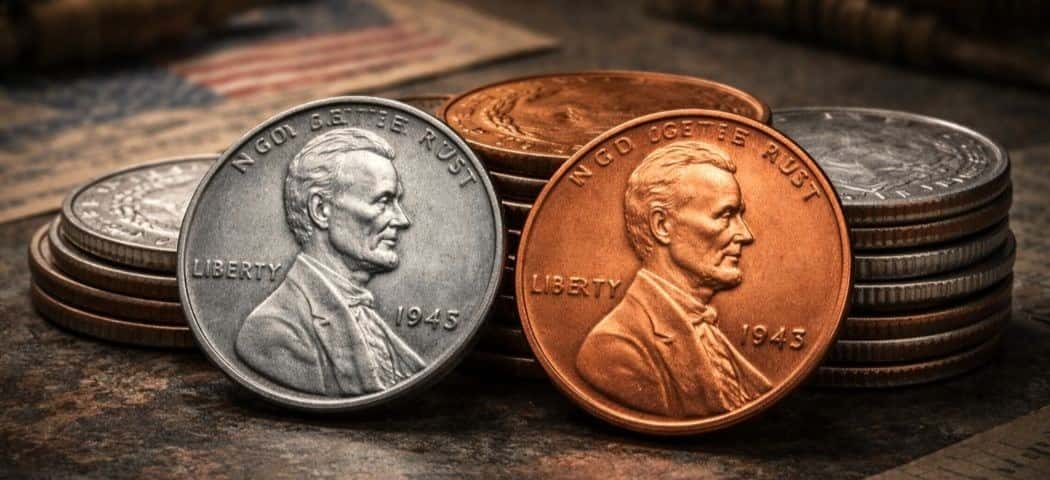
The Coin That Shouldn’t Exist
The 1943 Lincoln Wheat Penny occupies a singular place in American numismatic history. Struck during the height of World War II, this coin reflects a nation under pressure—balancing economic necessity, material shortages, and the demands of mass production. While most collectors are familiar with the silvery steel cent issued that year, far fewer understand why a small number of copper examples exist at all. That contradiction—between official U.S. Mint policy and surviving copper cents—is the wartime mystery that continues to fascinate collectors and historians alike.
A Brief History of the Lincoln Wheat Penny Series
Introduced in 1909 to commemorate Abraham Lincoln’s 100th birthday, the Lincoln Wheat Penny marked a historic shift in U.S. coinage by featuring a real individual rather than an allegorical figure. Designed by Victor D. Brenner, the series remained in circulation until 1958 and spanned nearly half a century of American history, including economic expansion, the Great Depression, and two world wars.
For most of its run, the Wheat Cent was struck in a consistent bronze composition. That long-standing uniformity makes the dramatic change in 1943 especially notable within the series.
Why 1943 Is the Most Unusual Year of the Wheat Cent
The 1943 Lincoln Wheat Penny is the only regular-issue U.S. cent intentionally produced in steel instead of copper. Its pale, silvery appearance immediately sets it apart from every other Wheat Cent before and after.
More importantly, 1943 represents a moment when tradition gave way to necessity. The change in composition affected not only the coin’s appearance, but also its durability, public perception, and long-term collectibility—cementing 1943 as the most distinctive year in the Wheat Penny series.
Wartime Pressure and the Shift Away from Copper
By 1943, the United States was fully mobilized for World War II, and copper had become a strategically vital resource. It was essential for ammunition, electrical wiring, communications equipment, and military hardware.
To conserve copper for the war effort, the U.S. Mint adopted zinc-coated steel for the one-cent coin. While practical from a production standpoint, steel cents rusted easily and were frequently mistaken for dimes, causing public frustration. Still, the steel cent fulfilled its wartime role—until a few unintended copper coins quietly entered circulation.
The Wartime Mystery: How Copper Pennies Were Struck in 1943
Despite the official transition to steel, a very small number of 1943 copper Lincoln Wheat Pennies were accidentally struck. These coins were produced on leftover bronze planchets from 1942 that were never fully cleared from the presses.
What deepens the mystery is that confirmed copper examples exist from Philadelphia, Denver, and San Francisco, indicating the error was not isolated to a single Mint. No surviving Mint records explain how or why the mistake occurred, likely due to the urgency and scale of wartime production. Today, fewer than 30 authenticated examples are known, making them among the rarest and most valuable U.S. coins ever produced.
The Legendary Error Coin: The 1943 Copper Wheat Penny
Among all U.S. mint errors, the 1943 copper Wheat Penny stands in a category of its own. Unlike typical errors involving die cracks or minor planchet flaws, this coin represents a complete departure from official Mint policy during World War II.
Because of their extreme rarity, authenticated examples have sold for hundreds of thousands to well over one million dollars, depending on condition and mint mark. Even circulated specimens command extraordinary premiums, placing the 1943 copper cent among the most valuable coins in American numismatics.
How to Tell Them Apart: Steel vs. Copper
Correct identification is critical, especially given the number of counterfeits.
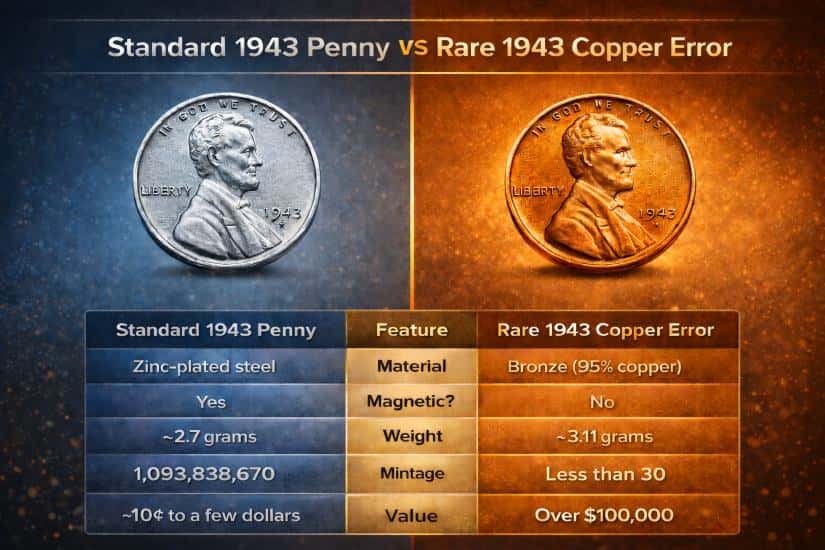
Standard 1943 Steel Penny Attributes
-
Composition: Zinc-coated steel
-
Weight: ~2.7 grams
-
Magnetic: Yes
-
Mints: Philadelphia (no mint mark), Denver (D), San Francisco (S)
-
Combined mintage: Over 1 billion
-
Typical value: $0.25 to $5 in circulated condition
Rare 1943 Copper Penny Attributes
-
Composition: Bronze (95% copper, 5% tin/zinc)
-
Weight: ~3.11 grams
-
Magnetic: No
-
Known mints: Philadelphia, Denver, San Francisco
-
Estimated survivors: Fewer than 30
-
Value: Six to seven figures when authenticated
A quick magnet test is often the first step:
-
Steel cents stick
-
Copper cents do not
However, this alone is not definitive.
Counterfeits and Altered Coins: Protecting Yourself from Fakes
The staggering value of the 1943 copper penny has made it one of the most counterfeited U.S. coins. Common forgeries include copper-plated steel cents, which remain magnetic and underweight, and altered 1948 pennies, where the “8” is reshaped to resemble a “3.”
Collectors should also be cautious of coins that have been chemically treated or artificially toned to simulate copper. These methods do not change the underlying composition and often reveal inconsistencies under magnification. Because even experienced collectors can be deceived, visual inspection alone is never sufficient.
Authentication and Grading: When It Matters Most
Given the prevalence of counterfeits, professional authentication is essential for any suspected 1943 copper Wheat Penny. Trusted third-party grading services such as PCGS or NGC use weight analysis, magnetic testing, metallurgical examination, and die study to confirm authenticity.
Even steel pennies can benefit from grading when found in exceptional condition, but for copper examples, authentication is non-negotiable. It is the step that separates legend from reality.
What to Do If You Think You Found One
Begin with non-destructive tests: a magnet check and precise weight measurement. Avoid cleaning or altering the coin in any way, as this can permanently reduce value. Handle the coin only by the edges and store it in a protective holder.
Seek evaluation from a reputable numismatic professional, and if the coin passes initial screening, submit it for third-party authentication. Until that process is complete, assumptions about rarity or value should be approached with caution.
A Coin Born of Conflict and Chance
The 1943 Lincoln Wheat Penny tells a story far greater than its one-cent denomination. It reflects wartime sacrifice, industrial adaptation, and the unpredictability of mass production under pressure. Whether a common steel cent or a legendary copper error, each 1943 penny is a tangible artifact of World War II America.
Its enduring appeal lies not only in value, but in mystery—proof that even during an era of strict controls and national urgency, history can still produce remarkable surprises.
Related reading you may find interesting:
Dimes Worth Money: How to Spot Valuable Dimes in Your Change
Indian Head Pennies: History, Key Dates, and What Drives Their Value
Lost Penny Day: History, Value & End of the U.S. Cent
16 Comments