View Charts
Silver Recycling and Its Impact on Market Supply
 0
0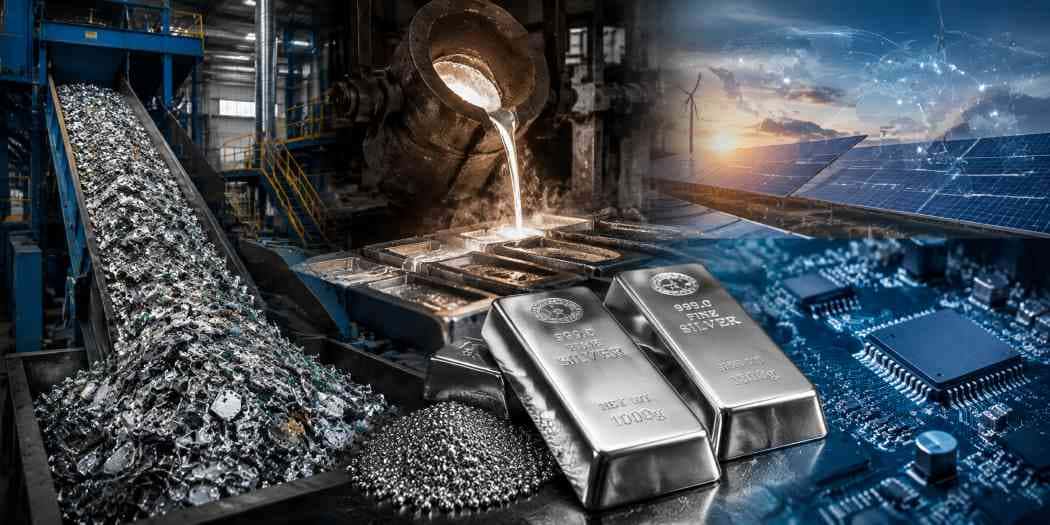
Secondary Silver Flows Are Quietly Reshaping Supply Dynamics in 2026
Silver supply is no longer defined solely by mining output. A growing share of global availability now comes from recycled material, and that shift is gradually changing how the market absorbs demand shocks, price volatility, and industrial consumption cycles. While primary production still anchors long-term supply expectations, secondary recovery streams—ranging from industrial scrap to end-of-life electronics—have become increasingly influential in balancing tightness across the bullion market.
What makes this dynamic more important in 2026 is the interaction between elevated industrial consumption and uneven mining growth. As silver demand expands across solar energy, electronics, and advanced manufacturing, recycling has moved from a supplementary source to a stabilizing force that helps prevent sharper dislocations in physical availability. This creates a more layered supply structure where recycled material now plays a meaningful role in short-term price formation.
Recycling Supply Is Becoming a Structural Component of the Silver Market
The silver market has traditionally been viewed through the lens of mine production, but that perspective increasingly underestimates the influence of secondary flows. Industrial scrap recovery, photographic waste streams, and electronic recycling collectively feed a consistent volume of refined silver back into the supply chain. While these sources fluctuate based on economic activity and industrial throughput, their aggregate contribution has become too significant to treat as marginal.
What stands out in recent years is the responsiveness of recycling supply to price levels. When silver spot prices strengthen, recovery rates tend to increase as more scrap becomes economically viable to process. This creates a natural feedback loop that can moderate upside momentum during strong rallies. However, the same mechanism can also slow downside moves when supply tightens, as reduced recycling activity limits immediate availability in weaker price environments.
This evolving balance has introduced a more dynamic relationship between price action and secondary supply responsiveness, reducing the purely linear connection between mining output and market equilibrium.
Industrial Consumption Patterns Are Driving More Recyclable Material Into the System
Industrial silver demand plays a central role in shaping recycling flows, particularly in sectors where silver is embedded in complex products rather than used in bulk form. Electronics manufacturing, photovoltaic production, and automotive components all generate recoverable silver at end-of-life stages, feeding a steady stream of material back into refining channels.
As industrial usage expands, so does the future recycling pipeline. However, this relationship is not immediate. There is often a time lag between consumption and recovery, meaning today’s industrial demand is effectively shaping tomorrow’s secondary supply. This creates a delayed supply response function that can smooth long-term availability but still allow short-term tightness during rapid demand shifts.
The growing importance of renewable energy infrastructure has intensified this dynamic. Solar panel production, in particular, embeds silver in ways that eventually return to the recycling system, but only after multi-year deployment cycles. This delay reinforces the structural importance of recycling as a long-term stabilizer rather than a real-time balancing tool.
High-Tech Demand Is Feeding Recycling Channels in Ways the Market Rarely Prices In
It is easy to treat industrial silver demand as a one-directional flow—mines produce it, manufacturers consume it, and that is where the story ends. In practice, the loop is more uneven. A significant portion of modern silver usage is embedded inside systems that do not simply “use” the metal but cycle it back into the broader supply chain over time, often without much visibility in headline data.
Take aerospace and advanced manufacturing ecosystems, where firms like SpaceX operate. Silver appears in highly specific applications—electrical contacts, thermal systems, and precision components—rather than as a bulk material input. The same pattern shows up in electric vehicle manufacturing, including companies like Tesla, where silver is concentrated in electronics, power management systems, and high-efficiency connectors. None of this shows up as “recycled silver demand” in any direct accounting sense, but it eventually feeds the scrap stream that recycling depends on.
What matters more than the immediate usage is the turnover cycle. AI infrastructure and large-scale data centers, for instance, operate on accelerated hardware refresh timelines compared to traditional industrial systems. That cadence quietly increases the volume of recoverable electronic material entering recycling channels over time, even if the silver content per unit remains relatively small. It is less about intensity of use and more about repetition at scale.
The market rarely prices this relationship cleanly. Recycling supply does not respond to headlines about AI expansion or EV adoption in real time. Instead, it arrives later, embedded in scrap flows that reflect decisions made years earlier in manufacturing cycles. That delay is what gives secondary silver supply its uneven, often underestimated influence on market stability.
Recycling as a Price Stabilizer Rather Than a Primary Driver
Although recycled silver contributes meaningfully to supply, its role in price formation is often misunderstood. It does not lead market direction but instead acts as a moderating force that responds to broader price trends. When silver prices rise, recycling becomes more attractive, gradually increasing supply and easing upward pressure. When prices fall, recovery slows, limiting additional downside supply expansion.
This countercyclical behavior introduces a stabilizing layer into silver bullion market supply conditions. It does not eliminate volatility, but it can reduce the extremes that might otherwise occur in a purely mine-driven supply system. The effect is most visible during periods of rapid demand acceleration, where recycling delays can temporarily tighten availability before secondary flows adjust.
For investors, this means that silver supply is no longer a fixed input variable. It is increasingly responsive to price signals, adding complexity to traditional supply-demand models.
Mining Output vs Secondary Supply: A Shifting Balance
Primary silver production still dominates long-term supply assumptions, but its relative influence is gradually being diluted by recycling growth. Mining output tends to be slower to adjust, constrained by capital investment cycles, geological limitations, and geopolitical factors. Recycling, by contrast, responds more fluidly to economic conditions and industrial throughput.
This divergence creates a two-speed supply system. Mining provides the baseline, while recycling introduces variability around that baseline depending on price incentives and industrial activity. In periods of supply stress, recycling can partially offset tightness, but it cannot fully replace primary production. Conversely, in periods of weak demand, reduced recycling can amplify oversupply conditions.
The interaction between these two streams has become a defining feature of modern silver market structure, particularly as industrial demand continues to expand faster than mining capacity growth.
Institutional Implications and Investor Positioning
For institutional participants, recycling introduces a layer of complexity that affects both short-term pricing models and long-term allocation strategies. Supply assumptions can no longer rely solely on mine output forecasts, as secondary flows increasingly influence inventory dynamics and near-term liquidity conditions.
This has implications for how investors interpret silver price stability. Periods of unexpected resilience in prices are often partially supported by constrained recycling activity, while sudden increases in available supply may reflect improved recovery economics rather than mining expansion. Understanding this distinction is becoming more important in portfolio positioning and risk assessment.
As a result, silver is increasingly viewed not just as a commodity tied to extraction, but as part of a broader circular supply system where reuse and recovery play a measurable role in market behavior.
Supply Structure and Market Sensitivity
Looking ahead, recycling is likely to remain a growing component of the silver supply ecosystem, particularly as industrial applications continue to expand across technology and energy sectors. However, its stabilizing influence will depend heavily on price levels and industrial efficiency cycles.
If demand continues to outpace mining growth, recycling will play an increasingly important role in smoothing supply gaps, though not eliminating them. If industrial demand slows, secondary supply may contract in response, reinforcing downside pressure during weaker cycles.
This evolving structure suggests that silver pricing will remain sensitive not only to macroeconomic conditions but also to the responsiveness of secondary supply streams. In that sense, recycling is becoming less of a background factor and more of a structural component in how the market balances itself over time.
A More Circular Silver Market Is Emerging
The silver market is gradually shifting toward a more circular supply model where recycling plays a meaningful role alongside mining output. This does not replace primary production, but it changes how supply responds to price movements, industrial demand cycles, and macroeconomic shifts.
For investors, the key takeaway is that silver supply is no longer static. It is increasingly adaptive, with secondary flows acting as a buffer that can either ease tightness or reinforce weakness depending on market conditions. This dynamic adds a new layer of complexity to metals investing, particularly as industrial demand continues to expand across multiple sectors.
Related reading you may find interesting:
Could SpaceX Ever Build a Strategic Silver Reserve?