View Charts
Could SpaceX Ever Build a Strategic Silver Reserve?
 0
0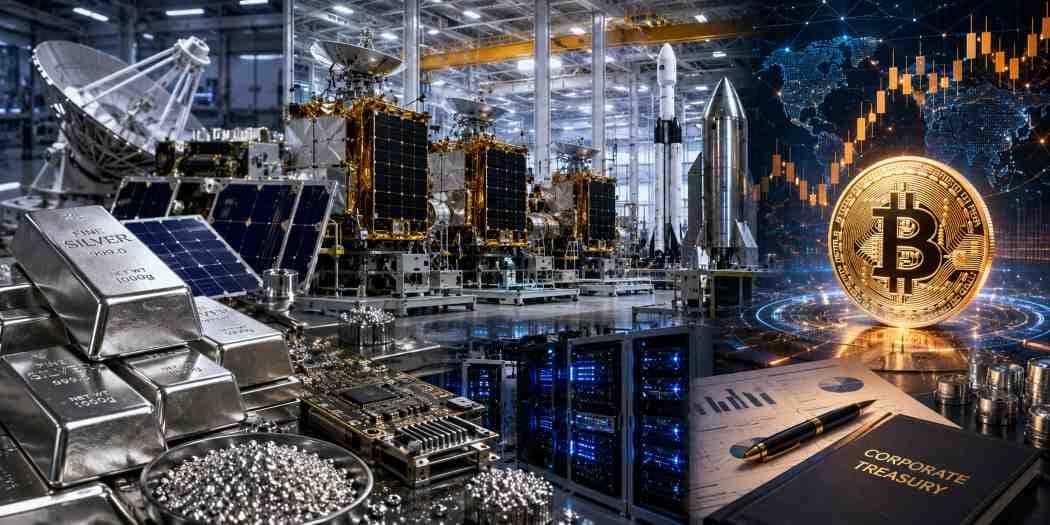
A Bitcoin Treasury Disclosure Raises an Unexpected Silver Question
SpaceX's recent public disclosure of its Bitcoin holdings generated headlines across both cryptocurrency and traditional financial markets. The company revealed ownership of 18,712 BTC, acquired at an approximate cost basis of $661 million and valued at roughly $1.29 billion as of March 31, 2026. More important than the size of the position was how it was described. Bitcoin was not presented as a speculative investment. Instead, it was identified as a strategic reserve asset for excess corporate cash.
That distinction immediately changed how investors interpreted the filing. The conversation shifted from cryptocurrency exposure to treasury strategy. SpaceX effectively confirmed that one of the world's most influential technology companies views digital scarcity as valuable enough to occupy a permanent place on its balance sheet.
Yet beneath the Bitcoin headlines sits a less obvious question. If SpaceX recognizes the strategic value of a scarce asset today, could a future version of the same logic eventually extend beyond cryptocurrency and into critical industrial commodities such as silver?
There is currently no evidence that SpaceX owns silver as a treasury reserve. The company's disclosures contain no indication of bullion holdings, exchange-traded funds, or physical metal stockpiles. Nevertheless, the question itself has become increasingly relevant as silver's role in advanced technology continues to expand while global supply remains constrained.
The Missing Link Between Bitcoin Reserves and Industrial Scarcity
Bitcoin and silver are rarely discussed in the same framework. One exists entirely in digital form, while the other is extracted from mines and consumed by industry. Their markets operate differently, their investors behave differently, and their supply mechanisms are fundamentally unrelated.
Yet both derive much of their value from scarcity.price
Bitcoin's scarcity is programmed. Its maximum supply cannot exceed 21 million coins. Silver's scarcity is operational. Production depends on exploration, mine development, refining capacity, recycling rates, and geopolitical stability. One form of scarcity is mathematical. The other is physical.
SpaceX's Bitcoin position demonstrates that corporate treasuries are becoming more comfortable allocating capital toward scarce assets outside traditional cash instruments. What makes silver intriguing is that it occupies a unique middle ground. It functions simultaneously as a monetary metal, an industrial resource, and a strategic material increasingly tied to emerging technologies.
The distinction matters because corporations do not necessarily accumulate assets for the same reasons investors do. Treasury managers seek resilience. Manufacturers seek certainty. In an environment where supply chains remain vulnerable and technological demand continues accelerating, those objectives may eventually begin to overlap.
Starlink, Rockets, and the Growing Importance of Silver Consumption
The silver discussion becomes considerably more interesting when viewed through the reality of SpaceX's business rather than through the lens of treasury management. While Bitcoin sits on the balance sheet as a reserve asset, silver quietly moves through the company's manufacturing ecosystem every day. Modern satellites, communications equipment, solar power systems, circuit boards, sensors, and aerospace electronics all depend on highly conductive materials, and silver remains the most electrically conductive metal available. In many mission-critical applications where reliability matters more than material cost, there are few practical substitutes.
The scale of Starlink adds another layer to the conversation. SpaceX has already launched thousands of satellites into orbit and continues expanding the constellation at a pace rarely seen in aerospace history. Individually, the amount of silver contained within a single satellite may seem insignificant. Collectively, however, the production requirements associated with a network of that size create a recurring source of physical demand that persists regardless of short-term fluctuations in silver prices.
What makes this demand especially important is that it behaves differently from investment demand. Investors can choose to buy silver when prices appear attractive and step away when sentiment changes. Manufacturers do not have that flexibility. If silver remains necessary for key components, procurement becomes an operational requirement rather than a market preference. As advanced communications systems, AI infrastructure, defense technologies, and satellite networks continue expanding, that distinction could become increasingly important when evaluating future supply pressures across the silver market.
A Strategic Stockpile Would Be Different From Manufacturing Inventory
Of course, industrial consumption alone is not the same as strategic accumulation. Companies routinely maintain inventories of raw materials needed to support production schedules. Aerospace manufacturers, semiconductor firms, automakers, and defense contractors all purchase components and materials well in advance of when they will actually be used. These inventories help reduce operational risk, but they are ultimately intended to be consumed.
A strategic reserve serves an entirely different purpose. Instead of purchasing material for near-term manufacturing needs, an organization intentionally acquires and holds assets to guarantee future access regardless of market disruptions, supply shortages, geopolitical events, or price volatility. Governments have followed this model for decades through strategic petroleum reserves and critical materials stockpiles designed to protect national interests during periods of uncertainty.
Historically, silver has not been viewed as a metal that required this level of protection. Supplies were generally considered adequate, and industrial users could usually secure material through traditional procurement channels. Yet the landscape has changed significantly in recent years. Solar manufacturing has emerged as a major source of demand, while electric vehicles, artificial intelligence infrastructure, advanced military systems, and next-generation communications technologies continue consuming increasing quantities of the metal. At the same time, many mining jurisdictions face declining ore grades, environmental restrictions, and permitting challenges that complicate future supply growth.
Viewed through that lens, the concept of a strategic silver reserve begins to look less like a theoretical exercise and more like a question some large industrial consumers may eventually need to consider.
What If SpaceX Allocated Part of Its Treasury to Silver?
This is where the discussion shifts from current reality into informed speculation. SpaceX has disclosed Bitcoin as a strategic reserve asset, but there is no evidence that the company owns investment-grade silver outside of normal manufacturing requirements. Still, the hypothetical scenario raises an interesting question: what would happen if a company with SpaceX's scale decided to treat silver the way it currently treats Bitcoin?
The answer is not necessarily tied to the size of the investment alone. What matters is the structure of the silver market itself. Compared to global equity, bond, and currency markets, the pool of readily available physical silver is surprisingly small. A billion-dollar allocation may not attract much attention within the technology sector, but within the physical silver market it represents a substantial amount of metal that would need to be sourced, refined, transported, and stored.
Unlike financial assets that can be created through additional issuance, physical silver must come from existing inventories or future mine production. If a large buyer entered the market seeking long-term ownership rather than short-term exposure, the impact could extend well beyond the initial purchase. Dealers might experience tighter inventories, industrial users could accelerate procurement activity, and futures traders would likely begin reassessing assumptions about future availability.
Importantly, none of this requires an actual shortage to develop. Markets frequently react to changing expectations long before inventories reach critically low levels. In that sense, strategic accumulation can influence pricing not only through physical demand but also through shifting perceptions of scarcity.
Where COMEX Inventories Enter the Equation
Any discussion about long-term silver availability eventually leads to COMEX, which remains one of the most important venues for silver price discovery and futures trading. Although most contracts never result in physical delivery, the relationship between paper positions and available inventories continues to attract attention from investors, industrial users, and market analysts alike.
If corporate buyers began acquiring silver for strategic ownership rather than immediate consumption, the market would be forced to evaluate a new category of demand. Industrial consumption gradually removes metal from circulation as products are manufactured and sold. Strategic reserves operate differently. Once acquired, the metal may remain largely untouched for years, effectively reducing the amount available to the broader marketplace.
This distinction matters because it changes the speed at which inventories can recycle back into circulation. Industrial demand consumes silver. Strategic demand immobilizes it. From a market perspective, both can tighten supply, but they do so through entirely different mechanisms.
In many respects, such behavior would resemble central bank gold accumulation more closely than traditional industrial procurement. When central banks acquire gold for reserve purposes, those holdings typically become long-term assets rather than active market inventory. A similar dynamic applied to silver could create a meaningful shift in how investors evaluate future supply availability.
The Emergence of Corporate Strategic Metals
The broader significance of this discussion may have less to do with SpaceX specifically and more to do with what its Bitcoin strategy potentially reveals about evolving corporate thinking. Companies increasingly operate in an environment where access to critical resources can be just as important as access to capital.
Technology firms compete for semiconductor capacity. Governments are investing heavily in critical minerals strategies. Manufacturers are seeking direct relationships with lithium, copper, rare earth, and battery supply chains. Against that backdrop, silver possesses many of the characteristics that have historically attracted strategic attention. It is difficult to replace, essential to advanced technologies, and increasingly tied to industries expected to grow for decades.
If a major corporation ever demonstrated a clear advantage from maintaining a strategic silver reserve, competitors would almost certainly take notice. The resulting demand would not resemble traditional investment buying or industrial consumption. Instead, it would be driven by supply security, operational resilience, and long-term planning.
Today, that possibility remains speculative. Yet many structural shifts appear unlikely until the moment they become commonplace. The question may not be whether silver can be viewed as a strategic asset, but whether future industrial consumers eventually decide that securing access is worth treating it like one.
The Real Question Facing the Silver Market
SpaceX's Bitcoin disclosure ultimately revealed more than a cryptocurrency position. It demonstrated that large corporations are increasingly willing to rethink traditional treasury management.
Today, that thinking has manifested through Bitcoin ownership. Tomorrow, it could potentially expand toward other scarce assets that serve strategic purposes beyond simple financial returns.
There is no evidence that SpaceX is stockpiling silver as a reserve asset. Yet the exercise of considering such a possibility reveals something important about the silver market itself. Demand is no longer being driven exclusively by investors, jewelry buyers, or traditional industrial consumers. It is becoming intertwined with some of the most significant technological developments of the modern economy.
If silver eventually evolves from an industrial input into a strategic corporate resource, the implications for supply, pricing, and long-term availability could be profound. In that scenario, the most important silver buyers may not be investors seeking exposure to rising silver spot prices. They may be technology companies seeking protection from a future in which access to critical materials becomes every bit as valuable as the materials themselves.
Related reading you may find interesting:
Why Artificial Intelligence Could Become Silver's Biggest Demand Driver