View Charts
September 11 & Gold Prices
 7
7Rewind to September 11. There is a familiar warning given in the mainstream financial press that goes something like this: “Do not buy gold during a geopolitical crisis because as soon as tensions fade the precious metal will give back all of its gains.”
We need to look no further than recent articles available online to confirm this warning.
Such as CNBC published this last week: Is the above advice accurate? Are the “experts” correct that gold should retrace if recent tensions with North Korea recede?
The answer is: it depends on what timescale one is referring to. By making a blanket statement and not quantifying the above warning with the proper perspective, this and similar articles risk misleading investors furthermore, as a critical period unfolds for gold over the next few years.
Let us examine a historical example.
September 11
Exactly 16 years ago today, let us rewind to September 11, 2001. Terrorist attacks have us examining the price action in gold from a technical basis. September 11 was a Tuesday. On the day of the attacks, gold spiked in price from $273 per ounce to $290. Which meant gold was a 6.2% gain. In today’s dollars, that would equate to an $84 intraday spike. The price action in the year leading up to the attack and in the months below:
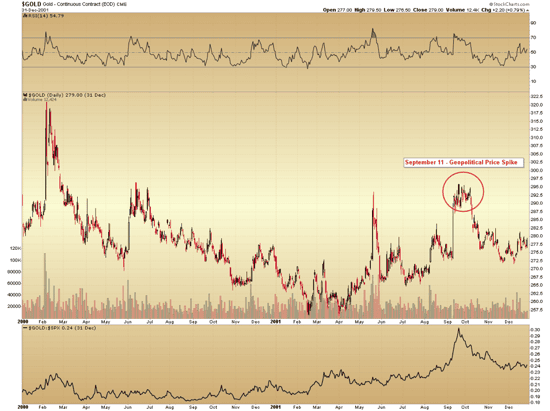
Note that after the September 11 surge, gold topped out over the following three weeks just below $300 per ounce. Moreover, in the two months that followed and as fears of an Armageddon scenario faded, gold did indeed give back all of its gains. Specifically, on November 24, gold closed below $272. $272 was the opening price from the morning of 9/11.
Many who bought gold in the days following the attacks were undoubtedly frustrated to be sitting on losses within a few months. Also, those who did not put this price action into proper context would sell and moved on to other asset classes.
But even though gold did give back all of its short-term gains, was selling and moving on wise in hindsight?
Increased Technical Perspective
Let us back out the above chart for an expanded perspective. Let's examine some of the technology trends that were in play at the time. Below we show gold from 1997 – 2002. A chart highlighting the same 9/11 geopolitical price spike is below:
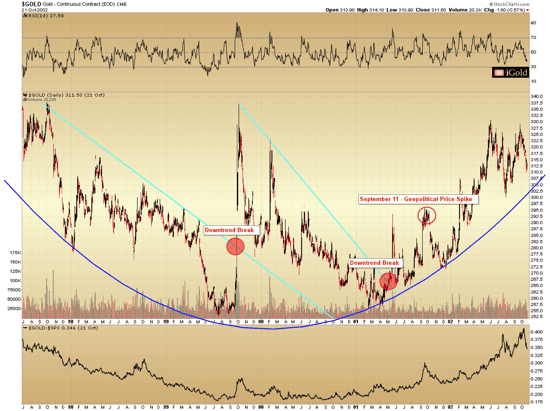
Further, gold had seen significant multi-year downtrend breaks. Breaks leading up to the September 11 price spike are shown above by the red callouts. A double-bottom was observed in April 2001, matching within a few dollars the July 1999 price of $252 per ounce.
In sum, gold was showing several classic technical patterns. Firstly, indicating that a trend change from the prior years of falling prices was in the process of unfolding. The September 11 terrorist-related spike, while it was given back throughout the following two months, was itself part of a longer basing formation for the precious metals in the early 2000s.
Longer-Term Perspective
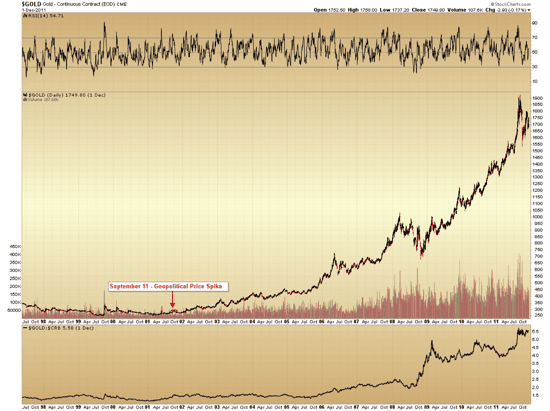
How did the “isolated” September 11 price spike look when viewed within the context of the bull market which unfolded over the next ten years? The following chart speaks for itself. The peak is seen slightly amidst the more significant bottom that served as a launching pad for the next decade.
Back to the Present
Tensions between the United States and North Korea continue to pick up in intensity. The gold price has spiked nearly $100 over the last six weeks. If tensions fade, will gold give back all of its gains? More importantly, would selling in such a scenario be the proper decision?
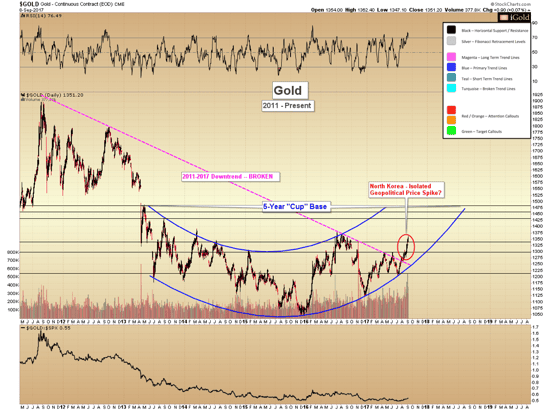
Examine the gold price action since 2011, below. Note the now-ongoing five-year cup base formation that is nearing its later stages. This trend is following an essential break of the 2011 – 2017 downtrend.
Does this chart not bear a striking resemblance to the 1997 – 2002 table, above? Are there similar downtrend breaks amidst a multi-year cup-basing formation? You be the judge.
Takeaway on Geopolitical Events and Gold
Gold may indeed see a short-term retracement. That is if tensions fade between the United States and North Korea (Read our previous article). Gold could give back $100 per ounce just as quickly as it gained it. The historic store of wealth is now five years into a clear basing process. This 5-year process is playing out irrespective of any short-term geopolitical price spikes. Multi-year bases are great setups for future market trends.
The lessons from the 1997 – 2002 timeframe, which includes the peak seen on September 11, should be valuable for investors to keep in mind as they navigate what should be a volatile final quarter to 2017. Geopolitical tensions come and go. Yet the unemotional language of the charts contains a message all its own.
Christopher Aaron, Bullion Exchanges Market Analyst Christopher Aaron has been trading in the commodity and financial markets since the early 2000s. He began his career as an intelligence analyst for the Central Intelligence Agency. This is where he specialized in the creation and interpretation of pattern-of-life mapping in Afghanistan and Iraq. Technical analysis shares many similarities with mapping — patterns base on observations of repeating and embedded patterns in human nature. His strategy of blending behavioral and technical analysis has helped him and his clients to identify both long-term market cycles and short-term opportunities for profit.
This article is a third party analysis and does not necessarily match the views of Bullion Exchanges. Readers should not consider this as financial advice in any way.
7 Comments