View Charts
Junk Silver Explained: A Complete Guide to 90% Silver Coins
 0
0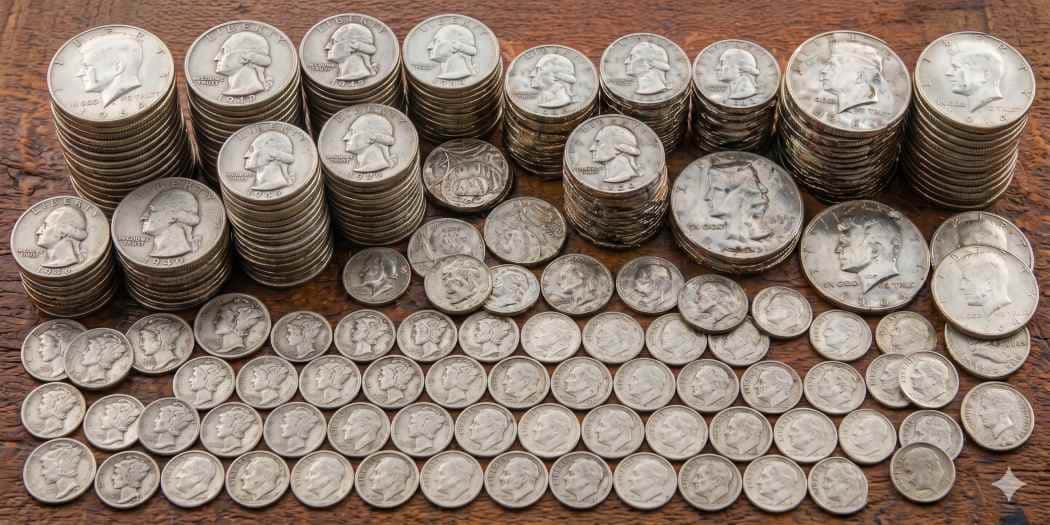
What Is Junk Silver? A Complete Guide to U.S. Silver Coins, Their Value, and How to Start Stacking
'Junk silver' is one of the most misunderstood terms in bullion. The coins aren't actually junk — they're circulated U.S. dimes, quarters, and half dollars from before 1965, when American circulating coinage was 90% silver. For investors who want silver in small, divisible, universally-recognized units, junk silver is arguably the most practical product on the market. Here's the full guide.
What you'll learn
-
What is junk silver?
-
Which U.S. coins qualify as junk silver?
-
Silver content per coin
-
Why stackers love junk silver
-
How to buy junk silver
-
Start stacking in the smallest denominations
What is junk silver?
Junk silver refers to circulated U.S. coins struck before 1965 that were produced in 90% silver alloy. They're called 'junk' not because they're worthless — they're very much not — but because they're in circulated condition and carry no numismatic premium beyond their silver content. In other words, you're buying them purely for the metal.
U.S. circulating dimes, quarters, and half dollars stopped containing silver after the Coinage Act of 1965. Since then, circulating coins have been clad copper-nickel.
Which U.S. coins qualify as junk silver?
90% silver (the classic 'junk silver')
-
Dimes: Mercury (1916–1945), Roosevelt (1946–1964).
-
Quarters: Standing Liberty (1916–1930), Washington (1932–1964).
-
Half dollars: Walking Liberty (1916–1947), Franklin (1948–1963), Kennedy (1964).
-
Silver dollars: Morgan (1878–1921), Peace (1921–1935).
40% silver Kennedy half dollars
Kennedy half dollars struck from 1965 to 1970 are 40% silver — a transitional alloy. They're often sold separately from classic 90% junk silver because the silver content per coin is different.
35% silver 'war nickels'
Jefferson nickels struck from 1942 to 1945 are 35% silver (the U.S. needed nickel for the war effort). These trade as a separate category and are popular with small-denomination stackers.
Silver content per coin
Rather than memorize individual coin weights, use these quick reference numbers. Each figure is the actual silver content per coin (not total coin weight):
-
90% silver dime: 0.0723 troy oz silver.
-
90% silver quarter: 0.1808 troy oz silver.
-
90% silver half dollar: 0.3617 troy oz silver.
-
Morgan or Peace silver dollar: 0.7734 troy oz silver.
-
40% silver Kennedy half: 0.1479 troy oz silver.
-
35% silver war nickel: 0.0563 troy oz silver.
Pros trade junk silver by face value. $1 face value of 90% silver coins contains roughly 0.715 troy oz of silver. So a $100 face value bag contains ~71.5 oz of silver. This ratio is the single most important number to memorize.
Independent resources like Coinflation publish live melt-value calculators that do this math automatically.
Why stackers love junk silver
-
Divisibility — tiny units (dimes) are useful in a scenario where silver is being used for transactions.
-
Universal recognition — any coin dealer in the U.S. will buy it, no assay needed.
-
No counterfeit premium — counterfeiting circulated junk silver at scale is economically unattractive.
-
Often lower premium than new silver rounds or bars, especially during normal market conditions.
-
Tangible historical value — these coins circulated during WWII, the Great Depression, and the Kennedy era.
How to buy junk silver
-
Decide face value, not weight. Most dealers sell junk silver in $1, $10, $100, $500, or $1,000 face-value increments.
-
Compare total delivered price against the coin's silver content at spot. A fair premium today is roughly 10–20% over melt in normal market conditions.
-
Choose denomination. Dimes and quarters are easier to trade in small amounts; half dollars and silver dollars stack more efficiently.
-
Buy in bag or roll form. Canvas bags (original banker bags) hold $1,000 face and weigh about 55 lbs.
-
Store like any other silver — airtight container, low humidity, away from tarnish-inducing rubber and paper.
Browse current 90% junk silver listings at BullionExchanges to see live per-$1-face pricing.
Start stacking in the smallest denominations
Buy junk silver by face value
Our 90% junk silver inventory prices every $1 face value increment live against spot. Ideal for first-time silver stackers who want divisibility.
Related reading you may find interesting:
How to Spot Fake Gold and Silver Coins: 10 Tests That Actually Work