View Charts
How to Test Gold at Home: Simple and Reliable Methods
 0
0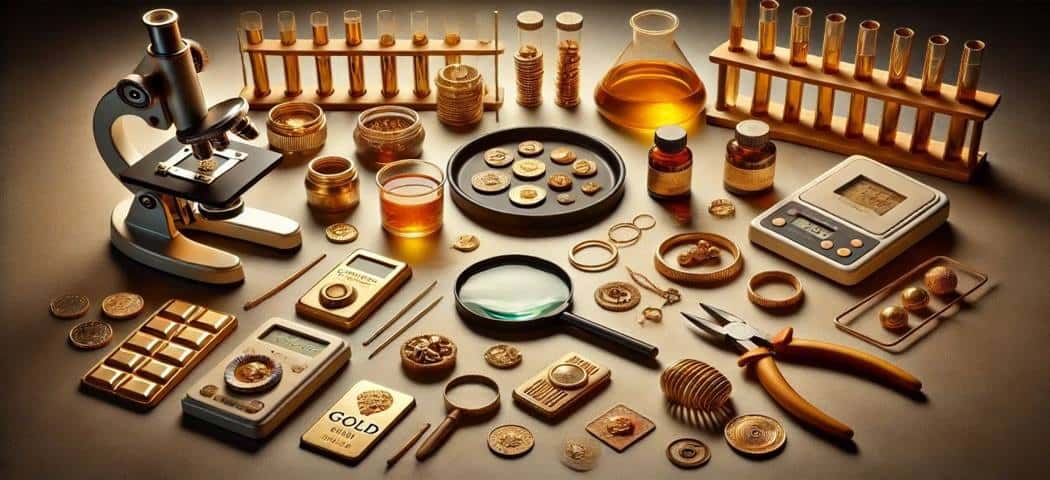
Testing gold is a valuable skill, whether you’re buying, selling, or just curious about your own collection. While professional assays provide the most accurate results, you can perform several tests at home to assess the authenticity and purity of gold. Here’s a guide to easy, effective methods for testing gold yourself.
Visual Inspection: Checking for Hallmarks and Stamps
One of the simplest ways to assess gold is by examining it closely. Real gold items are often stamped with hallmarks indicating the karat (purity) or type of gold, such as “10K,” “14K,” “18K,” or “24K.” Some may also include a manufacturer's mark or a stamp indicating the alloy type. Use a magnifying glass to look closely for these marks, as they can help verify that the item is genuine.
When inspecting, items stamped with labels such as “HGP” (Heavy Gold Plate), “GF” (Gold Filled), “GP” (Gold Plated), “H.G.E.” (Hydrostatic Gold Electroplating), “G.E.P.” (Gold Electroplating), or “1/20,” serve as indications that the item is gold-plated rather than solid gold. Additionally, marks like "800," "925," and "950" are silver hallmarks, meaning the item contains silver rather than gold.
Magnet Test: Detecting Magnetic Metals
Gold is not magnetic, so the magnet test can quickly reveal imposters. To perform this test, hold a strong magnet near the gold item. If the item is attracted to the magnet, it likely contains other metals, as pure gold or gold alloys do not react to magnets. However, be cautious, as some non-magnetic metals may be mixed with gold, so this test is not entirely definitive.
Ceramic Scratch Test: Looking for a Gold Streak
The ceramic scratch test can help identify real gold based on the color of the streak it leaves. Use an unglazed ceramic plate or tile, and gently rub the gold item against it. Real gold will leave a yellow or gold streak, while fake gold may leave a gray or black mark. Keep in mind that this test may scratch the item, so it’s best used on pieces where a minor mark won’t affect their value.
Density Test: Calculating Gold’s Unique Density
Gold has a high density, so measuring the density of an item can help verify if it’s genuine. Weigh the gold item on a scale, and then fill a graduated cylinder with water, noting the initial volume. Submerge the gold in the water, record the new volume, and calculate the item’s volume by subtracting the initial from the final reading. Dividing the weight by the volume will give you the density, which for real gold should be around 19.3 g/mL. This method is effective for items with few adornments and no hollow parts.
Acid Test: Verifying Gold’s Purity
An acid test can give a more accurate assessment of gold purity. Acid testing kits are readily available online and include different strength acids for testing various karats. Apply a small drop of acid to the gold item in an inconspicuous spot, or rub the item on a test stone and apply the acid to the mark. Pure gold will resist the acid, while lower purity gold or fake metals will react by changing color.
Safety Note: When performing an acid test, take proper precautions to protect yourself and your workspace. Always work in a well-ventilated area, and wear gloves and eye protection to prevent contact with the acid. It’s also important to protect your work surface with a non-reactive, acid-resistant mat or tray to avoid spills or damage. Handle acids with extreme care, and store them securely away from children and pets. With proper handling, the acid test is a reliable and straightforward method for verifying gold purity.
Electronic Testing: Fast and Convenient Purity Checks
Electronic testing devices provide a quick and convenient way to verify gold purity by measuring the metal’s electrical conductivity. Since pure gold has a unique conductivity level, these devices can give a general indication of an item’s authenticity based on its composition. Electronic testers are non-destructive and easy to use, making them ideal for coins, bars, and jewelry. Compact and portable, they’re especially helpful for quick, on-the-go checks, offering fast results that are useful for buyers, sellers, and collectors alike. For more precise assessments, electronic testing is often best when combined with additional methods.
X-Ray Fluorescence (XRF): Non-Destructive Testing
X-Ray Fluorescence (XRF) is a professional-grade, non-destructive test that provides an accurate reading of gold’s purity by analyzing its elemental composition. While this test requires a specialized device typically used by professionals, some jewelry stores and gold dealers may offer it as a service. It’s one of the most reliable methods for testing gold without damaging it, ideal for valuable or delicate items.
Choose the Best Test for Your Needs
Whether you’re a collector or an investor, knowing how to test gold at home can be incredibly useful. Each of these tests offers different levels of accuracy and simplicity, so choose the method that best fits your needs and the nature of the item you’re testing. For the most precise results, consider combining multiple methods or consulting a professional. Testing gold can give you confidence in your investments, helping ensure you’re buying and selling genuine, high-quality pieces.
Learn about more gold testing methods here.
Other articles that may interest you:
Assay vs. Certificate of Authenticity: How are they Different?
Density of Gold: Testing, Comparisons, and Purity