View Charts
Density of Gold: Testing, Comparisons, and Purity
 2
2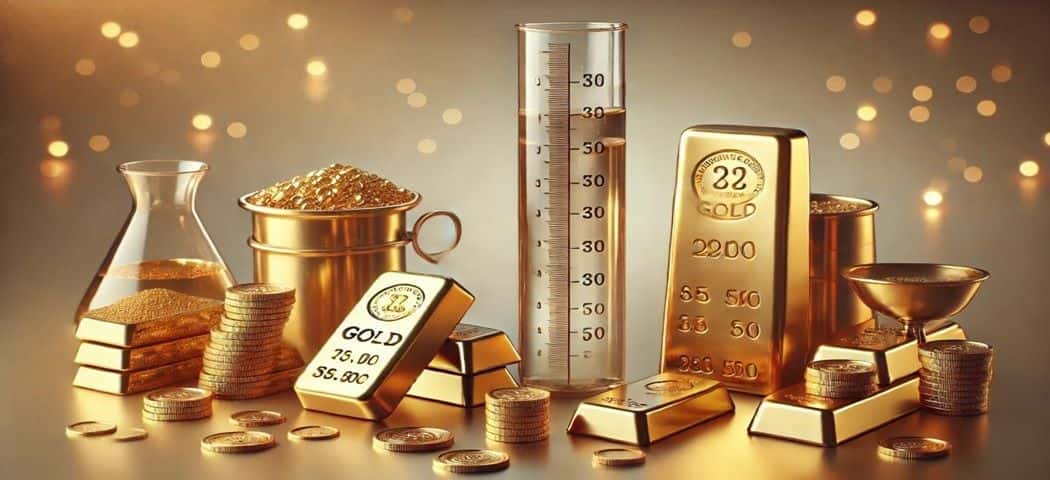
Gold has captivated humanity for centuries with its radiant beauty and unparalleled value. But beyond its color and allure, there’s another property that makes gold truly unique—its density. Understanding the density of gold can reveal a lot about its authenticity, purity, and how it stacks up against other precious metals like silver, platinum, and palladium. In this article, we’ll dive into what density means in relation to gold, how to test it at home, how gold’s density compares to that of other precious metals, and how density shifts depending on gold’s purity level. Let’s explore why this hidden property of gold is such a valuable tool for investors, collectors, and scientists alike.
What is Density, and Why Does It Matter for Gold?
Density, defined as mass per unit volume, is a fundamental property of matter that reveals how tightly atoms are packed within a material. For gold, density is significant because it sets it apart from other metals in terms of weight and purity. Pure gold, with a density of approximately 19.3 grams per cubic centimeter (g/cm³), is denser than many other elements, making it uniquely heavy. This high density makes gold resistant to wear and gives it a satisfying weight that adds to its perceived value and authenticity.
How to Test Gold’s Density
Testing the density of gold can be done using a simple water displacement method, which measures its volume to calculate density. Here’s a step-by-step guide:
-
Weigh the Gold Item: Use a precise scale to determine the weight in grams.
-
Fill a Graduated Cylinder with Water: Record the initial volume of water.
-
Submerge the Gold in the Water: Carefully lower the gold into the cylinder without spilling water.
-
Calculate the Volume Displaced: Record the new water level and subtract the initial volume from this final volume to get the volume of the gold.
-
Divide Weight by Volume: Divide the gold’s weight by its volume. If the result is close to 19.3 g/cm³, it’s likely pure gold.
This test is reliable for items like coins, bars, or jewelry without hollow parts, providing a straightforward way to verify gold’s density.
Gold’s Density Compared to Silver, Platinum, and Palladium
Gold’s density is one of the highest among common precious metals. Here’s a comparison:
-
Silver: Silver has a density of about 10.5 g/cm³, much lower than gold. This difference means that a gold coin of the same size as a silver coin will feel noticeably heavier.
-
Platinum: With a density of around 21.4 g/cm³, platinum is even denser than gold. Platinum’s high density gives it a solid, compact feel that adds to its value and durability, making it popular for fine jewelry and investment bullion.
-
Palladium: Palladium has a density of about 12.0 g/cm³, also lower than gold. Though palladium shares similar industrial and investment appeal, its lower density makes it lighter and less substantial by comparison.
These differences in density are not only interesting but can be helpful when identifying or verifying different precious metals.
Density Variations Across Gold Purity Levels
Gold is often mixed with other metals to create alloys for durability and color variation. This mixing affects density, as purer gold alloys tend to be denser. Here’s how density generally shifts across common purity levels:
-
24K Gold: 24-karat gold is 99.9% pure with a density close to 19.3 g/cm³.
-
22K Gold: 22K gold is 91.67% pure and slightly less dense due to the addition of metals like copper or silver, with a density around 17.5-18 g/cm³.
-
18K Gold: 18K gold contains 75% gold and has a density between 15-16 g/cm³, depending on the metals used in the alloy.
-
14K Gold: At 58.5% purity, 14K gold is even less dense, with a density between 12-14 g/cm³.
Knowing these density variations is useful when evaluating the purity of gold, as lower-density alloys tend to weigh less and feel different compared to higher-karat gold.
Why Density is Key in the World of Gold
The density of gold offers valuable insights into its authenticity, purity, and value, making it an essential factor for anyone dealing with precious metals. By understanding gold’s density, investors and collectors can better identify real gold, distinguish it from other metals, and verify different purity levels. Whether you’re conducting a density test at home or considering an investment, knowing the science behind gold’s unique density can give you confidence in your purchase. Next time you hold a piece of gold, take a moment to appreciate the hidden weight it carries—both physically and historically. After all, could there be gold in your collection that deserves a closer look?
Another article that may interest you:
How to Test Gold at Home: Simple and Reliable Methods
2 Comments