View Charts
Gold vs Silver vs Platinum: Best Metal in a Crisis?
 0
0
How Precious Metals Perform During Global Financial Crises
When global markets destabilize, investors instinctively search for protection. Banking stress, sovereign debt concerns, inflation shocks, war, and currency volatility often drive capital away from equities and into tangible assets. In these environments, the gold spot price, silver spot price, platinum spot price, and palladium spot price can behave very differently — even though all four fall under the “precious metals” category.
So which metal actually performs best in a global crisis? The answer depends on the type of crisis, the stage of the economic cycle, and whether investors prioritize stability, volatility, or recovery upside. Understanding how gold, silver, platinum, and palladium respond to financial stress allows investors to position more strategically rather than reacting emotionally to headlines.
Gold in a Global Crisis: The Historical Safe Haven
When investors search “best investment during a crisis,” gold consistently dominates the conversation. The gold spot price has historically responded positively to systemic instability, particularly during banking crises, currency devaluation, and geopolitical escalation.
Why Gold Leads in Crisis Environments
Gold’s strength comes from its monetary role:
-
Central banks hold gold reserves.
-
Gold is not tied to industrial demand.
-
It carries no counterparty risk.
-
It functions as a hedge against currency debasement.
During the 2008 financial crisis and the 2020 pandemic shock, the gold spot price surged as investors sought stability. Even when markets experience forced liquidation events, gold often recovers faster than other metals due to its global liquidity and institutional backing.
When Gold Struggles
Gold is not immune to volatility. Rising real interest rates and a strengthening U.S. dollar can pressure gold prices in the short term. However, in prolonged crises involving monetary instability or inflation risk, gold typically regains leadership.
In most global financial crisis scenarios, gold remains the foundation of defensive allocation.
Silver in a Global Crisis: Volatile but Powerful
The silver spot price behaves differently than gold because silver carries both monetary and industrial demand characteristics. This dual role creates heightened volatility during periods of stress.
The Silver Pattern in Crises
Historically, silver tends to:
-
Decline sharply during initial liquidity events.
-
Recover aggressively during monetary stimulus phases.
-
Outperform gold during inflation-driven recoveries.
This pattern explains why silver can underperform gold early in a crisis but later produce outsized gains. The gold-to-silver ratio often widens dramatically at the onset of turmoil, reflecting silver’s industrial sensitivity. As confidence stabilizes and liquidity increases, the silver spot price frequently compresses that ratio.
Silver’s Risk-Reward Profile
Because silver markets are smaller than gold, percentage swings can be amplified. Investors seeking higher upside during inflationary crises often prefer silver exposure, while conservative allocators typically prioritize gold.
In short: gold provides stability; silver provides torque.
Platinum in a Global Crisis: Cyclical Exposure Matters
The platinum spot price is heavily influenced by industrial demand, particularly automotive manufacturing and emerging hydrogen technologies. Unlike gold, platinum is not primarily a monetary hedge.
Industrial Sensitivity
During recessions or global slowdowns, platinum can underperform due to reduced manufacturing output. In contrast, supply disruptions — especially from South Africa, a key producer — can trigger sharp spikes in the platinum spot price.
Platinum’s Opportunity Window
Platinum often lags during crisis onset but may rebound during recovery phases. Investors monitoring industrial cycles may view platinum as a contrarian opportunity once recession fears peak.
However, platinum historically does not lead in defensive capital preservation compared to gold.
Palladium in a Global Crisis: The Most Reactive Metal
The palladium spot price is even more concentrated in industrial demand than platinum. Used primarily in gasoline vehicle catalytic converters, palladium pricing is closely linked to automotive production trends.
Crisis Vulnerabilities
In a recession-driven crisis, palladium typically underperforms due to declining vehicle demand. However, geopolitical supply disruptions — particularly involving Russia — can cause explosive price moves regardless of economic conditions.
High Sensitivity, High Volatility
Among the four major precious metals, palladium often exhibits the most dramatic percentage swings. While it can surge during supply shocks, it does not historically serve as a primary safe haven during financial crises.
Comparing Gold, Silver, Platinum, and Palladium in Different Crisis Scenarios
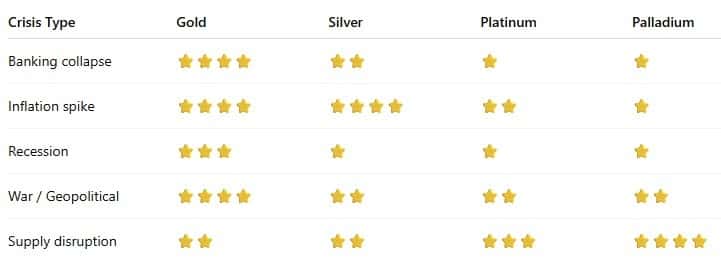
Performance varies depending on the nature of the crisis:
Banking Collapse or Currency Crisis
Gold spot price typically outperforms. Silver may follow later. Platinum and palladium tend to lag.
Inflation Shock
Gold and silver both respond positively, with silver sometimes outperforming as inflation expectations rise.
Deep Recession
Gold often holds value better than silver. Platinum and palladium typically face industrial headwinds.
Geopolitical Escalation
Gold leads due to safe-haven demand. Platinum and palladium may react if supply chains are disrupted.
This comparison highlights an important principle: no single metal wins every type of crisis.
Volatility Comparison: Stability vs Upside
A critical distinction between these metals is volatility:
-
Gold spot price movements are typically more measured.
-
Silver spot price movements are amplified.
-
Platinum spot price moves cyclically.
-
Palladium spot price can experience extreme spikes.
Investors prioritizing capital preservation often prefer gold. Those seeking higher risk-adjusted upside during recovery phases may incorporate silver or platinum. Palladium is generally considered a specialized, higher-volatility exposure.
Strategic Allocation During Global Uncertainty
For conservative investors, gold remains the cornerstone crisis hedge. Its liquidity, institutional acceptance, and historical performance make it the primary defensive metal.
A balanced approach may include:
-
Core allocation to gold.
-
Tactical exposure to silver for inflation-driven rallies.
-
Limited exposure to platinum or palladium for cyclical recovery plays.
Monitoring real-time movements in the spot prices of gold, silver, platinum, and palladium provides insight into shifting market sentiment.
So Who Wins in a Global Crisis?
In most systemic financial crises, gold emerges as the early and consistent leader. Its role as a monetary reserve asset and hedge against currency instability gives it structural advantages.
Silver often shines later in the cycle, especially during inflationary recoveries. Platinum and palladium are more sensitive to industrial activity and supply chain disruptions, making their performance more situational.
The broader lesson is that crisis dynamics matter. A currency crisis differs from a manufacturing recession. An inflation spike differs from a banking collapse. Precious metals do not move in unison — and understanding those distinctions allows investors to make informed decisions rather than reactive ones.
When global uncertainty rises, watching how the prices of gold and silver diverge — and how platinum and palladium prices respond — can reveal which phase of the crisis cycle is unfolding.
In times of instability, knowledge becomes the most valuable asset of all.
Related reading you may find interesting:
Could Silver Reach $400 in 2026?
Should You Invest in Gold or Platinum? A 2026 Comparison
Platinum vs Palladium: Why These Overlooked Metals Matter