View Charts
Gold Hits $4,900: What’s Driving the Historic Rally?
 0
0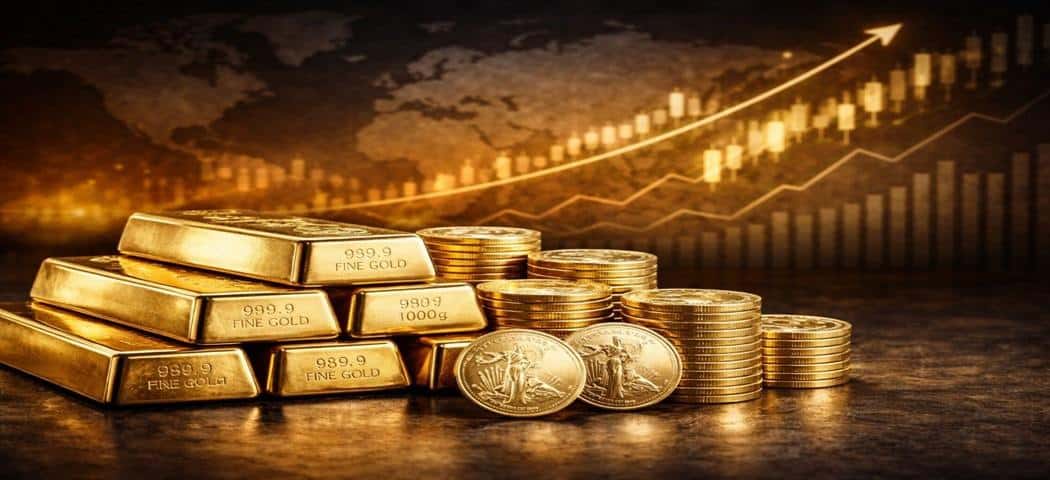
A Milestone Moment for Gold Investors
Gold has reached a historic milestone, breaking above $4,900 per ounce for the first time ever. This move places the price of gold at unprecedented nominal levels and signals a powerful shift in investor sentiment toward hard assets. As financial markets digest persistent inflation, elevated debt levels, and geopolitical uncertainty, gold’s role as a store of value is once again front and center. The question investors are asking now is not just why gold is rising, but what comes next.
Why Is Gold Surging to $4,900 Now?
The surge in the gold price today is not the result of a single catalyst, but rather the convergence of several powerful macroeconomic forces. Central bank demand remains a key driver, with sovereign institutions continuing to accumulate gold as a hedge against currency risk and long-term monetary instability. This structural demand has tightened supply and provided consistent upward pressure on prices.
At the same time, real interest rates remain under strain. Even as nominal yields fluctuate, inflation-adjusted returns on cash and bonds remain unattractive, reinforcing gold’s appeal as a non-yielding but value-preserving asset. Add to this a softer U.S. dollar environment and rising concerns over fiscal sustainability, and the momentum behind gold becomes clearer.
Geopolitical uncertainty has also played a role. Ongoing global tensions, trade realignments, and political instability have increased demand for safe-haven assets. Historically, periods of elevated uncertainty have coincided with strong gold rallies—and the current environment fits that pattern closely.
What’s Next for the Price of Gold?
With gold hitting $4,900, investors are naturally asking whether the rally is nearing exhaustion or entering a new phase. While short-term pullbacks are always possible after a sharp advance, longer-term trends suggest the gold market may still have room to run.
From a technical perspective, breaking through major psychological levels often attracts additional institutional participation rather than ending a move. From a fundamental standpoint, the drivers supporting higher gold prices—debt expansion, currency debasement, and central bank accumulation—remain firmly in place.
Looking ahead, analysts are increasingly discussing whether $5,000 gold is a matter of when, not if. While the path forward may not be linear, the broader trend continues to favor higher prices over time.
Is Gold’s Rally Lifting Other Precious Metals?
Gold’s strength is rarely isolated, and the current rally is influencing the broader precious metals complex. Silver prices have responded positively, supported by both monetary demand and industrial consumption. Historically, silver tends to lag gold initially before accelerating later in precious metals bull cycles.
Platinum and palladium have also shown renewed interest, particularly as investors look for relative value within the metals space. While each metal has unique supply-and-demand dynamics, gold’s leadership often acts as a confidence signal for the entire sector.
This intermetal relationship highlights why investors often view precious metals as a group rather than in isolation. When gold moves decisively, it tends to reset expectations across the market.
Are We Headed for a Crash—or Can the Rally Continue?
Concerns about a sudden gold price crash naturally surface after record-breaking moves. However, history suggests that gold rallies driven by macroeconomic stress and structural demand tend to be more durable than speculative spikes.
Unlike previous short-lived surges, today’s gold market is supported by long-term buyers, including central banks and institutional investors, rather than leveraged retail speculation alone. This reduces the likelihood of a sharp, disorderly collapse.
That said, volatility should be expected. Corrections and consolidation phases are normal—even healthy—within extended bull markets. The key distinction is whether the underlying drivers remain intact, and at present, they do.
How Should Investors Prepare at These Levels?
With gold trading near historic highs, preparation matters more than timing. Rather than attempting to predict short-term price movements, investors may benefit from focusing on strategy and allocation.
Diversification within precious metals—balancing gold with silver or other metals—can help manage risk while maintaining exposure. Dollar-cost averaging may also reduce the impact of volatility, especially for long-term holders.
Most importantly, investors should view gold not as a short-term trade, but as a strategic asset designed to protect purchasing power across cycles. At $4,900, gold is not just making headlines—it is reinforcing its role as financial insurance in an increasingly uncertain world.
A Defining Moment for Gold
Gold reaching $4,900 marks more than a numerical milestone—it reflects shifting confidence in currencies, monetary systems, and global stability. Whether the rally pauses or presses higher, the message from the market is clear: demand for real assets is growing.
For investors, this moment offers both opportunity and reflection. Understanding why gold is rising, how it interacts with other precious metals, and how to position thoughtfully may prove just as important as the price itself.
Related reading you may find interesting:
Silver Reaches $100: What This Historic Breakout Means
Gold Purity Standards Around the World: What Buyers Should Know