View Charts
Gold 1970s Rally: From $35 to the 1980 Peak
 0
0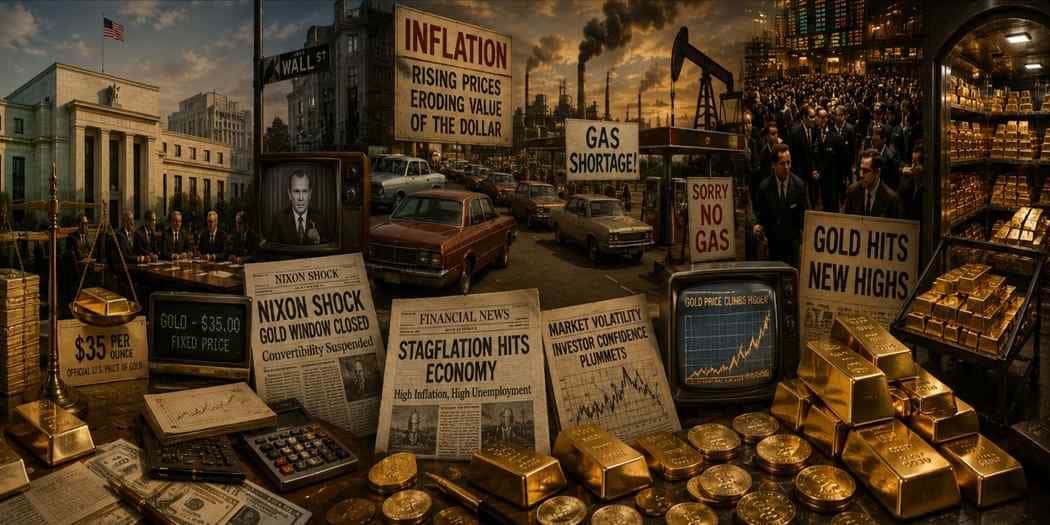
The Decade That Transformed Gold Into a Modern Safe-Haven Asset
Few periods in financial history reshaped investor perception of precious metals more dramatically than the 1970s. Over roughly a decade, gold surged from the long-standing fixed price of $35 per ounce to an intraday peak near $850 in January 1980 — a move exceeding 2,300%. The explosive rally permanently changed how investors, central banks, and global financial institutions viewed physical bullion as both a monetary hedge and crisis asset.
The gold 1970s boom did not occur in isolation. It unfolded during one of the most economically unstable periods in modern American history, marked by runaway inflation, oil shocks, geopolitical tension, currency instability, and collapsing confidence in the Bretton Woods monetary system. In today’s environment of elevated sovereign debt, persistent inflation concerns, and renewed central bank gold accumulation, many investors are revisiting the 1970s for insight into how precious metals behave during periods of systemic financial stress.
Understanding why gold moved so aggressively during that decade remains highly relevant as modern markets once again confront inflationary pressure and monetary uncertainty.
Bretton Woods Collapse Unleashed a New Gold Market
Before the 1970s, the gold spot price was largely constrained under the Bretton Woods system, which pegged the U.S. dollar to gold at $35 per ounce. Foreign governments could theoretically exchange dollars for physical gold reserves, anchoring the global monetary system around American gold holdings.
However, by the late 1960s, mounting fiscal deficits, expanding money supply growth, and rising international redemption pressure weakened confidence in the system. The United States faced increasing difficulty maintaining the dollar’s convertibility into gold while simultaneously financing both domestic spending programs and the Vietnam War.
In August 1971, President Richard Nixon suspended dollar convertibility into gold — an event now commonly known as the “Nixon Shock.” The decision effectively ended Bretton Woods and allowed gold prices to float freely in global markets for the first time in decades.
Once gold was released from its fixed-price structure, the market rapidly began repricing the metal against growing inflationary and monetary concerns.
Inflation Became the Dominant Driver of Investor Psychology
One of the defining characteristics of the 1970s was persistent and accelerating inflation. Consumer prices rose sharply throughout the decade due to multiple overlapping pressures:
-
Expansionary monetary policy
-
Oil embargoes and energy shocks
-
Rising government spending
-
Wage-price spirals
-
Weakening dollar confidence
Inflation in the United States eventually climbed into double digits, eroding purchasing power and undermining confidence in traditional financial assets. Real interest rates frequently turned negative, meaning inflation outpaced yields on savings accounts and many fixed-income investments.
Gold increasingly became viewed as one of the few assets capable of preserving purchasing power during this environment. Investors who traditionally relied on bonds or cash began reallocating capital toward physical bullion as inflation accelerated.
The shift was psychological as much as financial. Gold transformed from a tightly controlled monetary reserve into a globally traded hedge against monetary instability itself.
Oil Crises Intensified Economic Fear
The oil crises of the 1970s played a major role in accelerating gold’s rally. The 1973 Arab oil embargo triggered massive energy shortages, soaring fuel prices, and broad inflationary pressure throughout the global economy.
A second major oil shock emerged in 1979 following the Iranian Revolution, further destabilizing energy markets and intensifying fears surrounding inflation and geopolitical conflict.
These events contributed to stagflation — a rare combination of high inflation, weak economic growth, and rising unemployment. Traditional economic policy tools struggled to contain the crisis, causing investor confidence to deteriorate even further.
Gold benefited enormously from this environment because it operated outside traditional monetary systems. As uncertainty surrounding currencies and economic policy grew, demand for tangible hard assets expanded rapidly among both retail and institutional investors.
Central Banks and Currency Instability Reinforced Bullion Demand
Currency instability became another powerful force behind the decade’s gold rally. After Bretton Woods collapsed, exchange rates among major global currencies fluctuated far more aggressively than during previous decades.
The weakening U.S. dollar helped push commodity prices higher broadly, including gold. Investors increasingly questioned whether fiat currencies could maintain long-term purchasing power without direct precious metals backing.
At the same time, global central banks remained deeply involved in bullion markets. Although some governments sold gold reserves during portions of the decade, gold continued functioning as a core reserve asset within the international financial system.
This institutional role helped reinforce investor perception that gold remained fundamentally different from purely speculative commodities. Unlike industrial metals or agricultural products, gold retained monetary credibility even after formal convertibility ended.
Retail Gold Ownership Expanded Dramatically
Another important development during the 1970s was the expansion of retail gold ownership. Americans had faced restrictions on private gold ownership for decades following Executive Order 6102 during the Great Depression.
Those restrictions were lifted in 1975, reopening the domestic gold market to individual investors. Demand for bullion coins, bars, and physical gold products surged as inflation and economic instability intensified.
The legalization of private ownership coincided almost perfectly with growing fear surrounding inflation and currency weakness. Retail investors increasingly viewed gold as:
-
A hedge against inflation
-
Protection against financial instability
-
A store of long-term purchasing power
-
Insurance against geopolitical uncertainty
The combination of institutional demand and rising retail participation created powerful upward momentum throughout the decade.
Gold’s 1980 Peak Reflected Extreme Financial Panic
Gold ultimately reached its famous peak near $850 per ounce in January 1980. Adjusted for inflation, this remains one of the most dramatic commodity-market surges in modern financial history.
The final phase of the rally reflected an extraordinary convergence of fear-driven catalysts:
-
Double-digit inflation
-
The Iranian hostage crisis
-
Soviet invasion of Afghanistan
-
Severe dollar instability
-
Rising recession fears
-
Broad investor panic surrounding monetary policy
Speculative activity also intensified dramatically during the late stages of the move. Futures markets, leveraged trading, and momentum-driven buying accelerated the rally beyond levels supported purely by inflation fundamentals.
The sharp rise demonstrated how quickly gold markets can move when economic confidence deteriorates simultaneously across multiple sectors.
Paul Volcker’s Rate Shock Finally Broke the Rally
The gold rally eventually reversed after Federal Reserve Chairman Paul Volcker implemented aggressive monetary tightening policies aimed at crushing inflation. Interest rates were raised to historically extreme levels, pushing Treasury yields sharply higher and restoring confidence in the U.S. dollar.
Higher real interest rates reduced gold’s relative attractiveness because investors could once again earn meaningful returns on fixed-income assets. Inflation gradually declined, and economic confidence slowly stabilized during the early 1980s.
Gold prices corrected sharply following the 1980 peak, but the decade permanently reshaped the metal’s role within modern investment portfolios. Investors now viewed gold not merely as a commodity, but as a macroeconomic hedge tied directly to inflation, monetary policy, and systemic financial risk.
Why the 1970s Still Matter to Modern Gold Investors
The 1970s continue serving as one of the most important historical case studies for precious metals investors because many of the same structural concerns remain relevant today:
-
Elevated sovereign debt
-
Persistent inflation pressure
-
Currency debasement fears
-
Geopolitical instability
-
Expanding central bank balance sheets
Modern gold markets differ in important ways, particularly because ETFs, algorithmic trading, and digital financial infrastructure now accelerate capital flows far more rapidly than during earlier decades. However, the underlying psychology driving safe-haven demand remains remarkably similar.
The decade demonstrated how quickly gold can reprice when confidence in monetary systems weakens. It also reinforced the metal’s role as a long-term store of value during periods of economic dislocation and policy uncertainty.
For modern investors, the 1970s remain more than financial history. They represent a powerful reminder of how precious metals can respond when inflation, geopolitics, and currency instability converge simultaneously.
Related reading you may find interesting:
Gold’s 1980 Peak and Collapse After the $850 Surge
Gold 2020 COVID Crash: Liquidity Dip to Safe-Haven High