View Charts
Could Silver Reach $300? The Global Electrification Shockwave
 0
0
Silver’s Breakout: A Metal Entering a New Era
Silver’s dramatic rally beyond $63 per ounce has captured global attention, igniting renewed debate about how high the metal could climb as demand accelerates across multiple industries. For years, forecasts of triple-digit silver prices were dismissed as unrealistic. But today, with the world electrifying at a pace never seen before, analysts are beginning to re-evaluate those assumptions — and some now argue that $300 silver may be far more plausible than the market realizes.
As renewable energy expands, electric vehicles dominate new manufacturing, and advanced electronics require more silver than ever, the metal’s role is evolving from a precious commodity to a global technological necessity. Combined with persistent supply deficits and constrained mine output, silver may be entering a supply-demand environment unlike anything in the last century.
The core question for investors becomes:
Is the world dramatically underestimating future silver demand — and the price implications that follow?
Why $300 Silver Is No Longer Unthinkable
The math behind aggressive silver price predictions is increasingly grounded in measurable structural trends. Four forces, in particular, give weight to the $300 thesis:
1. Solar Energy Demand Is Exploding
Solar power is the fastest-growing renewable energy source in the world, and silver is essential for photovoltaic (PV) cell production. No available metal matches silver’s conductivity and efficiency, making substitution nearly impossible at scale.
Key drivers:
-
By 2030, annual solar installations may more than double from today’s levels.
-
PV manufacturers are consuming record quantities of silver, even as thrifting efforts struggle to reduce metal loadings.
-
Some projections show solar alone pushing silver demand above global mine output.
As nations race toward carbon-neutral energy goals, solar could become the single largest source of industrial silver demand ever recorded.
2. EV Growth Is Quietly Transforming the Silver Market
Each electric vehicle contains up to three times more silver than a traditional combustion car due to the metal’s essential role in:
-
battery systems
-
high-voltage circuitry
-
charging components
-
advanced driver-assistance systems
Global EV adoption is still in its early stages. But as manufacturing scales into the tens of millions of new vehicles per year, the industry’s silver consumption may reach levels the mining sector cannot match.
The result? A structural deficit that deepens annually.
3. High-Tech Electronics Depend on Silver’s Unique Properties
As the digital age expands, silver is irreplaceable in:
-
AI servers and data centers
-
5G and future 6G systems
-
Semiconductor components
-
Medical sensors and imaging
-
Robotics and automation technologies
Unlike many metals, silver’s conductivity and antibacterial properties have no cost-effective substitute. This creates inelastic demand — consumption that continues regardless of price.
Today’s global AI infrastructure buildout alone could reshape silver demand forecasts for the next decade.
4. Persistent Supply Deficits Are Mounting
Even before electrification accelerated, silver had already entered a multiyear supply deficit. Now those gaps are widening.
Supply challenges include:
-
plateauing mine output
-
lower ore grades
-
underinvestment in exploration
-
geopolitical and environmental constraints affecting major producing regions
-
shrinking above-ground stockpiles
When demand rises faster than supply can respond — especially in a critical industrial metal — prices tend to overshoot equilibrium.
This is the scenario underlying many of the most compelling $300 silver forecasts.
The Gold-to-Silver Ratio: What It Signals About Future Prices
The gold-to-silver ratio (GSR) — how many ounces of silver equal the price of one ounce of gold — is a powerful valuation indicator.
Historically, the ratio has averaged 40–60.
Recently, even with silver surging above $63, the ratio remains above 65, signaling:
-
silver is still undervalued relative to gold
-
silver has not yet fully repriced to reflect demand
-
the current rally may only be an early phase
During previous bull markets, the ratio collapsed dramatically as silver outperformed gold. If gold remains above $4,200 and the GSR compresses toward historical norms, silver prices could advance rapidly — potentially aligning with triple-digit targets.
Simply put: the ratio suggests silver is lagging, not peaking.
Why Analysts Underestimate Silver — Here’s the Math
Many mainstream forecasts fail because they model silver as a precious metal, not an industrial powerhouse.
But silver today is:
-
a monetary metal
-
a critical energy metal
-
a technology metal
-
a security metal
When you add projected demand from solar, EVs, and high-tech electronics, the "industrial baseline" for silver could rise by hundreds of millions of ounces per year.
If annual supply deficits widen — as current data strongly suggests — price normalization alone could push silver toward $150–$200. A supply shock or sustained investment surge could drive a test of $300.
This isn’t speculation — it’s arithmetic.
When Could Silver Reach $300? Timing the Scenarios
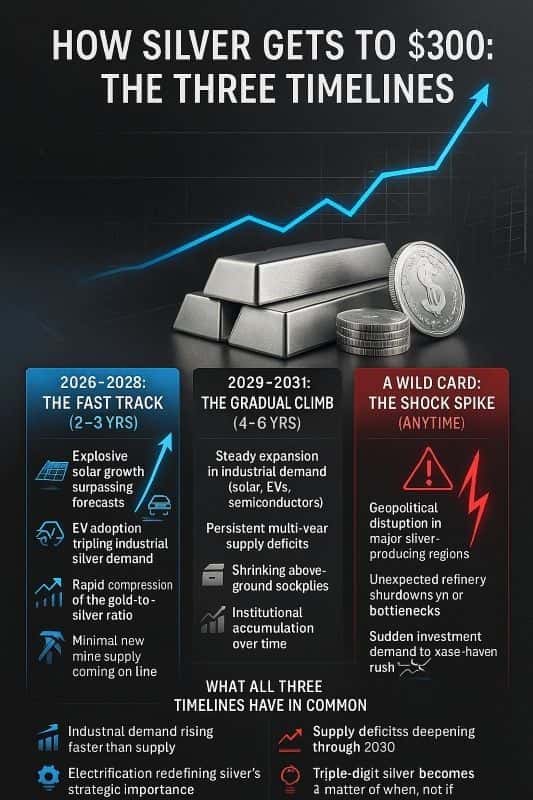
Forecasting exact timelines for silver is difficult, but supply-demand modeling allows analysts to outline several plausible paths toward $300 silver. Most scenarios fall into three categories:
1. The Accelerated Scenario: 2–3 Years (2026–2028)
In this case, electrification demand grows faster than expected, solar installations explode, and EV adoption sharply increases silver consumption. If mine supply fails to keep pace and the gold-to-silver ratio compresses rapidly, silver could break into triple digits within a couple of years and push toward $300 during a full-scale commodity repricing cycle.
2. The Structural Scenario: 4–6 Years (2029–2031)
Here, solar, EV, and electronics demand rise steadily, but not explosively. Supply deficits deepen, institutional investment increases, and above-ground stockpiles shrink. Under this slower-burn setup, silver gradually revalues higher, breaking $100, then $150, and eventually testing $300 as multi-year deficits compound.
3. The Shock Scenario: Anytime
This is the least predictable — but historically the most powerful. A geopolitical disruption in a major mining region, refinery shutdowns, a sudden investment surge, or a technological breakthrough could produce a rapid supply shock. In thin markets like silver, even modest unexpected demand can overwhelm available metal and create violent upward price spikes, potentially catapulting silver toward $300 far sooner than linear models assume.
Across all scenarios, the common thread is clear: the world is entering an era where structural deficits and electrification demand make dramatic price moves increasingly plausible.
Investor Takeaways: How to Prepare for a High-Demand Silver Era
For investors evaluating the road ahead:
1. Physical Silver Should Remain a Core Allocation
Bars, coins, and IRA-eligible bullion provide direct exposure to long-term price appreciation.
2. Monitor the Gold-to-Silver Ratio
GSR compression tends to mark the beginning of silver’s strongest secular rallies.
3. Expect Volatility — Not Weakness
Silver bull markets historically move in steep, sudden waves.
4. Industrial demand is not priced in — yet
Once institutions fully model electrification demand, valuations could reset higher.
5. Supply deficits are already here
And every major forecast shows them widening through 2030.
The Bottom Line: The World Is Not Ready for Silver’s Future
With the price of silver rocketing past $63 per ounce, the market is only beginning to reflect a monumental shift in global demand. Electrification, renewable energy expansion, and technological advancement are converging to create one of the most transformative environments in silver’s history.
If supply continues tightening and industrial demand accelerates as projected, $300 silver may be less outrageous — and more inevitable — than conventional analysts believe.
As always, Bullion Exchanges remains committed to providing the highest-quality silver bullion and expert insights as this historic transition unfolds.
Related reading you may find interesting:
What One Ounce of Silver Can Buy: A Commodity Price Comparison
Why Silver Prices Surged Above $66 and What It Could Signal Next