View Charts
Could Silver Reach $1,000 an Ounce? 2025 Outlook
 0
0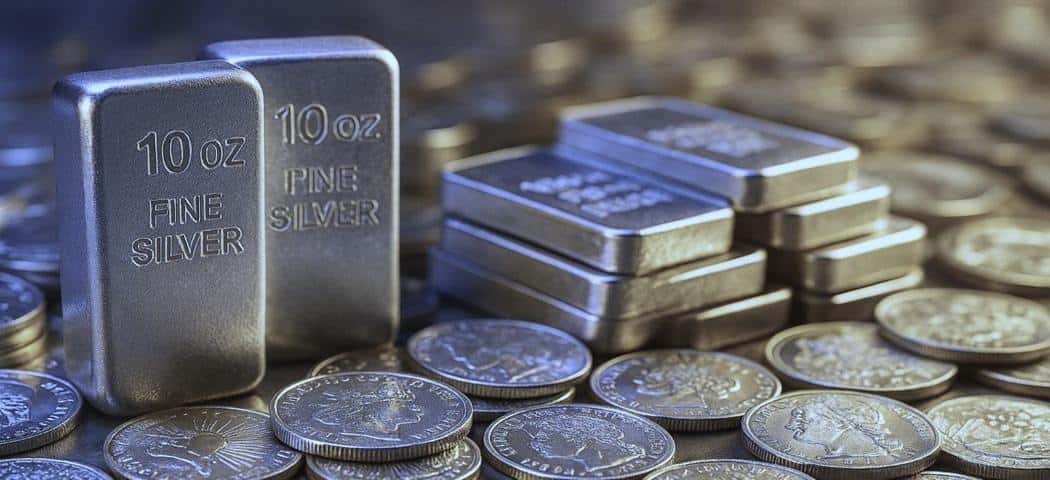
Silver’s Powerful Run in 2025
The year 2025 has been a breakout period for silver, with spot prices climbing above $41 per ounce, the highest level in 14 years. Investors and analysts are taking notice as silver continues to prove itself both as a safe-haven asset and as a critical industrial metal. With its dual role in wealth preservation and technology, silver’s momentum has raised a bold question: could silver one day reach $1,000 an ounce?
Silver’s Price Performance So Far
Through the first three quarters of 2025, silver has delivered gains of more than 30% year-to-date. Futures data shows strong bullish positioning as investors hedge against inflation, prepare for expected Federal Reserve rate cuts, and react to a weaker U.S. dollar. Compared to gold, silver’s smaller market size amplifies volatility, which can turn rallies into outsized moves.
Key Drivers Behind Silver’s Surge
Several powerful forces are pushing silver higher:
-
Monetary Policy: Anticipated Fed rate cuts have pressured real yields lower, favoring non-yielding assets.
-
Persistent Inflation: Sticky inflation remains a concern, keeping investor demand robust.
-
Industrial Growth: Silver is vital in solar panels, semiconductors, EV batteries, and 5G technology.
-
Geopolitical Risks: Energy disruptions, trade disputes, and global conflicts continue to strengthen safe-haven demand.
-
Dollar Weakness: A softer U.S. dollar increases silver’s affordability for global buyers.
Lessons from History: Past Silver Price Surges
Silver has a track record of dramatic rallies under extraordinary conditions:
-
1980: Prices spiked to $49.45/oz during the Hunt brothers’ attempt to corner the market, a speculative frenzy that ended abruptly.
-
2011: Amid post-crisis inflation fears and quantitative easing, silver surged to $49.51/oz before correcting.
-
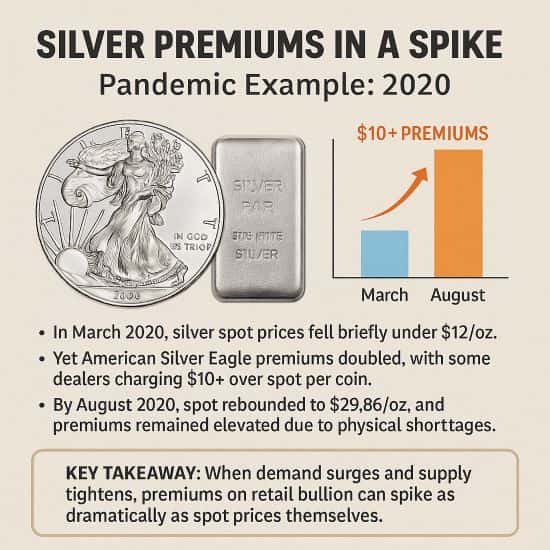
2020 Pandemic Spike: Silver rallied from under $12 in March to over $29.86/oz by August, as global uncertainty and stimulus measures drove demand.
These historical examples highlight silver’s volatility—and its ability to produce sharp, rapid gains.
What This Means for Investors
For today’s investors, silver offers a unique blend of opportunity and risk:
-
Physical Silver: Coins, bars, and rounds offer direct exposure to spot prices.
-
ETFs and Mining Stocks: Provide leveraged plays on silver but carry added risks tied to company performance and liquidity.
-
Numismatics: Rare and limited-mintage silver coins can see premiums rise faster than bullion during bull markets.
-
Short-Term vs. Long-Term: Traders may seek to capture volatility, while long-term stackers focus on wealth preservation.
-
Gold-Silver Ratio: Historically a key valuation metric, the ratio remains elevated compared to past bull cycles, suggesting silver still has room to outperform.
-
FOMO Awareness: If silver pushes toward or above the $50 level, fear of missing out may drive sudden buying pressure. While this can accelerate gains, it also introduces heightened risk of sharp corrections, making disciplined entry and exit strategies essential.
-
Premium Volatility: During past silver spikes, retail premiums on popular products like American Silver Eagles, Silver Maple Leafs, and specialty bars such as First Mint have soared well above melt value. Investors should be prepared for premiums to fluctuate sharply in a FOMO-driven market, especially when physical demand outpaces supply.
Is $1,000 Silver Possible?
While silver’s rally has fueled speculation about $1,000 per ounce, reaching that level would require a rare convergence of extreme conditions, such as:
-
Currency Crisis: A collapse of trust in fiat money could push global capital into tangible assets.
-
A Return to Metal-Backed Money: If currencies were partially tied to silver, systemic revaluation would be necessary.
-
Severe Supply Crunch: Industrial and investment demand colliding with limited mine output.
-
Hyperinflation or Sovereign Debt Shocks: Extreme macroeconomic instability could reprice silver sharply higher.
At present, these conditions are highly speculative. Still, silver’s past demonstrates that under pressure, the metal can move in extraordinary ways.
Year-End Projections for 2025
More grounded forecasts suggest silver could consolidate in the $40–$45 range, with some bullish projections eyeing $50/oz if rate cuts accelerate and industrial demand stays strong. Hitting $50 would be especially significant, as it would break the long-standing records set in 1980 and 2011. While $1,000 silver remains more of a long-term theoretical scenario, the near-term outlook points to continued strength and the possibility of new decade highs.
Technical Outlook: The $50 Barrier
From a technical perspective, $50 represents a critical psychological resistance level. It marks not only the historical peaks of 1980 and 2011 but also a threshold that could trigger renewed momentum if decisively broken. A sustained move above $50 would likely attract both institutional inflows and retail enthusiasm. In such a scenario, FOMO could play a significant role, as investors who have been waiting on the sidelines may rush to buy, amplifying volatility and potentially accelerating silver’s climb. Until then, $50 remains the line that separates silver’s current rally from a truly historic breakout.
What’s Next for Silver?
Looking ahead, investors should keep watch on:
-
Federal Reserve policy and inflation releases.
-
Renewable energy demand, especially solar and EVs.
-
Silver supply from top producers in Mexico, Peru, and China.
-
ETF flows and central bank reserve decisions.
These factors will determine whether silver sustains momentum or enters a new consolidation phase.
A Metal of Possibility
Silver’s surge above $41 per ounce in 2025 reaffirms its dual identity as both an investment hedge and a critical industrial resource. While $1,000 silver remains speculative and far from today’s reality, history has shown silver’s capacity for dramatic price shifts under the right conditions. For investors and collectors alike, silver remains one of the most dynamic and essential assets for both wealth preservation and long-term opportunity.
FAQ: Silver Price Outlook
What was silver’s highest price ever?
Silver reached $49.51/oz in 2011, slightly above its 1980 peak of $49.45.
Why is silver more volatile than gold?
Silver’s smaller market size amplifies moves; modest shifts in demand can spark outsized rallies.
What industries use the most silver?
Electronics, solar panels, and automotive components are among the largest industrial users.
Is silver a better investment than gold?
Silver offers higher upside potential during rallies, but gold tends to hold value more consistently.
How does the gold-to-silver ratio affect silver prices?
A high ratio suggests silver may be undervalued relative to gold; historically, major silver rallies often follow peaks in the ratio.
Can silver supply keep up with growing industrial demand?
Global production, concentrated in countries like Mexico, Peru, and China, faces challenges from declining ore grades and rising costs—potentially tightening future supply.
Other articles that may interest you:
Is $50,000 Gold Possible? 2025 Insights and Scenarios
Silver Thursday at 45: Lessons Amid Today’s Rising Silver Prices