View Charts
Could a Trillion-Dollar Platinum Coin Really Solve the US Debt Crisis?
 0
0
Exploring the Controversial Proposal, Its Legal Roots, and Where Key Leaders Stand in 2025
As the United States approaches yet another critical juncture in its ongoing debt ceiling debate, a once-theoretical idea has re-entered the conversation: minting a trillion-dollar platinum coin.
The concept has been floated periodically since the early 2010s, but it has taken on new relevance in 2025 as lawmakers seek innovative solutions to fund federal obligations without igniting a fiscal standoff. With inflation concerns, rising interest payments, and global market unease, some are asking: could the Treasury legally mint a $1 trillion platinum coin to bypass the debt ceiling—and would it actually work?
Let’s explore the origin of the idea, how it’s being viewed today, and why it continues to spark headlines in times of fiscal stress.
The Legal Foundation: What Makes It Even Possible?
At the heart of the trillion-dollar coin discussion is a specific clause in U.S. law—31 U.S. Code § 5112(k). This provision allows the U.S. Treasury to mint platinum coins of any denomination and is uniquely broad compared to statutory restrictions on other metals like gold or silver.
Originally crafted to authorize commemorative coinage, the language of this law does not impose any face-value limit on platinum coins. As a result, some legal scholars and policymakers argue it could theoretically be used to mint a coin worth $1 trillion—or more—and deposit it with the Federal Reserve. This would, in theory, allow the federal government to meet its financial obligations without breaching the statutory debt ceiling.
Where Did the Trillion-Dollar Coin Idea Come From?
The concept gained traction during the 2011 debt ceiling crisis, when lawmakers faced a potential government default due to political gridlock. It resurfaced in 2013, 2021, and again in 2023, as each new debt ceiling showdown raised the specter of default and government shutdowns.
The basic idea: Mint a coin with a face value of $1 trillion using the legal authority provided by § 5112(k), deposit it into the Treasury's account at the Federal Reserve, and use the credited funds to pay government expenses—without issuing new debt.
While never enacted, the proposal has been endorsed by some economists and lawmakers as a legally plausible emergency tool.
Arguments For and Against the Coin
Supporters Say:
-
It’s legal. The plain language of the law allows for it.
-
It avoids default. The coin would provide the Treasury with liquidity to meet its obligations.
-
It neutralizes political brinkmanship. The idea removes the debt ceiling as a bargaining chip during fiscal negotiations.
Critics Warn:
-
It undermines financial credibility. Opponents say it could be viewed as an accounting trick or erode confidence in U.S. fiscal governance.
-
It may trigger inflation. Injecting $1 trillion in reserves—even hypothetically—raises concerns about inflationary pressure.
-
It’s untested. The proposal has never been used, and the legal, economic, and political fallout remains unknown.
Where the Treasury and Fed Stand in 2025
Scott Bessent, U.S. Treasury Secretary (2025):
As of April 2025, Secretary Bessent has not supported the use of the trillion-dollar coin, focusing instead on traditional fiscal strategies. While not ruling it out entirely, Bessent has remained aligned with a conventional, debt-issuance-based approach to funding federal operations.
Janet Yellen, Former Treasury Secretary:
Yellen, who served as Secretary of the Treasury under President Biden, was firmly opposed to the idea. In a 2023 statement, she called it a “gimmick” and raised concerns that the Federal Reserve might refuse to accept such a coin, potentially triggering a constitutional and financial crisis.
Federal Reserve’s Position:
The Fed has expressed reluctance to play a direct role in funding government operations through extraordinary measures. Officials have voiced concerns that accepting such a coin could compromise the Fed’s independence and create uncertainty in monetary policy.
Could It Actually Work?
While the legal basis exists, implementation would likely lead to major legal challenges, political fallout, and economic uncertainty. It’s not clear whether markets would respond favorably to such an unorthodox maneuver—even if it succeeded in avoiding a short-term funding crisis.
The move could also set a dangerous precedent by bypassing Congress’s constitutional power of the purse. Critics argue it could open the door to politicizing the money supply, undermining trust in both the Treasury and the dollar.
Still, in a true emergency, it remains a tool that some view as better than default.
Why Platinum?
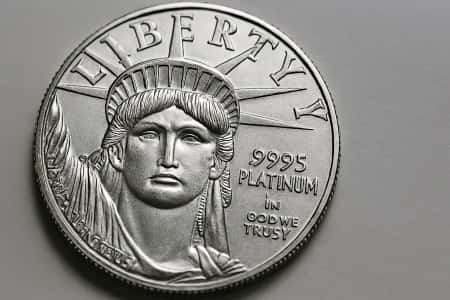
It’s no accident that the coin would be made of platinum. Under U.S. law, the Treasury is only authorized to issue coins with arbitrary denominations using platinum. Gold, silver, and other metals are restricted to fixed denominations, making platinum the only legally viable option for such a high-value creation.
The irony? The coin wouldn’t need to contain anywhere near a trillion dollars’ worth of platinum. A standard-sized platinum coin could carry a face value of $1 trillion solely through legal declaration, not intrinsic metal value.
Investor Takeaways
For precious metals investors and crypto holders alike, this debate has serious implications:
-
It highlights platinum’s unique role in modern monetary law—even if symbolically.
-
It underscores the urgency of debt ceiling reform, reminding investors of potential instability in U.S. fiscal policy.
-
It elevates gold and silver as traditional hedges in times of monetary experimentation.
Whether or not the coin ever becomes a reality, the very discussion illustrates just how unconventional the future of money might become.
Invest in Real Platinum with Bullion Exchanges
While the trillion-dollar platinum coin remains a theoretical concept, the demand for physical precious metals is anything but speculative. At Bullion Exchanges, we offer a wide range of platinum, gold, and silver products, from government-backed coins to investment-grade bullion bars—all available at competitive prices.
Whether you're looking to hedge against economic uncertainty or diversify your portfolio with tangible assets, our platform gives you the tools to:
-
Track live platinum and gold prices in real time
-
Shop a curated selection of IRA-eligible bullion and collectibles
-
Secure fast, insured shipping with trusted service
-
Access detailed product specs and market insights to guide your buying decisions
As debate swirls around symbolic monetary solutions, savvy investors know that real assets never go out of style. Start building your position in precious metals today—right here at Bullion Exchanges.