View Charts
Certified Coins - Coin Grading Guide
 3
3Factors in Certified Coins Grading
The grading system of certified coins is reliant on many factors. One of which is a matter of perspective. The number of coins that you have taken a close look at; the precision of your eyesight and the lighting; and even biases and social pressures can all have an impact on what you see when you look at a coin for the first time. Some say that the official grades given to coins are subjective. But, isn’t every grading procedure at least somewhat reliant on perspective? A big factor in official grading standards is the rarity of the coin. Grading companies are cautious when they look at coins that are rare and high quality. Or, even rare coins that have only graded two or three times. This caution is to make sure that there are no coins with unearned grades. Unearned grades would have a significant effect on their reputation. Additionally, it could lead to collectors and dealers choosing not to send their coins to that company for grading.
Grading Process
Graders often only look at a coin for a minute or less before they assign a grade. Third-Party Graders know that if one grader looks briefly at a coin, it could mean the difference between a Mint State (MS) grade of 69 and one of 70. If only one grader looks at a coin, there is a 25-30% risk of inaccuracy. To avoid this, they have multiple graders look at each coin. This shrinks the inaccuracy rate all the way down to 10%. There is a process they’ve set for this. The first is to have one grader establish whether the coin is gradable. This means that the coin is not damaged, counterfeit, or altered- and assign a starting grade. The second-grader will offer a grade of their own. Finally, a third-grader will do the same. All of these grades are assigned independently of the others. In the end, the grades merge for an official grade.
Elements
Lighting, eye appeal, and surface alteration all play roles in the graded elements of coins. In this section we will explore these: If you’re interested in emulating the environment that a grader would use, here are the steps. Professional graders are always careful to set up the best lighting conditions possible. Natural light, specifically full sunshine, is best unless you are on the eastern seaboard of the United States. This is because it sits under a photochemical haze. The next best lighting option is the full incandescent lighting which you can achieve with a standard 60-watt filament bulb. Another excellent lighting option is a 100w frosted incandescent light in a room that is otherwise dark. A Tensor lamp will suit your needs if you are unable to avoid indirect overhead lighting. Never use fluorescent or halogen lights because they will give the coin false improvements. Whatever lighting situation you choose, consistency is vital. At this point in the process, a grader will use a magnifier with different resolutions called a loupe to assess the five grading factors. It’s important to wait until this point before using the magnifier. This is because it could lead to a false grade if some of the marks appear more damaging than they are. Professional graders look for five major grading factors: eye appeal, strike, luster, surface marks, and toning.
Eye Appeal
This is the most important factor. The grader takes the overall appearance into account along with how it would look at first glance. This is achieved by holding the coin from half an arm’s length of distance. The hardest part of this process is training the eye to pick up on the light circulation rub on the high relief areas of the coins. This light rub can mean the difference between AU and MS states. These states price differently by thousands of dollars. Contact marks are unavoidable. Even the finest coins will have marks from their packaging or transport. Professional graders can evaluate these marks correctly and evaluate the impact they have on the coin’s appearance as a whole.
Surface Alteration
Graders check to make sure that the surface of a coin was not altered or doctored at any point. Some people will send in coins for grading that have been waxed or buffed. They do this to falsely earn a higher grade. If a professional grader sees the altering of a coin in this way, they will “body bag” it- meaning they mark it ungradable.
Third-Party Graders
Coin collecting in the US really took off in the mid 19th century. This led to the need for professional grading. In the US, three grading companies really stand out for their reputation and reliability. The rest may charge lower premiums, but have reputations of inconsistency in their grades. The top three companies are PCGS (Professional Coin Grading Services); NGC (Numismatic Guaranty Corporation); and ANACS (America’s Oldest Coin Authentication and Grading Service). ANACS is the oldest of the three with grades marketplace acceptable. The most highly rated and trusted companies are PCGS and NGC, both of which make use of the Sheldon scale for grading. More information is available on this topic here.
Sheldon Scale
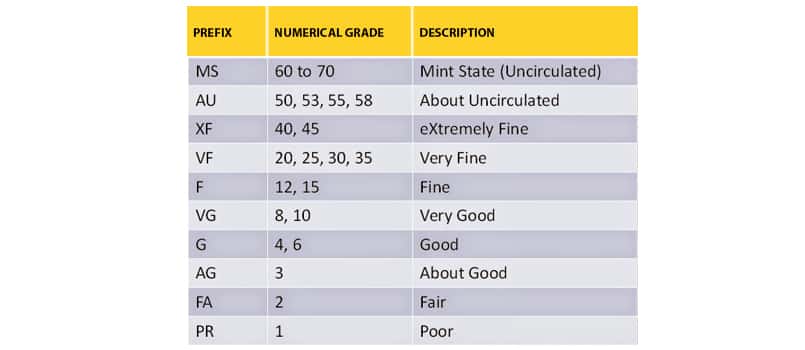 In 1949, we first saw the Sheldon Scale. It has stood the test of time since then. This 70-point scale was modified in the 1970s.
Scale for US Coins:
Poor-1 or P-1 (Poor) Fair-2 or FR-2 (Fair) AG-3 (About Good) G-4 (Good) G-6 (Good-plus) VG-8 (Very Good) F-12 (Fine) VF-20 (Very Fine) VF-30 (Good Very Fine) EF-40 (Extremely Fine) XF-45 (Choice Extremely Fine) AU-50 (About Uncirculated) AU-55 (Good About Uncirculated) AU-58 (Choice About Uncirculated) MS-60 - MS-70 (Mint State) The price difference between the two grading levels can be very high.
Mint State
Mint state coins never entered the collection. These conditions are coins at a level between 60 and 70 on the grading scale. By purchasing a mint state coin, you are buying a coin in the same condition that it was when produced, or very close to the same. Mint state coins will have “MS” before the number in their name.
Proof
Most coins are struck only once during production. Proof coins strike twice. This gives them a more defined appearance along with a unique shine. This bonus in their appearance has afforded them a lot of popularity on the market.
First Strike and Early Release
Coins received for grading within the first 30 days of their release have a special designation. Both PCGS and NGC used to call this by the same name of “First Strike.” Recently, NGC has replaced this with their term of “Early Release”. This designation adds to the coin’s initial price. So, it is difficult to say whether they keep their value with time. Regardless, this is a favorite label amongst collectors.
Assay versus Certificate of Authenticity
When a coin undergoes the assaying process, its alloy, precious metals, and ore composition are all tested to determine the fineness. This process is to ensure that the coin mints according to the correct standards of purity and content. A Certificate of Authenticity accompanies a coin to guarantee its authenticity. While an assay card seals the piece, this certification is a separate piece of paper. It will contain the authenticity and approval stamp, purity, and mintmark. An assay card or certification can assure you that your investment is legitimate. This topic is in greater detail in this previously released post.
3 Comments