View Charts
AVDP vs Troy Ounce: Key Differences Explained
 0
0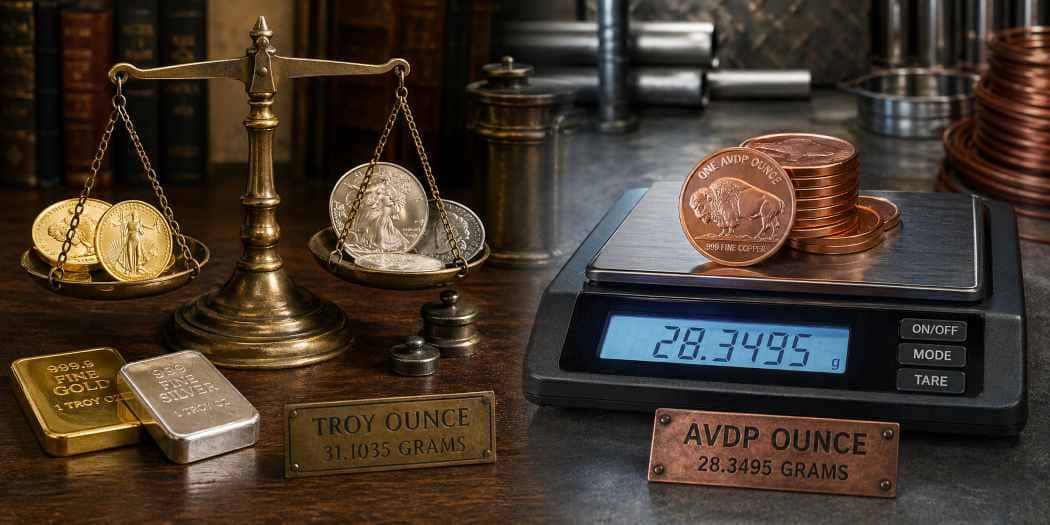
Why Weight Standards Like AVDP vs Troy Ounce Matter in Today’s Bullion Market
With gold holding elevated price levels and silver continuing to attract both retail and institutional demand, precision in bullion measurements has become more important than ever. Investors today are not just comparing spot prices of gold and silver—they are scrutinizing weight, purity, and overall value across multiple metals.
One of the most misunderstood yet critical distinctions in the market is the difference between the AVDP ounce (avoirdupois) and the troy ounce. While both are labeled as “ounces,” they operate under entirely different systems. This becomes especially relevant as interest grows in alternative metals like copper, where AVDP weight is commonly used instead of the traditional troy standard.
Understanding how these systems work—and why they differ—helps eliminate confusion, ensures accurate product comparisons, and ultimately leads to better-informed investment decisions.
How AVDP and Troy Ounces Create Two Distinct Measurement Standards
At a glance, the difference between these two systems may seem minor, but in practice, it defines how metals are valued and traded.
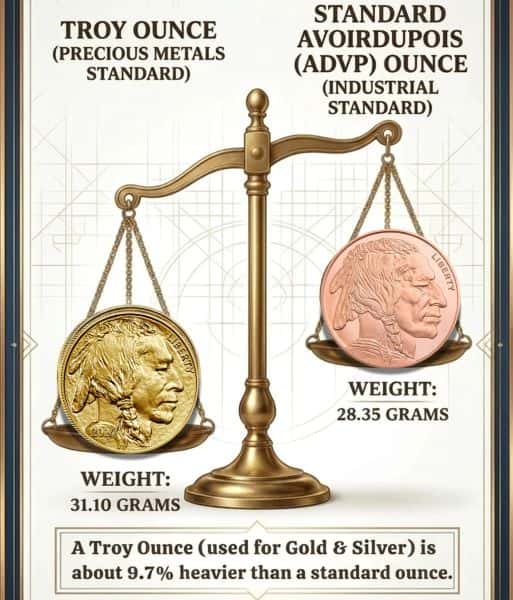
A troy ounce weighs approximately 31.1035 grams and is the global standard for precious metals such as gold, silver, platinum, and palladium. In contrast, an AVDP ounce (avoirdupois) weighs about 28.3495 grams and is the standard unit used for most everyday goods in the United States.
That approximately 9.7% difference in weight has significant implications in a price-driven market. When gold trades in the thousands per ounce, even a small variation in measurement can translate into meaningful value differences.
The key takeaway is simple: although both units are called “ounces,” they are not interchangeable, and understanding which system is being used is essential when evaluating bullion products.
Why the Troy Ounce Remains the Standard for Precious Metals
Gold and silver are deeply tied to the global financial system, functioning not only as commodities but also as monetary assets and reserve holdings. Because of this, their measurement must remain consistent across all markets.
The troy ounce fulfills this role.
It has been used for centuries in precious metals trading and remains embedded in modern financial infrastructure. From futures contracts and ETFs to central bank reserves, the troy ounce ensures uniformity in pricing and reporting worldwide.
This standardization is critical. Without it, discrepancies in measurement could distort valuations, disrupt trading, and create inefficiencies across global markets. The continued use of the troy ounce reflects the need for precision in assets that carry significant monetary value.
Why Copper Is Measured in AVDP Instead of Troy Weight
Copper operates under an entirely different framework than gold and silver, which is why it uses the AVDP system.
As an industrial metal, copper is primarily used in manufacturing, construction, and electrical applications. Copper’s price is significantly lower, and it is typically traded in much larger quantities. Because of this, using the AVDP ounce aligns with practical, everyday measurement standards.
The AVDP system is widely recognized in the United States and simplifies transactions involving bulk materials. For copper bars and rounds sold at the retail level, this standard makes it easier for buyers to understand quantities without needing to convert between systems.
This distinction is rooted in function. Precious metals require a globally unified system due to their financial role, while industrial metals like copper benefit from the simplicity and familiarity of the AVDP framework.
How AVDP vs Troy Ounce Differences Affect Bullion Pricing
For buyers comparing products across different metals, the difference between AVDP and troy ounces can create confusion if not clearly understood.
A one-ounce silver coin is measured in a troy ounce, while a one-ounce copper round is measured in an AVDP ounce. Because the troy ounce is heavier, the actual metal content differs even though both are labeled “1 oz.”
This can lead to misleading price comparisons, especially for newer investors who assume all ounces represent the same weight. In reality, pricing reflects both the type of metal and the measurement system used.
Recognizing this distinction allows buyers to evaluate products more accurately and avoid common misconceptions when comparing value across metals.
Historical Development Behind AVDP and Troy Systems
The existence of both AVDP and troy systems is the result of centuries of economic specialization.
The troy system originated in medieval Europe, where it became the standard for trading precious commodities. Its precision made it ideal for high-value goods, and it eventually became the global benchmark for bullion markets.
The AVDP system developed separately to support general commerce. Designed for everyday goods and bulk materials, it offered practicality and ease of use, which led to its widespread adoption, particularly in the United States.
Rather than replacing one another, these systems evolved in parallel, each serving a distinct purpose. Today, their continued use reflects the different roles metals play within the global economy.
Market Expansion and the Growing Role of Copper in AVDP Weight
Copper has gained increased attention in recent years due to its role in electrification, renewable energy, and infrastructure development. As demand rises, more investors are exploring copper as a complementary asset.
This growing interest makes understanding AVDP weight even more important.
Unlike gold and silver, copper does not function as a monetary hedge or store of value in the traditional sense. Instead, its value is driven by industrial demand and economic growth. The use of AVDP measurement aligns with this role, reinforcing its position as a practical, utility-driven metal.
For investors expanding into copper products, recognizing this difference ensures a clearer understanding of pricing, weight, and overall value.
How Understanding AVDP vs Troy Ounce Strengthens Buying Decisions
In a market where precision directly impacts value, understanding the difference between AVDP and troy ounces is essential.
Gold and silver will continue to rely on the troy system due to their financial and institutional importance. Copper and other industrial metals will remain tied to the AVDP system because of their practical applications and broader accessibility.
For buyers, this knowledge provides a critical advantage. It removes ambiguity, improves product comparisons, and reinforces confidence when navigating an increasingly diverse metals market.
As bullion investing continues to evolve, clarity in fundamentals—like weight measurement—remains one of the most powerful tools for making informed decisions.
Related reading you may find interesting:
Which Weighs More: A Pound of Gold or a Pound of Feathers?