View Charts
Anticipating the "Biggest Crash Of Our Lifetime" in 2024
 0
0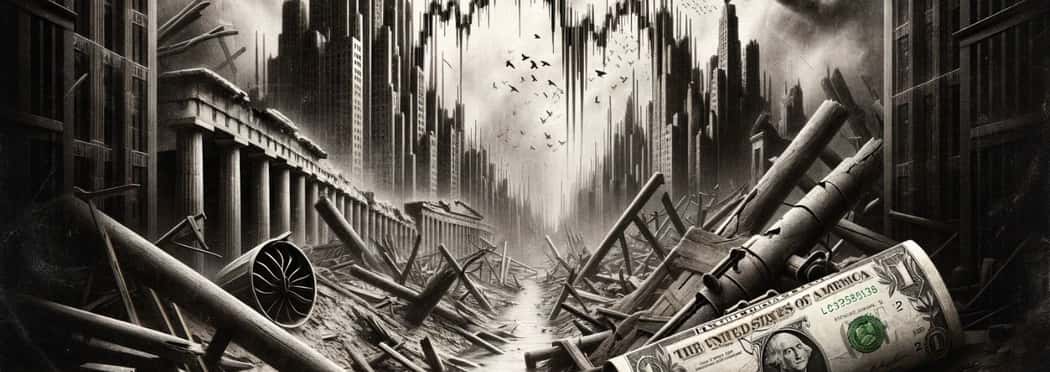
In a startling declaration, economist Harry Dent has warned of what he calls the "biggest single crash year we'll see in our lifetime," slated for 2024. This prediction, made during a recent interview with Fox Business, hinges on Dent's analysis of the U.S. economy's trajectory since 2009, characterized by what he deems as artificial financial bolstering through unprecedented money printing and deficits. Such a forecast not only stirs memories of past economic downturns but also raises crucial questions about the future of global financial stability.
Harry Dent's Analysis
Dent, who heads the HS Dent Investment Management firm, has long been a vocal critic of the U.S. government's fiscal policies. His main contention lies with the massive $27 trillion in deficits accrued over the past 15 years, a strategy he asserts is wholly artificial and unsustainable. Dent likens the current economic climate to a bubble, one that began inflating in late 2021 amidst the COVID-19 pandemic and is now on the brink of bursting.
Historical Context and Comparisons
Dent's warning is not without historical precedent. He draws parallels to the Great Depression, specifically the stock market crash of 1929. This analogy is not merely rhetorical; Dent suggests that the magnitude of the impending crash could rival that of the early 1930s, a period marked by widespread financial ruin and prolonged economic hardship.
Varied Perspectives in the Financial Community
Dent's grim outlook, however, is not unanimously echoed across the financial sector. Analysts like John Hussman of Hussman Investment Trust have expressed similar concerns about an impending market crash.
In contrast, investment banking giant Goldman Sachs has projected a more optimistic scenario. In a recent report, Goldman Sachs raised its 2024 S&P 500 target by 8 percent to 5,100, citing potential tailwinds from falling inflation and declining interest rates.
Source: Canva
The Role of the Federal Reserve
Central to this economic debate is the role of the Federal Reserve. The Fed's recent shift away from monetary policy tightening, as indicated by Chairman Jerome Powell, has brought discussions of rate cuts into focus.
Goldman Sachs anticipates a series of rate cuts throughout 2024, a move that could either mitigate or exacerbate the predicted crash. This uncertainty underscores the pivotal role of the Federal Reserve in shaping the U.S. economy's trajectory.
The Counterargument: A Potential Recovery
Amidst the dire predictions, there's a counter-narrative suggesting a potential economic recovery. This outlook is buoyed by factors such as an anticipated decrease in inflation and the Federal Reserve's policy adjustments. Firms like Bank of America Global Research have revised their forecasts, expecting more aggressive rate cuts by the Federal Reserve, signaling a potential rebound.
A Historic Economic Crossroads
The conflicting forecasts place the global economy at a historic crossroads. Dent's prediction, if accurate, calls for a reevaluation of central banking practices and a shift in fiscal policy. On the flip side, if the more optimistic forecasts prove true, it could signify a remarkable economic recovery, defying the odds of a post-pandemic world.
Conclusion
As the world edges closer to 2024, the economic landscape remains shrouded in uncertainty. With expert opinions divided, the coming year is poised to be a defining moment in economic history.
Dent's forecast of the "biggest crash of our lifetime" is a stark reminder of the fragility and complexity of global financial systems. Whether his prediction materializes or not, it underscores the importance of preparedness and adaptability in an ever-changing economic environment.
For investors, policymakers, and the public at large, 2024 will undoubtedly be a year watched with bated breath, as the world awaits to see which of these economic forecasts will unfold.