View Charts
$5,000 Gold and $100 Silver: A Question of When, Not If
 0
0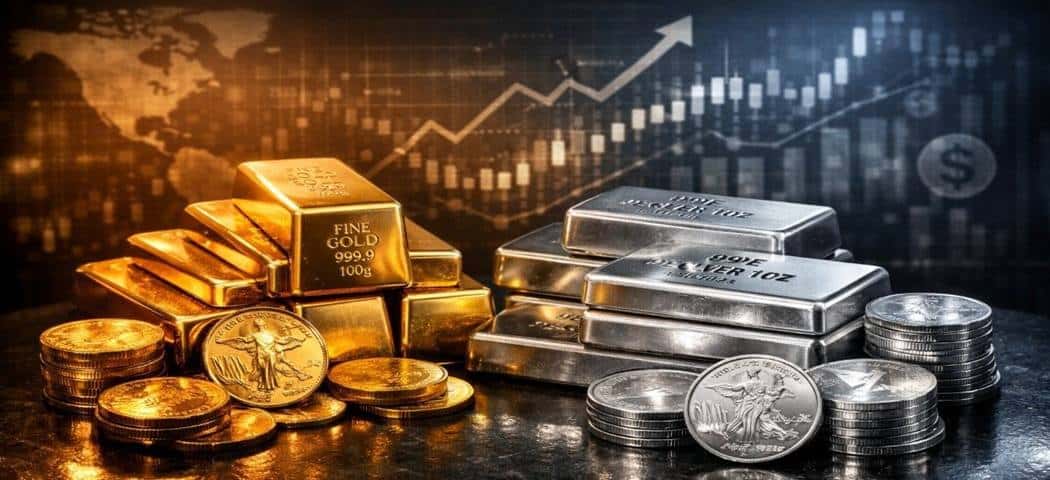
Why These Price Targets Are Back on the Table
Gold and silver are captivating the spotlight as both metals continue to demonstrate resilience amid economic uncertainty, geopolitical tension, and shifting monetary policy expectations. What once sounded like aggressive speculation—$5,000 gold and $100 silver—is now increasingly discussed as a matter of timing rather than possibility.
This renewed attention is not driven by hype alone. Structural forces shaping today’s financial landscape suggest that higher precious metals prices may be a logical outcome of long-term trends already in motion. Rather than asking if gold and silver can reach these levels, investors are increasingly focused on when the conditions align.
History, Inflation, and the Illusion of “Record Highs”
While headlines often emphasize new nominal highs in the price of gold or the price of silver today, inflation-adjusted history provides a far more meaningful frame of reference. Comparing raw price levels across decades without accounting for the erosion of purchasing power can significantly distort how “expensive” or “cheap” precious metals truly are.
Over time, inflation steadily reduces the real value of currency. As a result, what appears to be a record high in nominal terms may still fall well short of historic peaks when measured in constant dollars. This distinction is critical when evaluating long-term trends in the gold price outlook and silver price forecast.
Silver in 1980: The Hunt Brothers and a Real-World Benchmark
Silver’s most famous price spike occurred in January 1980, when the metal surged to roughly $49.45 per ounce. This dramatic move was heavily influenced by the actions of Nelson and William Hunt, who attempted to corner the silver market by accumulating massive physical and futures positions. Their buying frenzy, combined with inflation fears and geopolitical tension, helped push silver to unprecedented nominal levels.
While the Hunt brothers’ influence unquestionably amplified the speed and intensity of the rally, the episode remains a valuable historical benchmark. When adjusted for inflation, silver’s 1980 peak equates to well over $200 per ounce in today’s dollars, depending on the inflation model used. This means that even after recent strength, the current price of silver, at around $95 per ounce, remains far below its inflation-adjusted historical extreme.
The key takeaway is not that silver must repeat a speculative episode like 1980, but that prior market stress produced price levels that, in real terms, remain significantly higher than today’s pricing. This perspective adds depth to discussions around long-term upside without relying on sensationalism.
Gold’s 1980 Peak and the Inflation Reality
Gold experienced a similar surge during the same period. In early 1980, amid runaway inflation, geopolitical instability, and declining confidence in fiat currencies, the price of gold briefly exceeded $850 per ounce. Unlike silver, gold’s move was less influenced by concentrated speculation and more reflective of broad macroeconomic fear and monetary stress.
When adjusted for inflation, gold’s 1980 peak equates to roughly $3,400 to $3,600 per ounce in today’s dollars, depending on the inflation model used. With spot gold now trading above $4,700, the metal has not only surpassed its prior nominal highs, but has also moved decisively beyond its inflation-adjusted 1980 peak.
This shift is significant. It suggests that today’s gold market is being driven by structural forces—such as sustained inflation, central bank demand, and currency confidence concerns—rather than short-lived speculative excess. From a real purchasing-power perspective, gold’s current price action reinforces why higher long-term targets continue to be discussed by analysts and investors, even as headlines focus on new nominal records.
Why Inflation-Adjusted History Still Matters Today
The influence of inflation, speculative excess, and monetary stress shaped precious metals pricing in the past, just as they do today. While the Hunt brothers’ attempt to corner the silver market was an outlier event, the broader environment that allowed such a surge—currency debasement, high inflation, and loss of confidence—remains relevant.
By evaluating today’s gold and silver prices against inflation-adjusted historical benchmarks, investors gain a clearer understanding of where current markets sit within a longer-term cycle. This approach reinforces the idea that rising nominal prices often reflect weakening currency value rather than excessive valuation of precious metals themselves.
Monetary Stress and Central Bank Behavior
One of the most significant drivers behind the long-term gold price outlook is central bank behavior. Over the past several years, central banks around the world have been consistent net buyers of gold, signaling a desire to diversify reserves away from fiat currencies.
This trend reflects broader concerns about sovereign debt, fiscal sustainability, and currency confidence. As global debt levels continue to rise, gold’s role as a neutral reserve asset becomes more prominent. Central bank accumulation helps establish a structural floor under the gold price, reinforcing its role as a long-term monetary asset rather than a short-term trade.
Supply Constraints and the Economics of Mining
Another often overlooked factor in both the price of gold and the price of silver is supply. Mining output for both metals faces increasing challenges, including declining ore grades, higher energy costs, regulatory hurdles, and limited new discoveries.
These pressures mean that sustaining current production levels alone may require higher prices. For silver in particular, much of global supply comes as a byproduct of base metal mining, limiting miners’ ability to respond quickly to rising demand. Supply-side constraints reinforce the idea that higher gold and silver prices may be structurally necessary over time.
Silver’s Unique Role as Monetary and Industrial Metal
Silver occupies a rare position in the financial system. It functions both as a monetary metal and as a critical industrial input, used extensively in solar panels, electronics, medical applications, and energy infrastructure.
As industrial demand continues to grow, especially in renewable energy sectors, pressure on the price of silver increases. Historically, silver has tended to lag gold early in precious metals bull markets, only to outperform later as momentum builds. This dual demand profile strengthens the long-term silver price forecast, particularly in environments where investment demand and silver industrial usage converge.
The Gold-to-Silver Ratio as a Market Signal
One of the most closely watched indicators in precious metals analysis is the gold-to-silver ratio, which measures how many ounces of silver are required to purchase one ounce of gold. Historically, elevated ratios have often preceded periods of strong silver outperformance.
When the ratio begins to compress, it frequently signals accelerating silver demand relative to gold. In past bull markets, sharp declines in the gold-to-silver ratio coincided with explosive moves in the price of silver. For investors watching long-term trends, the ratio serves as a key signal supporting the possibility of $100 silver in a sustained metals rally.
Market Structure and Why Moves Can Be Fast
Precious metals markets are highly sensitive to shifts in sentiment and liquidity. Futures markets, leverage, and paper contracts can amplify price movements when physical demand tightens or confidence in financial assets weakens.
This structure explains why gold and silver bull markets often unfold in stages, with periods of consolidation followed by rapid upward moves. Once momentum takes hold, price discovery can occur quickly, pushing both the price of gold and price of silver higher in relatively short timeframes.
What Would It Take to Reach $5,000 Gold and $100 Silver?
Reaching $5,000 gold and $100 silver would likely require a convergence of several conditions: sustained inflation pressure, lower real interest rates, continued central bank accumulation, and heightened demand for safe-haven assets.
Importantly, these targets do not require extreme or unprecedented scenarios. Rather, they reflect an extension of trends already visible in global markets. While timing remains uncertain, the structural case continues to strengthen as financial risks accumulate.
Risks, Counterarguments, and the Importance of Patience
No market moves in a straight line. Stronger-than-expected economic growth, tighter monetary policy, or reduced geopolitical tension could delay higher prices. Technological substitution may also affect long-term industrial demand for silver.
That said, risks tend to influence timing more than direction. For long-term investors, understanding volatility and maintaining discipline is often more important than attempting to predict short-term price movements.
When the Question Becomes Timing, Not Possibility
The discussion surrounding $5,000 gold and $100 silver is no longer confined to speculation. Supported by inflation trends, central bank behavior, supply constraints, and historical precedent, the long-term case for higher precious metals prices is increasingly difficult to ignore.
While exact timelines remain uncertain, the broader trajectory suggests that rising ceilings for the spot price of gold and spot price of silver may be a reflection of deeper monetary realities. For investors and collectors alike, understanding these forces is essential—not to chase prices, but to prepare thoughtfully for what may lie ahead.
Related reading you may find interesting:
Gold Hits $4,900: What’s Driving the Historic Rally?