View Charts
Lincoln Memorial Cent Series Value, Errors & Key Dates Guide
Why Lincoln Memorial Pennies Still Matter in Today’s Coin Market
The Lincoln Memorial Cent series continues to hold a unique position in U.S. coin collecting, bridging everyday circulation with serious numismatic potential. Produced from 1959 to 2008, these coins are among the most widely collected modern U.S. coins due to their accessibility and hidden rarity potential. Many collectors begin their journey with Lincoln Memorial cents because they are still commonly found in circulation, yet certain varieties can be worth thousands of dollars. Investors also pay close attention to this series, particularly rare error coins and high-grade certified examples that have shown consistent demand. In today’s market, searches for “Lincoln Memorial cent value” and “rare penny errors” remain extremely popular, reinforcing the ongoing relevance of this series. This guide will help collectors, investors, and newcomers understand the history, design, key varieties, and market value of these iconic coins.
The Transition from Wheat Cents to the Lincoln Memorial Reverse
The Lincoln Memorial cent was introduced in 1959 to commemorate the 150th anniversary of Abraham Lincoln’s birth, replacing the long-running Wheat Cent reverse. The obverse portrait of Lincoln, originally created by Victor David Brenner in 1909, was retained, preserving continuity across generations of coinage. The new reverse design, created by Frank Gasparro, featured the Lincoln Memorial in Washington, D.C., symbolizing national unity and remembrance. This marked the first time in U.S. history that the same individual appeared on both sides of a circulating coin, as Lincoln’s statue is visible within the Memorial.
A major turning point occurred in 1982 when the U.S. Mint transitioned from copper to copper-plated zinc due to rising metal costs. This change created multiple varieties within the same year, making 1982 one of the most complex and collectible years in the series. Production levels surged during the later decades, with annual mintages reaching into the billions.
Design Elements That Define the Lincoln Memorial Cent
-
Obverse (Victor David Brenner): Features Abraham Lincoln’s profile, symbolizing leadership and continuity, and remains one of the longest-running coin designs in U.S. history.
-
Reverse (Frank Gasparro): Depicts the Lincoln Memorial, with visible columns and Lincoln’s statue, reinforcing themes of national unity and legacy.
-
Edge: Plain edge design consistent with U.S. cent coinage.
-
Initials: “VDB” appears on the obverse, while “FG” is found on the reverse, identifying the designers.
-
Symbolism: Combines political history and national identity, making it one of the most recognizable coins worldwide.
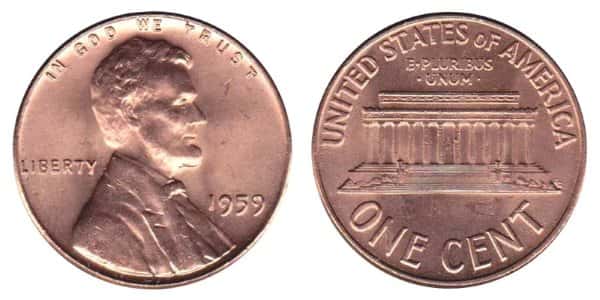
1959 Lincoln Memorial Cent
Technical Specifications and Massive Mintages Explained
-
Denomination: One cent, widely circulated and produced in extremely high volumes.
-
Composition (1959–1982): 95% copper, offering intrinsic metal value and higher weight.
-
Composition (1982–2008): Copper-plated zinc, introduced to reduce production costs.
-
Weight: 3.11g (copper) vs. 2.5g (zinc), making weight a key identifier for rare varieties.
-
Diameter: 19.05 mm, consistent throughout the series.
-
Mintage Volumes: Frequently exceeded billions annually, meaning rarity comes from errors rather than scarcity.
-
Mint Marks: Philadelphia (no mark), Denver (D), San Francisco (S – proofs only)
- Finish Types: Circulation strikes, proof coins, and Special Mint Sets (1965–1967).
Most Valuable Lincoln Memorial Cent Errors and Key Varieties
The Lincoln Memorial cent series is famous for its valuable errors and die varieties, many of which remain discoverable today.
-
1972 Doubled Die Obverse: Strong doubling on date and lettering; one of the most recognized modern errors.
-
1983 Doubled Die Reverse: Clear doubling on “ONE CENT” and inscriptions.
-
1983 Copper Cent Error: Extremely rare transitional error struck in copper instead of zinc.
-
1992 Close AM Variety: Letters “A” and “M” nearly touching; one of the rarest modern cents.
-
1995 Doubled Die Obverse: Widely collected with moderate doubling visible.
-
1998–2000 Wide AM Varieties: Reverse design anomaly increases collector interest.
Collectors should use magnification and weight checks to identify these coins. True doubled dies show rounded, separated details, while machine doubling appears flat and shelf-like.
Why Collectors and Investors Are Drawn to Lincoln Memorial Cents
The Lincoln Memorial cent series appeals to a broad spectrum of collectors due to its accessibility and variety. Beginners can easily assemble date-and-mint sets from circulation, while advanced collectors focus on high-grade coins and rare varieties. Certified coins graded by PCGS or NGC often command significantly higher premiums, especially in MS66 and above.
From an investment perspective, key varieties such as doubled dies and transitional errors have shown strong long-term appreciation. Dealer insights indicate that error coins consistently outperform common-date coins, particularly when certified and well-preserved. The low entry cost combined with high upside potential makes this series especially attractive to new investors.
Market Values and Notable Auction Records
While most Lincoln Memorial cents are worth face value, rare varieties can command significant premiums depending on condition and rarity.
-
1992 Close AM (MS67RD): Sold for $25,850 at Heritage Auctions (Jan. 2017)
-
1992 Close AM (MS62RD): Sold for $2,640 at Stack’s Bowers (Aug. 2018)
-
1992 Close AM (AU55): Sold for $4,830 at Bowers & Merena (Jan. 2010)
These results demonstrate how condition and certification significantly impact value. High-grade examples with strong eye appeal consistently achieve the highest prices.
Fascinating Facts and Hidden Details in the Series
One of the most unique features of the Lincoln Memorial cent is that Lincoln appears on both sides of the coin, a rarity in U.S. coinage. The visibility of the statue within the Memorial is a subtle but historically significant design element. The 1982 composition transition created multiple varieties, adding complexity to the series. Coin roll hunters continue to find valuable varieties decades after release, keeping the series exciting and relevant. Additionally, the sheer volume of coins produced means that rare errors are often overlooked in everyday change.
Modern Collecting Strategies and Expert Tips
Collectors should focus on known key dates and varieties when searching for valuable Lincoln Memorial cents. Using a digital scale to identify copper versus zinc coins is essential, especially for 1982 issues. A magnifying loupe helps detect doubling and spacing errors. Avoid cleaning coins, as this can significantly reduce value and desirability. Certification is recommended for rare or high-grade coins, as it enhances authenticity and marketability. Storing coins in protective holders ensures long-term preservation and value retention.
A Lasting Legacy in American Numismatics
The Lincoln Memorial cent series remains one of the most enduring and accessible coin series in U.S. history. Its combination of historical significance, design continuity, and hidden rarity makes it appealing to collectors at all levels. Whether assembling a basic set or searching for high-value errors, this series offers countless opportunities. As interest in rare coins continues to grow, Lincoln Memorial cents remain a foundational entry point into the numismatic market. Their legacy is not just in their history—but in the discoveries still waiting to be made.
Image source: USA Coin Book