View Charts
1982 Lincoln Penny Value & Varieties: The Transition Year
A Pivotal Moment in U.S. Coinage History
The 1982 Lincoln Memorial Cent is more than just a regular penny — it's a symbol of a monumental shift in U.S. coinage. This seemingly ordinary coin was at the center of a major transition, marking the end of the era of copper pennies and the introduction of the zinc-based penny. Although billions of 1982 pennies were minted, subtle variations in composition, weight, and design make it a must-have for coin collectors. Among the most coveted varieties is the 1982-D Small Date Copper penny, an error coin that has gained significant value among collectors.
This article will delve into the historical context of the penny's transformation, explain how to identify the various 1982 penny types, and highlight the factors that make these coins highly valuable to both novice and expert collectors alike.
The Economic Shift Behind the 1982 Penny's Transformation
In the early 1980s, the U.S. Mint faced an escalating crisis due to rising inflation and surging copper prices. By 1981, the cost of producing a one-cent coin was exceeding its actual face value, making it financially unsustainable for the government to continue minting copper pennies. Furthermore, with the growing tendency of Americans to hoard copper coins for their intrinsic metal value, the U.S. Mint needed a solution to prevent further disruption in coin circulation.
To address the issue, Congress approved a proposal to change the composition of the penny from 95% copper to a more cost-effective zinc core coated with a thin copper layer. This new alloy, consisting of 99.2% zinc and 0.8% copper, allowed the Mint to dramatically reduce production costs while still maintaining the penny's circulation status.
However, due to the mid-year conversion, both copper and zinc pennies were struck in 1982, creating a rare overlap and a variety of penny types for collectors. The decision not to distinguish between the two metals on the coin has fueled decades of intrigue among numismatists.
Design: A Familiar Portrait in a Changing World
Despite the significant change in metal composition, the design of the 1982 penny remained unchanged. The obverse continues to feature the classic portrait of Abraham Lincoln, sculpted by Victor David Brenner. This iconic image was introduced in 1909 to celebrate Lincoln’s centennial and remains one of the longest-running designs in U.S. Mint history.
-
Obverse: Features a right-facing bust of Abraham Lincoln, accompanied by the inscriptions LIBERTY, IN GOD WE TRUST, and the date 1982. The mintmark, D for Denver or no mintmark for Philadelphia, is placed below the date.
-
Reverse: Designed by Frank Gasparro, the reverse features the Lincoln Memorial in Washington, D.C. It is inscribed with UNITED STATES OF AMERICA, E PLURIBUS UNUM, and ONE CENT.
-
Edge: Plain, as is standard for U.S. cents.
This consistency in design allowed the Mint to make the transition as seamless as possible to the public while ensuring that the penny would remain financially viable.
The Eight Varieties of the 1982 Penny
The mid-year changeover by the U.S. Mint resulted in an unprecedented scenario — eight distinct varieties of the 1982 Lincoln Cent. These variations stem from three primary factors: the metal composition (copper vs. zinc), the mintmark (Philadelphia or Denver), and the date style (Large Date or Small Date).
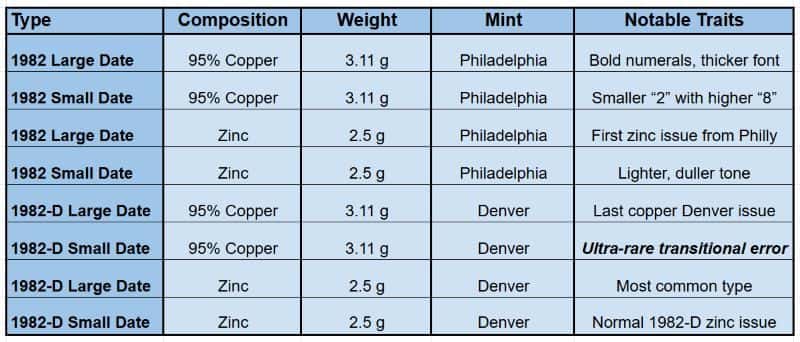
How to Tell Large vs. Small Date:
-
Small Date: The “2” has a delicate curve, and the top of the “8” aligns with the “9.”
-
Large Date: Features thicker numerals, and the “8” sits lower than the “9.”
These minute differences are visible under magnification and are essential for collectors looking to identify the right variety.
The Rare 1982-D Small Date Copper Penny
Undoubtedly, the 1982-D Small Date Copper penny is the most prized variety in the 1982 Lincoln Cent series. This transitional error coin was created when leftover copper planchets were accidentally used in the Denver Mint presses that were equipped with Small Date dies. As a result, these coins weigh 3.11 grams, which is heavier than the 2.5 grams of the zinc pennies.
This rare variety is considered an off-metal strike and is one of the most coveted modern errors. Only a few of these 1982-D Small Date Copper pennies are known to exist, verified by PCGS and NGC. As of recent years, the value of these coins has skyrocketed:
-
In 2017, a specimen graded MS63BN sold for $18,800.
-
In 2021, another example fetched more than $24,000.
These coins are so rare that fewer than 10 confirmed specimens are believed to exist. Collectors can verify potential finds by weighing each 1982-D penny; if it weighs 3.11 grams, you may have stumbled upon a treasure worth thousands.
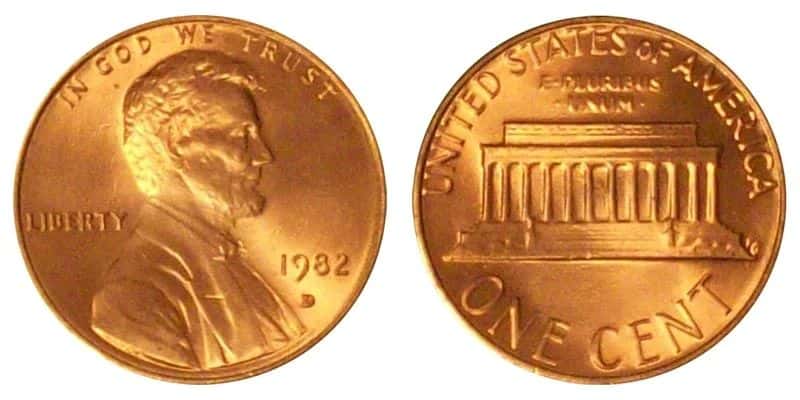
1982-D Small Date Copper Penny
Appeal to Collectors and Investors
The 1982 penny series attracts a wide range of collectors for several compelling reasons:
-
Historical Significance: This coin marks the transition from the copper era to modern minting processes.
- Variety Hunting: The eight different types of 1982 pennies offer collectors a fun and engaging challenge.
-
Investment Potential: Rare varieties, especially the 1982-D Small Date Copper, have skyrocketed in value, making them attractive investments.
-
Connection to Precious Metals: The intrinsic value of copper ties the coin to the broader precious and industrial metals market, appealing to investors who follow the spot price of gold and silver price trends.
- Affordability: Most varieties are still reasonably priced and easy to find in circulation or bulk rolls.
With the combination of collectible variety and the potential for high-value discoveries, this year of pennies remains a top target for both roll hunters and serious numismatists.
Modern Relevance and Tips for Collecting
The 1982 Lincoln Cent continues to be an exciting topic for collectors. Here’s how to build and preserve your collection:
-
Weigh your coins: Copper = 3.11 g, Zinc = 2.5 g.
-
Inspect the edges: Copper coins tend to have a red tone, while zinc coins show a dull edge.
-
Look for minting errors: Die cracks or doubling can add value.
-
Don’t clean your coins: Cleaning can damage the surface and reduce their grade.
-
Use protective holders: Airtight flips or slabs help prevent damage.
-
Consider certification: Professional grading from PCGS or NGC enhances authenticity and value.
Even experienced collectors will find that few coins offer as much insight or opportunity as the 1982 penny.
The 1982 Penny: A Coin with Historic Value
The 1982 Lincoln Cent is far more than just a one-cent piece — it represents a pivotal moment in U.S. economic and industrial history. The shift from copper to zinc marked the end of over 150 years of copper coinage and the beginning of a new era in U.S. minting.
Whether you collect for the history, the varieties, or the potential value, the 1982 penny serves as a reminder that even the smallest coins can hold the largest stories.
Image source: usacoinbook.com