View Charts

1839-1908 Liberty Head $5 Gold Coin
A Symbol of Prosperity in a Transforming Nation
The 1839–1908 Liberty Head $5 Gold Coin, commonly known as the Half Eagle, represents a defining era of American coinage. Struck in .900 fine gold across seven U.S. Mint locations, this coin bridged generations—from the California Gold Rush through the Civil War and into the dawn of the 20th century. Designed by Christian Gobrecht, the Liberty Head $5 Gold Coin united artistry, durability, and economic purpose in an age when gold defined national wealth.
Design Origins and Specifications
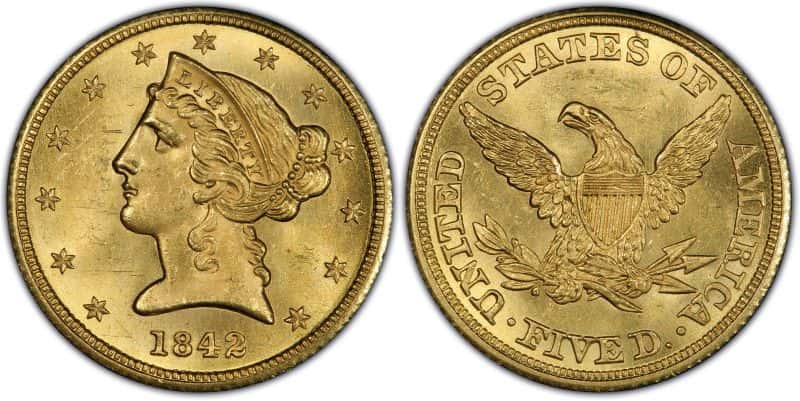
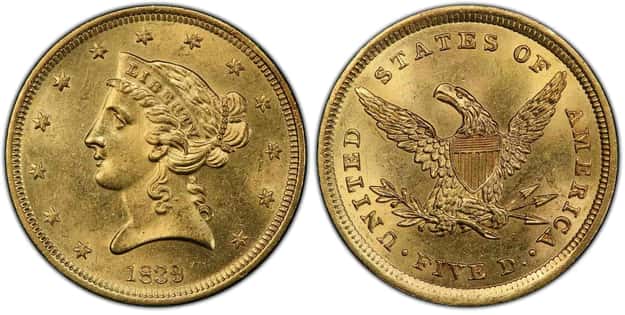
The Liberty Head design debuted in 1839, featuring Lady Liberty facing left, her hair secured with a string of pearls beneath a coronet inscribed LIBERTY. Gobrecht’s rendition—sometimes called the Coronet Head—exemplified the neoclassical ideals popular in American sculpture of the era.
-
Metal Composition: 90% gold, 10% copper (0.2419 troy oz pure gold)
-
Weight: 8.359 grams (129 grains)
-
Diameter: 22.5 mm (1839 issues), reduced to 21.6 mm in 1840
-
Edge: Reeded
-
Designer: Christian Gobrecht, U.S. Mint Chief Engraver (1840–1844)
The copper alloy improved hardness for circulation—replacing earlier gold-silver blends—and set the composition standard used in later U.S. gold coins.
From Expansion to Upheaval: The Historical Context
The Liberty Head $5 emerged as the U.S. expanded westward. Following the discovery of gold in Georgia and North Carolina, branch mints in Charlotte (C) and Dahlonega (D) opened in 1838, bringing coinage closer to local mines. When gold was later discovered in California, the San Francisco (S) Mint followed in 1854 to meet skyrocketing regional demand.
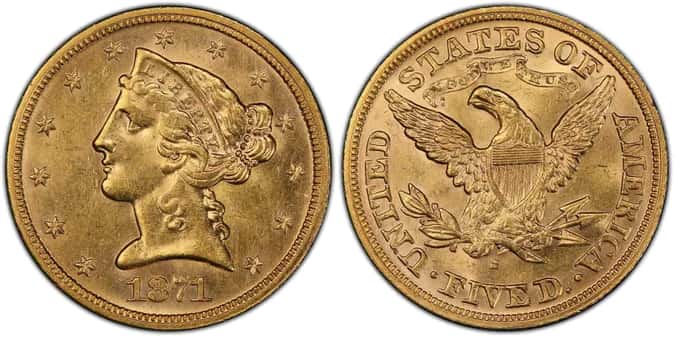
During the Civil War (1861–1865), the Liberty Head Half Eagle became a tangible store of value as paper currency fluctuated wildly. After the war, a wave of national reflection influenced American coinage: in 1866, Treasury Secretary Salmon P. Chase directed that “IN GOD WE TRUST” be added to U.S. coin designs, marking the transition from the No Motto (1839–1866) to the With Motto (1866–1908) types. This phrase, born of the era’s deep religious sentiment, became a lasting symbol of unity and faith through reconstruction and beyond.
Mint Marks and National Identity
The Liberty Head $5 Gold Coin holds the distinction of being the only denomination struck at all seven historic U.S. Mint facilities:
-
Philadelphia (no mintmark) – The principal mint; coins struck here carry no mark.
-
Charlotte (C) and Dahlonega (D) – Southern mints producing limited gold coinage from local deposits until their closure at the onset of the Civil War.
-
New Orleans (O) – Active before the war and again briefly afterward, producing select rarities.
-
San Francisco (S) – Established during the California Gold Rush, becoming a vital hub for Western bullion.
-
Carson City (CC) – Operating from 1870–1893, famed for low-mintage issues highly sought after today.
-
Denver (D) – Entered production in 1906, continuing the Half Eagle series until its conclusion in 1908.
Each mintmark tells a regional story—from Southern mints that fell to war, to Western facilities striking gold drawn from frontier mines.
Value and Market Overview
Type 1 – No Motto (1839 – 1866)
Early-date Liberty Head Half Eagles generally carry significant premiums due to low survival rates and Southern-mint scarcity.
-
Typical circulated examples (VF–XF): $900 – $1,600
-
Choice AU–low Mint State (AU55–MS61): $2,000 – $5,000 for common dates
-
Exceptional rarities (e.g., Charlotte, Dahlonega, or early Philadelphia issues): $10,000 – $50,000+ depending on grade and provenance
Type 2 – With Motto (1866 – 1908)
Later issues are somewhat more available, though key Carson City and low-mintage San Francisco coins remain elusive.
-
Circulated (VF–XF): $750 – $1,200
-
Select AU–MS63: $1,500 – $3,500 for most common dates
-
Condition rarities (CC or low-mintage S issues): $6,000 – $25,000+
Note: Actual market values fluctuate with both collector demand and the price of gold; certified grading from NGC or PCGS remains the benchmark for establishing true worth.
Collecting and Evaluation Tips
When assessing condition, pay attention to:
-
High-points of wear: Liberty’s coronet, hairlines, and the eagle’s breast and wing tips.
-
Strike quality: Southern-mint coins may show softness from primitive dies.
-
Original luster and color: Genuine pieces display rich yellow-orange tones typical of 19th-century gold-copper alloys.
-
Mint mark placement: On the reverse below the eagle, often sharply struck yet occasionally faint on well-worn coins.
-
Surface preservation: Avoid cleaned or polished examples, as original surfaces can multiply value.
Because Liberty Head $5s span nearly 70 years and seven mints, they offer countless combinations for specialized sets—by mint, by year, or by design type—making them a rewarding pursuit for both historical and financial appreciation.
End of an Era: Roosevelt’s Coinage Renaissance
By the early 1900s, President Theodore Roosevelt called for a modernization of U.S. coinage. In 1908, the Liberty Head $5 Gold Coin was replaced by Bela Lyon Pratt’s Indian Head Half Eagle, featuring the innovative incuse design carved below the coin’s surface. The transition symbolized a shift from classical imagery to a bold, modern national aesthetic.
Why the Liberty Head $5 Gold Coin Endures
The Liberty Head Half Eagle is more than a collectible relic—it’s a narrative of American expansion, artistry, and resilience. From the Southern gold fields to Western frontier mints, these coins embody the optimism and faith of a growing nation. Today, they continue to attract collectors seeking both intrinsic gold content and the tangible legacy of 19th-century America.
Images sourced from PCGS CoinFacts